

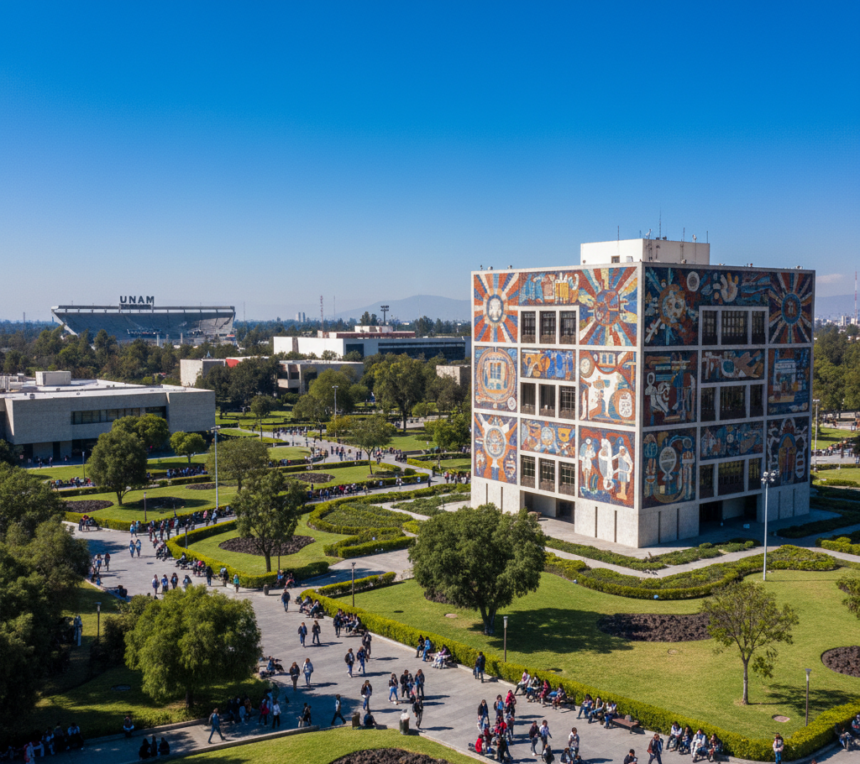
In the heart of Mexico City lies a colossal intellectual and cultural powerhouse: the Universidad Nacional Autónoma de México (UNAM) . Far more than just a university, UNAM is a national institution, a UNESCO World Heritage site, and the academic home to over 360,000 students. As we navigate through 2026, UNAM continues to make headlines, not just for its historic past, but for its pioneering steps into the future of education and its critical role in national affairs. From leveraging artificial intelligence in admissions to monitoring active volcanoes, UNAM remains at the forefront of innovation and social leadership.
This comprehensive guide explores everything you need to know about UNAM in 2026. We’ll delve into its rich history, its monumental campus, its global impact, and the cutting-edge developments that solidify its title as “la Universidad de la Nación” (the University of the Nation).
The Genesis of an Institution: From Royal Decree to Autonomous Powerhouse
To understand UNAM’s present, one must appreciate its profound history. Its roots extend deep into the colonial era, making it one of the oldest universities in the Americas.
The Royal and Pontifical University
The university’s story began on September 21, 1551, when King Charles I of Spain issued a royal decree establishing the Royal and Pontifical University of Mexico . For centuries, it served as the primary center of higher learning in New Spain, educating the colony’s elite. However, following the Mexican War of Independence, the university faced a turbulent period, eventually being closed by liberal reformers in the 19th century who sought to secularize and modernize education .
The Rebirth and the Fight for Autonomy
The modern incarnation of the university was born in 1910 as the National University of Mexico, a project spearheaded by Justo Sierra, a prominent intellectual and educator during the Porfiriato. His vision was to create a modern, secular institution that could lead the nation’s progress.
The most pivotal moment in its history came in 1929, when President Emilio Portes Gil granted the university its long-sought autonomy. This hard-won independence, reaffirmed in the 1940s, granted UNAM the freedom to govern itself, manage its own budget, and define its curriculum without direct interference from the federal government . This principle of autonomy, fiercely protected to this day, has fostered an environment of academic freedom, critical thinking, and political activism that defines the university’s character. As recent as February 2026, this autonomy was a topic of national discussion when President Claudia Sheinbaum had to publicly clarify that the designation of a new member to UNAM’s Junta de Gobierno was an internal university matter, free from political interference .
Ciudad Universitaria: A UNESCO World Heritage Oasis
The main campus, known as Ciudad Universitaria (CU) , is more than just a collection of buildings; it is a masterwork of 20th-century modernist architecture, urban planning, and muralism. Completed in 1954, it was built on a solidified lava bed in the southern part of Mexico City, creating a self-contained “university city” .
In 2007, UNESCO designated the central campus a World Heritage Site, recognizing it as a unique example of architectural and artistic integration from the modern era. The campus is an open-air museum where you can find:
-
The Central Library: The undisputed icon of UNAM, its four sides are covered in stunning stone murals by artist Juan O’Gorman. The north wall depicts the pre-Hispanic past, the south wall the colonial period, and the east and west walls the modern and contemporary world, creating a visual encyclopedia of Mexican history.
-
The Olympic Stadium (Estadio Olímpico Universitario): Home to the UNAM Pumas football team, this stadium is famed for the massive relief mural by Diego Rivera on its exterior, titled “The University, the Mexican Family, Peace, and the Youth of Sports.” It hosted the 1968 Olympic Games and remains a vibrant hub of student life .
-
The Cultural Center: A sprawling complex that includes the Nezahualcóyotl Concert Hall (home to the UNAM Philharmonic Orchestra), the National Library, the University Museum of Contemporary Art (MUAC), and several other performance and exhibition spaces.
Beyond CU, UNAM’s footprint extends across Mexico and the world. It operates satellite campuses in the Mexico City metropolitan area (like Acatlán, Aragón, and Iztacala) and research outposts in Querétaro, Morelia, Mérida, and Ensenada. Its international presence includes schools in the United States and Canada .
Academic Excellence: The Intellectual Pulse of Mexico
As the largest university in Latin America, UNAM’s influence on Mexican academia and research is unparalleled. It produces 60% of the country’s scientific publications and is consistently ranked as the best university in Mexico and one of the top in the Spanish-speaking world .
A Diverse and Rigorous Curriculum
UNAM’s academic structure is vast, encompassing:
-
Faculties and National Schools: These are the heart of undergraduate and graduate education. Notable faculties include Law, Engineering, Medicine, Philosophy and Literature, and Sciences. The Faculty of Political and Social Sciences (FCPyS) , established in its current form in 1968, is a powerhouse for public administration, communication studies, international relations, and sociology, having educated generations of Mexican journalists, diplomats, and politicians .
-
Research Institutes: UNAM houses world-renowned research centers. The Institute of Astronomy, the Institute of Biotechnology, and the Institute of Physics are just a few of the many institutes that drive cutting-edge discovery . In mathematics, collaboration between the Faculty of Sciences (FC) , the Institute of Mathematics (IM) , and the Research Institute for Applied Mathematics and Systems (IIMAS) covers everything from pure algebra to financial mathematics .
Nobel Laureates and Notable Alumni
The caliber of UNAM is reflected in its alumni, who have shaped Mexico and the world. It counts three Nobel Prize winners among its former students:
-
Alfonso García Robles (Peace, 1982) for his work in international disarmament.
-
Octavio Paz (Literature, 1990), one of the most influential writers of the 20th century.
-
Mario Molina (Chemistry, 1995), a key researcher in the discovery of the Antarctic ozone hole .
Its alumni rolls also include a staggering number of Mexican presidents, from Miguel Alemán Valdés to Carlos Salinas de Gortari, as well as prominent opposition figures, intellectuals, and business leaders .
UNAM in 2026: Trending News and Digital Transformation
The keyword “UNAM” is trending in early 2026 for compelling reasons that demonstrate its dynamic role in contemporary society. The university is not resting on its historical laurels; it is actively shaping the future.
1. The Digital Leap: AI-Powered Online Entrance Exams
In a groundbreaking move announced in January 2026, UNAM is revolutionizing its notoriously competitive admissions process. The university has begun implementing online entrance exams for both high school and undergraduate applicants .
This shift is monumental for accessibility. For the 2026 admission cycle, this change will prevent approximately 1.6 million people from having to travel to exam locations, significantly reducing the carbon footprint and easing logistical burdens for students from across Mexico and abroad .
To ensure academic integrity in this new format, UNAM is employing a two-tiered supervision system. While human proctors monitor the exams, artificial intelligence (AI) tools are used to flag anomalous behavior for later review. Importantly, university officials have stressed that AI only provides evidence; the final decision to cancel an exam due to irregularities is always made by a human being . This represents a balanced approach to technology, increasing inclusivity while attempting to safeguard fairness.
2. On the Front Lines of Science: Monitoring El Chichón Volcano
UNAM’s scientific relevance extends far beyond the classroom. In February 2026, researchers from UNAM published a study documenting significant changes inside the El Chichón volcano in southern Mexico .
Between June and December 2025, scientists observed:
-
The crater lake turning from green to a grayish color due to increased sulfate and silica.
-
Elevated temperatures on the crater floor.
-
The emission of hydrogen sulfide and carbon dioxide.
While the team, led by volcanologist Patricia Jácome Paz, concluded that these changes are consistent with hydrothermal processes rather than an imminent magma-driven eruption, their continuous monitoring is vital for public safety. This research, utilizing drones and satellite remote sensing, highlights UNAM’s role as a critical guardian of national risk assessment .
3. UNAM and the National Political Landscape
As mentioned earlier, UNAM’s autonomy remains a cornerstone of its identity. A political opinion piece in Excélsior on February 14, 2026, highlighted this principle in action . The commentary praised President Sheinbaum for respecting UNAM’s internal processes regarding the appointment of a new member to its Junta de Gobierno (Board of Governors).
The appointment of academic Rosaura Martínez Ruiz was based on her merit and decided by the University Council, not by external political forces. This incident serves as a powerful reminder that UNAM operates by its own rules, safeguarding its academic freedom from the shifting tides of national politics .
A Cultural and Sporting Giant
UNAM is not just about academics; it’s a cultural identity for millions.
The Spirit of “Pumas”
The university’s sports teams, known as the Pumas, are a source of immense pride. The Club Universidad Nacional football team is a founding member of the Liga MX and has a passionate, dedicated fanbase. Playing in the iconic Estadio Olímpico Universitario, a Pumas home game is a vibrant spectacle of university spirit .
Cultural Outreach
UNAM is the primary cultural engine of the nation. It manages:
-
Museums: From the colonial Museo de San Ildefonso to the avant-garde University Museum of Contemporary Art (MUAC) , and the striking crystal-and-iron Museo Universitario del Chopo .
-
Theatres and Cinemas: The Casa del Lago in Chapultepec Park offers a serene setting for plays, dance, and music .
-
Publications and Broadcasting: UNAM’s publishing house is one of the largest in the Americas, and its radio and TV stations provide cultural and educational programming across the country.
How to Be Part of UNAM
For prospective students, entering UNAM is a significant life goal. The university offers:
-
High School (Bachillerato): Through its extensive networks: the Escuela Nacional Preparatoria (ENP) and the Colegio de Ciencias y Humanidades (CCH) .
-
Undergraduate (Licenciatura): Over 130 undergraduate programs across its faculties and national schools.
-
Postgraduate (Posgrado): A vast array of master’s and doctoral programs attracting students from all over the world .
With the new online exam system for 2026, the first step is now more accessible than ever. Aspiring students should regularly consult the official UNAM website (www.unam.mx) for announcements regarding application dates, requirements, and procedures .
Important Note: When searching for “UNAM” online regarding payments or applications, be careful to distinguish between the National Autonomous University of Mexico (UNAM.mx) and other institutions with similar acronyms, such as the University of Namibia (UNAM.edu.na) .
Conclusion: The Eternal University
In 2026, the National Autonomous University of Mexico stands as a testament to the enduring power of public education. It is an institution that honors its 475-year legacy while fearlessly adopting artificial intelligence to modernize its processes. It is a place where students can protest in the morning and attend a Nobel laureate’s lecture in the afternoon. From monitoring the very earth beneath the nation’s feet to shaping the minds that will lead its future, UNAM is, and will always be, the University of the Nation.