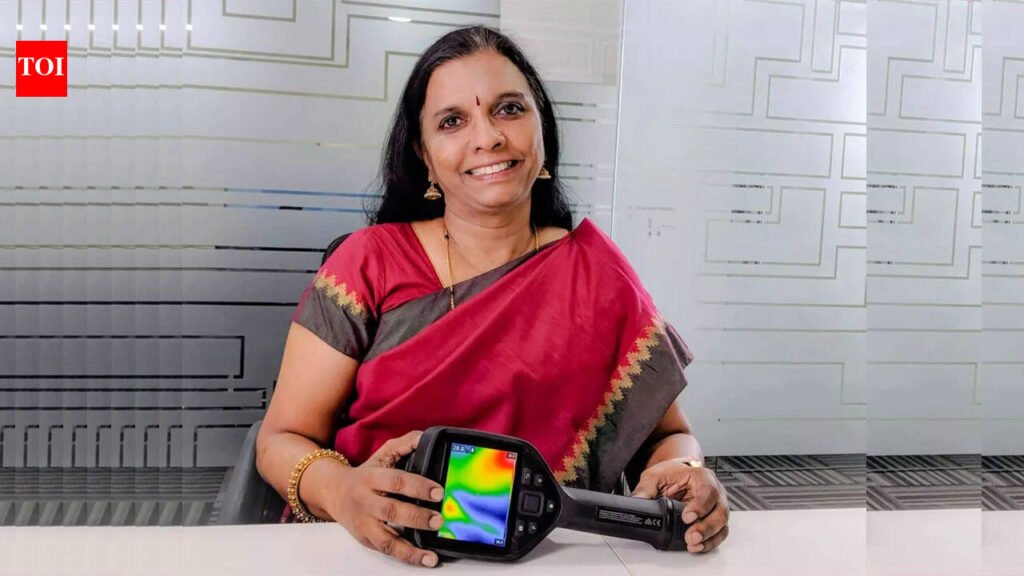
For Dr Geetha Manjunath, breast cancer was not initially a research problem or a startup opportunity. It became deeply personal after she lost two cousins to the disease within a short span of time.In one case, according to accounts of her journey, a mammogram failed to detect the cancer. By the time the disease was discovered, it was too late. Around six months later, another woman in the family was diagnosed with breast cancer and also died.For Manjunath, an artificial intelligence researcher with decades of experience, the losses led to a question: could technology help detect breast cancer earlier and make screening more accessible?That question would eventually lead to the creation of NIRAMAI Health Analytix, an Indian health-tech startup that uses artificial intelligence and thermal imaging for breast cancer screening.
From Bengaluru to IISc and India’s early supercomputing efforts
Manjunath grew up in Bengaluru and studied Computer Science at the University Visvesvaraya College of Engineering (UVCE). She later pursued her master’s degree and PhD at the Indian Institute of Science (IISc), Bengaluru, where she was a gold medallist.Her career placed her at the intersection of computing and research long before artificial intelligence became a mainstream buzzword.She began at the Centre for Development of Advanced Computing (C-DAC), where she was part of the team involved in building India’s early commercial supercomputing capabilities in the 1990s.She later spent 17 years at Hewlett Packard Labs as a principal research scientist and subsequently became a lab director at Xerox Research in India, leading data analytics research.But after the deaths in her family, her research interests took a more personal direction.
The idea: Can heat reveal what screening misses?
Manjunath began studying the challenges surrounding breast cancer detection. One major concern was late diagnosis, particularly when access to screening facilities is limited.She and her team began exploring thermal imaging. The underlying idea was that cancerous tissue can exhibit changes in metabolic activity and blood flow, potentially creating heat patterns that differ from surrounding tissue.A thermal camera can capture these patterns without radiation or physical contact. However, interpreting thermal images is far from straightforward.That is where Manjunath’s background in artificial intelligence and machine learning became central. The team developed technology designed to analyse thermal patterns and identify abnormalities that could require further medical evaluation.Their early clinical work included thermal imaging research with a medical institution in Manipal.
Leaving corporate research to build NIRAMAI
In 2016, Manjunath left her corporate research career and co-founded NIRAMAI with former colleague Dr Nidhi Mathur.The name stands for Non-Invasive Risk Assessment with Machine Intelligence. The company’s technology, known as Thermalytix, combines thermal imaging with artificial intelligence to support breast cancer screening.Unlike conventional mammography, the approach does not involve radiation or compression. The portable nature of the technology also offers the possibility of taking screening services beyond large hospitals and into locations where access to conventional equipment may be limited.According to the information shared about the company’s journey, more than 400,000 women have been screened across over 250 locations in India, with more than 2,000 cancers detected.
When education becomes a tool to solve a real problem
Manjunath’s journey offers a different perspective on what an engineering or research education can eventually lead to.Her degrees, years of work in supercomputing, artificial intelligence and data analytics did not initially have anything to do with breast cancer. But when a personal tragedy exposed a problem she believed technology could help address, those decades of technical experience became the foundation for a new solution.Her story is also a reminder that innovation does not always begin in a college hostel or with a search for the next big startup idea.Sometimes, it begins with a problem that refuses to go away.For Dr Geetha Manjunath, two devastating losses led to a question. Her years of education and research helped her attempt to build an answer.Disclaimer: This article is based on publicly available information and social media posts shared by the individuals or sources cited. The views and claims expressed are those of the respective sources and do not necessarily reflect the views of TOI Education.