

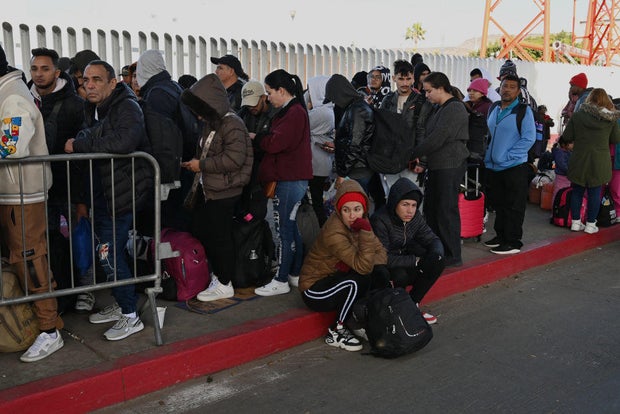
The Trump administration on Friday formally proposed a regulation that would dramatically restrict work permits for asylum-seekers, confirming a CBS News report about a plan to upend longstanding U.S. immigration policy.
Since the 1990s, U.S. law has allowed immigration officials to grant work permits to asylum applicants if their cases have been pending for at least 180 days. That has generally allowed asylum applicants to request a work permit 150 days after they make their claim. Those eligible can be granted the permit after another 30 days.
But a proposed Trump administration regulation unveiled Friday would suspend the acceptance of asylum work permit applications until U.S. Citizenship and Immigration Services reaches the point where it decides all asylum cases within an average of 180 days.
That requirement would almost certainly amount to indefinite pause on asylum-related work permits, since the U.S. government faces a massive backlog of asylum applications. A federal government watchdog found in 2024 that more than 77% of the asylum applications before USCIS had been pending for beyond 180 days. Nearly 40% of applications remained unresolved after two years. USCIS is currently overseeing more than 1.4 million pending asylum applications, according to the agency.
The text of the regulation acknowledged such a pause could last for “many years,” predicting that, without considering the proposed changes, it could take officials between 14 and 173 years to adjudicate asylum cases within an average of 180 days.
The Department of Homeland Security proposal also stipulates that asylum-seekers would only qualify for a work permit a year after they apply for asylum, increasing the eligibility wait period from 180 days to 365 days.
Additionally, the rule proposed to disqualify migrants who crossed the U.S. illegally from work permit eligibility, unless they told immigration officials within 48 hours of entering the country that they were fleeing persecution.
The proposed regulation is subject to a 60-day period during which the public can file comments in support or opposition to the changes. It would need to be converted into a final rule before it can take effect.
CBS News revealed in June 2025 that Trump administration officials were developing a regulation to pause asylum-related work permits and impose stricter eligibility requirements for them.
Carlos Moreno/NurPhoto via Getty Images 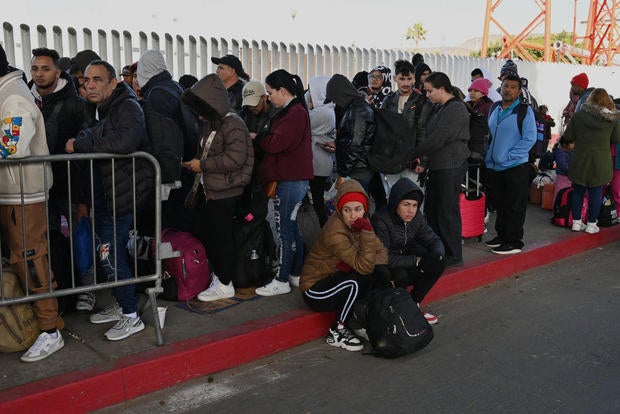
The effort seeks to curtail what Trump administration officials have identified as a “magnet” factor that attracts illegal immigration: the practice of some economic migrants using the asylum system to work and live in the U.S. while their petitions are reviewed, a process that typically takes years to complete due to the backlog of cases.
Asylum is designed to provide a permanent safe haven to foreigners who can prove they are fleeing persecution because of certain factors, like their race, religion or political views. While factors like nationality and legal representation play a key role, many applicants do not ultimately meet the legal threshold to win asylum, government figures show.
“For too long, a fraudulent asylum claim has been an easy path to working in the United States, overwhelming our immigration system with meritless applications,” DHS said in a statement Friday. “We are proposing an overhaul of the asylum system to enforce the rules and reduce the backlog we inherited from the prior administration.”
Advocates strongly denounced the proposed measure, saying it would prevent asylum-seekers from financially supporting themselves and their families and hurt the U.S. economy.
“This proposal would cause chaos in communities across the U.S. as over a million immigrant workers could fall out of the workforce despite having a pending immigration application,” said Conchita Cruz, co-executive director of the Asylum Seeker Advocacy Project, a group that helps asylum-seekers.
Under the Trump administration, USCIS has severely tightened immigration programs, affecting broad swaths of immigrants, legal and illegal alike. Late last year, after an Afghan national allegedly shot two National Guard soldiers in Washington, the agency paused all asylum cases, as well as immigration applications filed by those born in several dozen “high-risk” countries.