

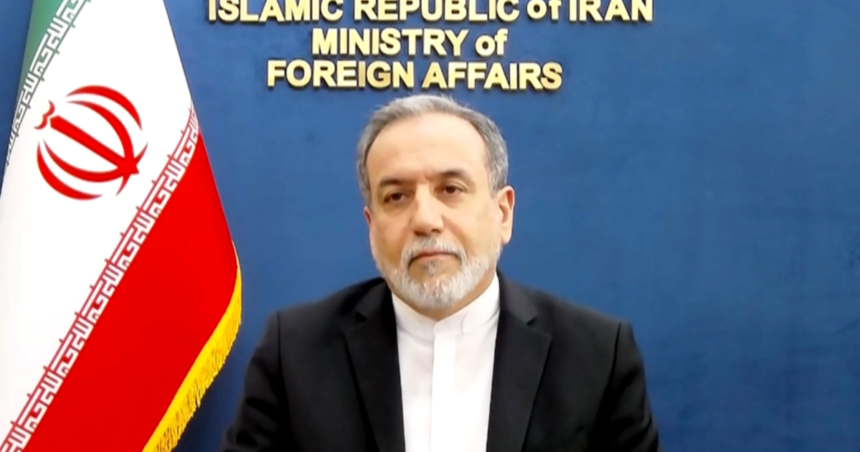
The following is the transcript of the interview with Iranian Foreign Minister Abbas Araghchi that aired on “Face the Nation with Margaret Brennan” on Feb. 22, 2026.
MARGARET BRENNAN: We turn now to the escalating tensions between the U.S. and Iran. The U.S. has assembled what is, by some measures, the biggest military buildup in the region since the 2003 invasion of Iraq, as the world’s largest warship also heads towards the region. But President Trump has said he’d prefer a diplomatic deal with Iran. For the latest, we go now to Tehran and the Iranian Foreign Minister Abbas Araghchi. Welcome to ‘Face The Nation.’
FOREIGN MINISTER ABBAS ARAGHCHI: Well, thank you, Margaret. Thank you so much for having me this evening.
MARGARET BRENNAN: So do you believe President Trump plans to strike Iran, or is he using this threat as leverage?
MINISTER ARAGHCHI: Well, I’m not- I cannot judge. But one fact is there that if they want to find a resolution for Iran’s peaceful nuclear program, the only way is diplomacy. And we have proved this in the past, and I believe that still, there is a good chance to have a diplomatic solution which is based on a win-win game, and a solution is at our reach. So there is no need for any military buildup. And military buildup cannot help it, and cannot pressurize us.
MARGARET BRENNAN: Well, you said on Friday that you would have a draft proposal within two to three days. Have you gotten the supreme leader to sign off on that proposal yet? And if so, when will you give it to envoy Steve Witkoff?
MINISTER ARAGHCHI: Well, we are still working on that, and we are trying to make it something which consists of elements which can accommodate both sides’ concerns and interests, and we are working on those elements. And I believe that when we meet, probably this Thursday, in Geneva again, we can work on those elements and prepare a good text and come to a fast deal. This is my understanding. I see it quite possible.
MARGARET BRENNAN: So you have confirmed a meeting with Steve Witkoff Thursday in Geneva, but your leadership has still not signed off on the proposal. Is that right?
MINISTER ARAGHCHI: But these are two separate things. Of course, we continue our negotiation. At the same time we are working on it- on- on- on on the elements of a deal, and draft of the text. So I hope that when we get there, we are prepared to talk and negotiate on those drafts.
MARGARET BRENNAN: Well, let me ask you this. You helped negotiate that 2015 nuclear deal under the Obama administration. How would this deal with Trump be different than that one?
MINISTER ARAGHCHI: Well, 10 years have passed, and there is a new situation. Our nuclear program has advanced, technologically more advanced at that time, and there are, of course, more sanctions and more pressures. So I believe that a better deal than JCPOA or 2015 nuclear deal is possible. And there are elements that are- could be much better than the previous deal. So–
MARGARET BRENNAN: –Like what?
MINISTER ARACHI: I have the experience- I have the experience of that- that deal, as you said, I negotiated that deal. We went into so many details, but I think right now, there is no need for that much details. We can agree on basic things, and we can make sure that Iran’s program, nuclear program, is peaceful and will remain peaceful forever, and at the same- same time, more sanctions would be lifted.
MARGARET BRENNAN: Well, just very quickly you’re talking about nuclear, you are offering a nuclear only deal at this stage? Because Secretary Rubio said anything meaningful would also have to involve ballistic missiles and your support for proxies in the region.
MINISTER ARAGHCHI: Right now, we are negotiating only nuclear and there is no other subject.
MARGARET BRENNAN: Okay. Would you be willing to allow weapons inspectors unfettered access to your nuclear sites and for American inspectors to be among them?
MINISTER ARAGHCHI: Well, we are a committed member of NPT, Non-Proliferation Treaty, and we have a safeguard agreement with the agency, International Atomic Energy Agency, and we are ready to- to cooperate with the agency in full, according to the, you know, safeguard and we may accept, in certain conditions, the additional protocol to the safeguard, to the NPT. And I think a full verification mechanism, full monitoring mechanism, is acceptable and can be in place.
MARGARET BRENNAN: Okay, so you continue to say that your nuclear program is peaceful. And you know, there are a lot of skeptics around the world, including in the United States Congress. There is pressure on President Trump from within his own party. There were 52 Republican senators, 177 House Republicans who have called on President Trump to demand zero enrichment and full dismantlement of your nuclear program. Why should President Trump consider allowing Iran to have even the smallest bit of enrichment?
MINISTER ARAGHCHI: Well, first of all, enrichment is our right. We are a member of NPT, and we have every right to enjoy a peaceful nuclear energy, including enrichment. How we use this- this right is something you know related to us only. The enrichment is a sensitive part of our negotiation. The American team know about- they know our position, we know their position, and we have already exchanged our concerns, and I think a solution is achievable, but I’m not going to negotiate through media.
MARGARET BRENNAN: No, I understand, but we have seen very public statements from the president that he said no enrichment, and that’s a red line. But when you say it’s your right, okay, but you could get enriched uranium and buy it from someplace else. You know this. You’ve done this. Is demanding the right to enrich on Iranian soil really worth the risk right now? You’re facing a potential destruction of your country and the regime based on the kind of military buildup we’re looking at.
MINISTER ARAGHCHI: Well, I think, as a sovereign country, we have every right to decide for ourselves, by ourselves. We have developed this technology by ourselves, by our scientists, and it’s very dear to us, because we have paid a lot- we have paid a huge expense for that. We have been on the sanctions for- for at least 20 years and we have lost our scientists, and we have- we have had a war because of that. So that is now a matter of dignity and pride for Iranians, and we are not going to give it up. There is no legal reason to do that, while everything is peaceful, while everything is safeguarded by the agency, while we had an agreement in the past when we were- we remain fully committed to that, and you know, it was the U.S. who just withdrew with no justification. So we are a committed member of NPT. We want to use our right. We want to have our right and to exercise that.
MARGARET BRENNAN: But you understand this could be make it or break it for you here. I mean, look, your air defenses were largely demolished by Israel this past summer. They dominate your military. They killed the leader of your most powerful proxy in Hezbollah the United States bombed your underground nuclear facilities. Your economy is in shambles right now. So why do you think the regime could even survive unless you give this up?
MINISTER ARAGHCHI: Well, that is not the case when you talked about the air defense and the war we had with Israel. You know, yes, we had problem with our air defense, but Israelis had also problem with their air defense and our missile- missiles were able to hit targets inside Israel. So it’s- so you know, they started the war, but after 12 days, they asked for a cease fire, unconditional cease fire. Why? Because they couldn’t defend themselves against our missiles. So we have a very good capability of missiles, and now we are even in a better situation than previous war. So as a matter of fact, we are in a powerful position to defend ourselves. We know how to defend ourselves. We did it in the- in 12 day war, and we are fully prepared to repeat that, if necessary.
MARGARET BRENNAN: Respectfully, Israel has air superiority over Iran. But let’s talk about what you’re- you are saying in terms of your–
MINISTER ARAGHCHI: –no, our missiles- our missiles have also- our missiles have also superiority over the space of Israel. They can hit their targets. They hit their targets in a very exact way, and they can do it again.
MARGARET BRENNAN: Okay. Well, there are 40,000 American personnel in the Middle East right now, in Iran’s letter to the U.N. Security Council, you seem to threaten them, because you said America will bear full responsibility. You said you don’t want war. But if that’s what happens, all bases, facilities and assets of the hostile force in the region will be legitimate targets. Are you saying Iran will hit U.S. bases in the Gulf, or will you also bomb the Gulf countries that are your neighbors?
MINISTER ARAGHCHI: Well, I’m not going to say what we are going to do exactly. Obviously, we defend ourselves. If the U.S. attack- attacks us, then we have every right to defend ourselves. If the U.S. attacks us that is the act of aggression. What we do in response is the act of self defense. So- and it is justifiable and legitimate. So our missiles cannot hit the American soil. So obviously we have to do something else. We have to hit, you know, the Americans’ base in the region. That- that is- that is a fact. I am a diplomat. I’m not supposed to talk about, you know, our military plans, but what can I say is that why we should go for war when there is every possibility for a peaceful solution?
MARGARET BRENNAN: Mr. Foreign Minister, I have more questions for you, but I am out of time here. We are going to watch this diplomacy very carefully to see what happens in the coming days. Thank you for joining us. We’ll be right back–
MINISTER ARAGHCHI: Thank you, thank you–
MARGARET BRENNAN: –with a lot more ‘Face the Nation.’ Stay with us.