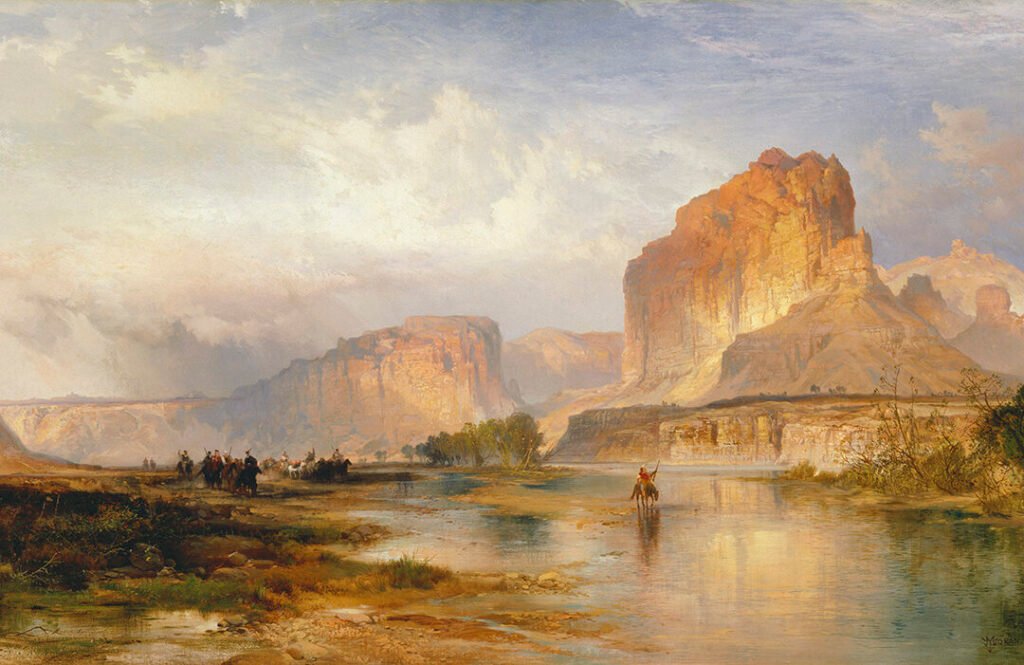
In the late 19th century, the United States was expanding westward. It was a time of exploration, greed, and preservation. Many pioneers who ventured west wanted to know about the land they intended to settle.
One artist used his landscape paintings not only to show Easterners the beauty of Western nature, but to help preserve it. His paintings had a profound impact on protecting these natural resources. This man was Thomas Moran (1837–1926).

A photograph of Thomas Moran, 1890, by Napoleon Sarony. Public Domain
Moran was part of a noteworthy family of artists, as his three brothers also had a creative eye; two were painters, and the third was a photographer.
Ironically, although Moran made his name by painting American scenery, he wasn’t born in the United States. He was born on Feb. 12, 1837, in Lancashire, England. Both his parents were handloom weavers, but the invention of the power loom brought hard times to the family. Struggling to feed their seven children, they emigrated to the United States in 1844, settling in Philadelphia the next year.
As a child, Moran gravitated toward art and loved exploring the local galleries and museums. At age 16, he began his apprenticeship as a wood engraver at the shop of Scattergood and Telfer. But he found the process very tedious and the subjects boring, so he spent every spare minute pursuing more fulfilling artistic hobbies. He painted with watercolors during the day and sketched in black and white by gaslight at night.
His employers quickly lost patience with his indifference to their business and complained to his father. Thomas soon struck a deal with Mr. Scattergood by agreeing to give him the paintings he produced, which his employer sold for a tidy sum.
Related Stories

Realizing the worth of his watercolors, Thomas began trading them to a bookstore owner. An insatiable reader, he exchanged his art for volumes on every subject of art, literature, and science.
This arrangement at Scattergood and Telfer continued until 1856, when Moran was stricken with a bout of rheumatic fever and pleurisy. When he recovered from his hacking cough, he determined that he’d learned all he could from his indentureship. His father helped him end what was supposed to be a seven-year apprenticeship after three years.
Landscape Artist
Now 19, Moran believed that painting was the path he should follow. He shared a crowded art studio with his older brother Edward (1829–1901), who was establishing himself as a maritime oil painter. Edward introduced his younger brother to oil painting. The two brothers shared studio space and work closely together for years.
Partly due to the limited art training resources in Philadelphia at the time, Moran didn’t study art formally. He learned from other artists in the city, most notably his brother and their neighbor, James Hamilton (1819–1878). Despite the immeasurable impact Hamilton had on Moran’s style, he later insisted that he “was never under any master.” He believed that art is more an innate skill than something that can be taught.

(Left) “Scene on the Hudson (Rip Van Winkle),” 1845, by James Hamilton. (Right) “Under the Trees,” 1865, by Thomas Moran. Public Domain
Moran soon turned his focus to landscape painting. He was inspired by Hamilton and by the British landscape artist J.M.W. Turner, whose paintings he copied and whose works he studied on a trip to London.
Never content to paint the commonplace scenes of nature found in his neighbor’s backyard, Moran traveled to find the true beauty of nature as subject matter for his art. He often went on expeditions with his brother John (1831–1902), who would capture landscapes in photographs as Thomas did with his sketch pad or brushes. He’d often begin with an open-air, or plein air, watercolor study and later make a larger oil painting of the same subject.
The Big Picture
By the 1860s, Moran was a married man with a growing family. He found a profitable use for his art in producing illustrations for Scribner’s Monthly, becoming the magazine’s chief illustrator by the end of the decade.
In 1871, he was assigned to illustrate “The Wonders of The Yellowstone,” an article written by Nathaniel P. Langford (1832–1911) that appeared in the May and June 1871 editions of Scribner’s Monthly; Langford had visited the Montana Territory on an expedition.
Moran was intrigued by the scenery described in the story, so he began planning a way to travel west himself.

“The Mosquito Trail,” 1874, by Thomas Moran. Public Domain
That summer, he solicited Scribner’s to finance his joining geologist Ferdinand Hayden’s (1829–1887) government survey to the heads of the Yellowstone River, offering to produce sketches and reports from the expedition.
He ended up getting the desired funding from Northern Pacific Railway tycoon Jay Cooke (1821–1905), who was eager for publicity for the expedition. Cooke financed many aspects of Hayden’s expedition in hopes that it would bring attention to the West and more business to his expanding railroad network.
Also visually documenting the expedition was landscape photographer William Jackson (1843–1942). He and Moran often worked in tandem to find the best vantage points in the wild, new land.

William Henry Jackson, as a member of the U.S. Geological Survey exploring the Teton country in 1872. Public Domain
While Jackson had to be sparing with his supplies when he took photographs, Moran sketched every angle of every sight that struck his fancy. He was particularly captivated by the view of Yellowstone’s Lower Falls.

“The Grand Canyon of the Yellowstone,” circa 1893–1901, by Thomas Moran. Smithsonian American Art Museum. Public Domain
When he returned to his New Jersey studio, he produced his most famous painting, “The Grand Canyon of the Yellowstone.” At 7 feet by 12 feet in size, it was the largest painting he had produced, and he lovingly dubbed it his “big picture.”
Rather than producing an entirely topographically accurate depiction of the landscape, Moran sought to capture the color, majesty, and spirit of the region. He admitted that none of the sights depicted in his painting could actually be seen from that spot, but the impression created by this painting was so overwhelming that Congress purchased it for $10,000.
This painting’s success launched his career and earned him the nickname Thomas “Yellowstone” Moran. He’s part of a group of Western landscape painters known as the Rocky Mountain School (in contrast to the East Coast’s Hudson River School).
‘The Great Surveys’
Moran’s painting of Yellowstone’s Grand Canyon was just the first of many awe-inspiring landscapes of now-famous Western monuments. Moran accompanied the expeditions known as “The Great Surveys.” These paintings include “The Chasm of the Colorado,” a dramatic rocky landscape, which Congress purchased for $10,000 to be hung opposite “The Grand Canyon of the Yellowstone” in the Capitol.

“The Chasm of the Colorado,” 1873–1874, by Thomas Moran. Public Domain
There, the two paintings hung until the 1960s, when the secretary of the interior loaned them to museums. They returned to the U.S. Department of the Interior Museum for permanent display in 2020.
Moran’s paintings of our nation’s natural treasures were more than beautiful landscapes. For many Americans of his day, they were a first glimpse of the wonders that lay out in the West.
Moran’s lasting legacy is his influence on the creation of national parks. Congress was debating whether to declare Yellowstone a national park right when Moran’s dynamic oil painting was presented. The artwork revealed the color and majesty of a region that most of the congressmen had never visited.
Moran’s sketches were used alongside Jackson’s photographs in lobbying Congress to pass the resolution. Jackson himself credited the painter’s “wonderful coloring” with securing Yellowstone’s national park status.
Looking at the vast collection of gorgeous oil landscape paintings Moran produced, one can understand his words:
“The motive … was the gorgeous display of color that impressed itself upon me. Probably no scenery in the world presents such a combination. The forms are extremely wonderful and pictorial, and, while I desired to tell truly of Nature, I did not wish to realize the scene literally, but to preserve and to convey its true impression.”