


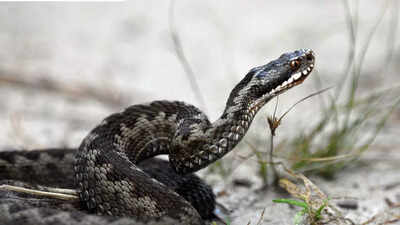
Run? By the time your brain registers the hiss, the moment has already passed. Research shows that certain snakes, particularly vipers, operate on a biological timescale far quicker than human perception and movement. You may notice the head begin to shift, but the signal travelling from your eyes to your brain and then to your muscles arrives too late. Specialists explain that this gap has nothing to do with panic or poor reflexes. Instead, it reflects a fundamental limit of the human nervous system. Speed alone wouldn’t matter without effective venom delivery. Viper’s long, hinged fangs rotate forward at the moment of impact.
Snakes react faster than human reactions: Viper strike speed study reveals
According to the study published in the Journal of Experimental Biology titled ‘Kinematics of strikes in venomous snakes’ in 2025, the actions of snakes are studied. The high-speed cameras have allowed researchers to measure full viper strikes finishing in under 70 milliseconds. Some appear closer to 40. That includes the head launch, fang contact, venom delivery, and withdrawal. For instance, the average human visual reaction time sits somewhere between 200 and 250 milliseconds. That’s under ideal conditions. Even spinal reflexes, the fastest responses humans have, usually kick in around 50 to 70 milliseconds. The high-speed videography entered the lab when cameras capable of thousands of frames per second let researchers break strikes into tiny slices of time. A large comparative study published in the Journal of Experimental Biology looked at strike performance across more than 30 snake species which included mostly vipers. The result was consistent. Strike durations ranging from about 40 to 90 milliseconds, depending on temperature, species, and situation. Once initiated, they can’t be adjusted mid-motion.
Why can’t humans react on time
It’s interesting to think that faster reflexes would help. Human reactions follow a long biological chain. Vipers bypass the whole comparison; they preload muscles before any visible movement occurs. By the time your brain is aware that something moved, the strike has ended.This is why experts say avoidance matters more than reaction. This kind of acceleration doesn’t come from willpower. Vipers have highly flexible neck vertebrae that allow rapid head projection. Their muscles and tendons store elastic energy, releasing it in a sudden burst rather than a gradual push.


