The recent catastrophic ice-rock avalanche along the Tibet–Nepal border has once again exposed the Chinese communist regime’s ultimate weakness—a political architecture so obsessed with narrative supremacy that it treats disaster management as an exercise in state self-preservation rather than human relief.
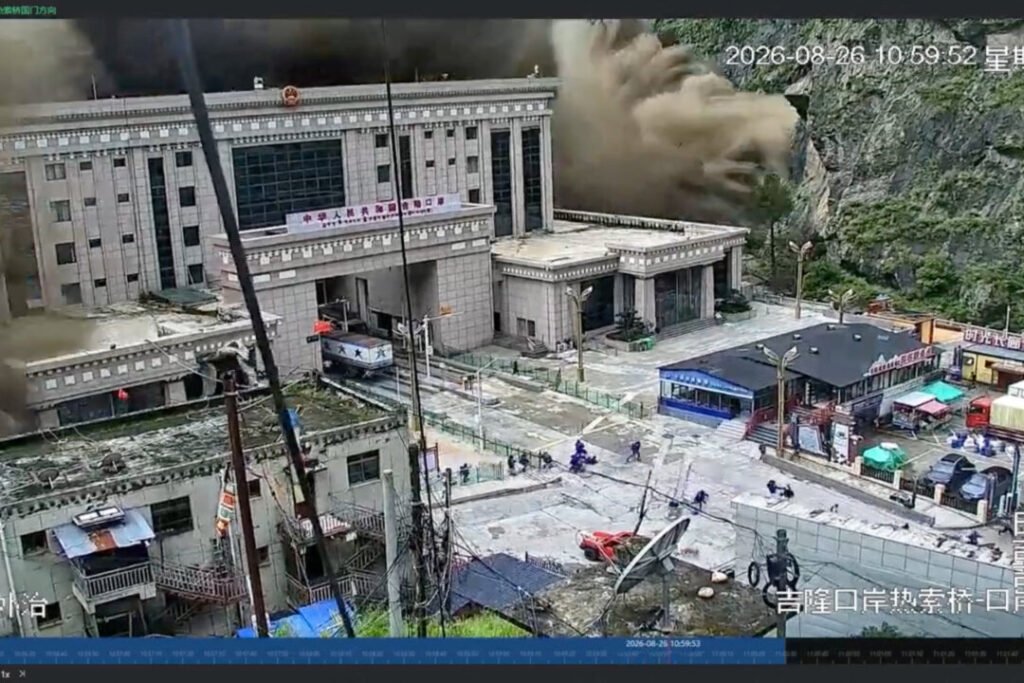
Millions of cubic meters of hanging ice, fractured bedrock, and permafrost sheared off the crest, instantly pulverizing into a high-velocity slurry with the density of wet cement.
Tearing down the narrow Gyirong and Trishuli river corridors, the surge obliterated customs posts, washed away hydropower facilities down to their rebar skeletons, and erased riverside settlements across Nepal’s Rasuwa and Nuwakot districts.
The physical catastrophe was transboundary, but the political responses on opposite sides of the frontier revealed two incompatible worlds.
In Nepal, the tragedy was met with painful, chaotic transparency: local officials went on air, journalists broadcast live from the mudflats, and the acknowledged count of dead and missing rapidly surged into the hundreds.
Across the border in Tibet, the Chinese Communist Party (CCP) deployed a very different apparatus—a five-decade-old governance playbook designed not to manage the physics of a crisis, but to preserve the absolute political infallibility of the state.
Related Stories


Within hours of the collapse, while scientists were still reconstructing the event from seismic and satellite data, Chinese state media blasted a definitive verdict: the glacier collapse had originated on the Nepali side of the border.
The Chinese Embassy in Kathmandu followed with swift public rebukes, labeling any downstream questions about upstream dam failures or unannounced water releases as malicious “fake news.” Their message ended with a pointed moral lecture: “Accusation helps nothing. Cooperation saves lives.”
Disaster Relief for the CCP
The speed of Beijing’s narrative offensive was not a matter of scientific certainty; it was an institutional reflex. In the Party’s governance model, natural catastrophes are treated as acute political vulnerabilities.
It seems like the regime approaches major disasters through a standard operating procedure: conceal the numbers, deflect institutional blame onto external actors, suppress the “man-made” factors, callously minimize domestic relief in favor of grand geopolitical posturing, and turn human mourning into a celebration of state mobilization.
That framework was on display in the initial numbers released by state broadcaster CCTV: three confirmed dead, alongside 558 missing. In standard crisis administration, such a ratio seems a contradiction when an entire multi-story border checkpoint is buried under meters of sludge, especially noting the Nepali side’s reporting of hundreds of deaths.
In the Party’s administrative hierarchy, however, confirmed casualties trigger bureaucratic liability and public fury, while a “missing” figure remains politically inert, buying time for censors to secure the perimeter.
Because more than 260 of the missing were foreigners, probably many traveling on pilgrimage to Mount Kailash, an absolute blackout proved impossible. Yet state television quickly pivoted away from civilian suffering, airing polished footage of Premier Li Qiang inspecting the mudflats.
A Repeating Pattern
This instinct to insulate the regime at all costs is deeply embedded in the Party’s history.
In July 1976, when an earthquake leveled the industrial city of Tangshan, local seismic warnings had been reportedly ignored by cadres afraid of causing “social panic” during Mao Zedong’s final days. The regime classified the devastation as a state secret, hiding the staggering toll of over 242,000 dead for three years while rejecting all foreign humanitarian assistance.
During the 2008 Wenchuan earthquake in Sichuan, roughly 69,000 people were confirmed dead, and another 18,000 remained missing, thousands of them crushed under poorly constructed public schools that collapsed while adjacent government buildings remained standing.
State broadcasts celebrated Premier Wen Jiabao with a megaphone amid the ruins, but the approach tightened when grieving parents compiled lists of their deceased children; they were arrested, while citizen investigators were imprisoned.
More recently, during the 2021 Zhengzhou floods, municipal authorities concealed 139 subway and tunnel deaths after failing to halt transit networks during consecutive red alerts.
In the 2023 Hebei inundation, authorities deliberately routed floodwater into designated storage areas around populated parts of Hebei, including Zhuozhou, while the provincial Party chief instructed Hebei to serve as Beijing’s ‘moat’ and identified the prestige project Xiong’an as a flood-protection priority.
And in the 2025 Miyun deluge, investigative reports detailing the drowning of elderly residents in an unwarned care facility were scrubbed from the internet within hours.
What makes the recent Himalayan disaster particularly acute is its intersection with China’s overseas infrastructure push. The Gyirong Gorge is the flagship overland conduit of the China–Nepal Economic Corridor, a centerpiece of the Belt and Road Initiative. For years, state-backed engineering firms have blasted cliffs, excavated transit tunnels, built dry ports, and dammed tributaries along this fragile geological corridor.
‘Tofu-Dreg Projects’
With the recent passing of former Premier Zhu Rongji, the phrase “tofu-dreg projects”—which he famously coined during another catastrophe, the 1998 Yangtze River floods—has taken on renewed resonance.
Inspecting ruptured flood dykes that corrupt officials had filled with gravel and wood scraps instead of reinforced rebar, Zhu openly confronted local cadres on national television. In the decades since, the fleeting moment of the Party’s tolerance for technocratic self-critique has long evaporated.
While there is no direct evidence confirming that Belt and Road blasting triggered this specific glacial rupture, the possibility warrants serious consideration. Under Beijing’s current political architecture, however, that will probably never be independently verified.
It is doubtful that independent glaciologists, domestic investigative reporters, and foreign engineering teams will be permitted to inspect the ridgelines. To question the geological integrity of a flagship Belt and Road artery is to challenge the central leadership’s administrative wisdom.
The Fragile Authoritarian
This dynamic exposes the central paradox of modern Chinese state power. Beijing can ostensibly construct tens of thousands of miles of high-speed rail, assemble space stations, and pour more concrete in a decade than Western nations did in a century.
Yet this same superpower cannot tolerate an unvarnished casualty count or a transparent post-disaster investigation. Also, it raises the question of whether all of its grand projects are really safe in the long term.
In a political system where the CCP demands total control over society, it must maintain the illusion of total competence. Normal governments absorb failures through electoral turnover; totalitarian systems treat the admission of structural negligence as an existential challenge to their right to rule.
As high-altitude Himalayan glaciers melt, transboundary flash floods and rock avalanches may recur along these shared corridors. The true danger confronting downstream communities in South Asia is not merely the volatility of the mountains, but a political system that prioritizes information control over early-warning data. And down in the valley, it’s always the ordinary people who pay the price.
Views expressed in this article are opinions of the author and do not necessarily reflect the views of The Epoch Times.