

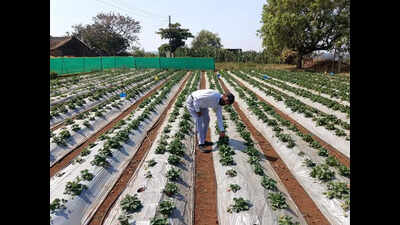
Pune: For hundreds of tribal farmers living in the forested hills around the Bhimashankar temple in the district’s Ambegaon tehsil, this harvest season was supposed to mark a turning point.
Instead, the unexpected closure of the famed Jyotirlinga shrine for restoration has left them struggling to sell a highly perishable crop — strawberries — grown for the first time with borrowed capital and high hopes. Janabai Ugale, a farmer from Jambhori village, around 150km from Pune, shifted to strawberry cultivation after watching other growers in the region earn steady returns in recent years. Like most farmers in the area, her marketing strategy relied almost entirely on the continuous stream of pilgrims who visit Bhimashankar throughout the year. “Our entire planning was based on the temple crowd. Devotees come in thousands, and we sell our produce directly near the temple. We never went to distant markets,” Janabai told TOI. She added, “But the temple is shut and will open only after two or three months now. By then, the season will be over.” At least 20 tribal villages located on the steep hills and foothills surrounding the temple are facing similar distress. With no organised local market and no cold storage facilities available easily, farmers are now being forced to transport strawberries nearly 60km to Manchar, the nearest major agricultural market. “For a crop like strawberry, transport itself is a big risk. The cost of fuel, labour and damage during travel wipes out our margins,” Janabai said. Over the last three years, the Ambegaon tehsil agriculture office has actively promoted strawberry cultivation in these villages, citing favourable climatic conditions, cool temperatures and soil characteristics similar to Mahabaleshwar in Satara district, India’s most well-known strawberry belt. The initiative aimed to create a sustainable income source for tribal communities living in ecologically sensitive and geographically isolated terrain. Farmers say the shift was not without cost. While the cultivated area is small, often limited to table-top patches carved out of hill slopes, the investment in saplings, mulching sheets, irrigation and labour is significant. “We may be cultivating on small land parcels, but the capital investment is high.
If the crop does not sell at the right price, the losses can be severe,” said Akash Morale, another farmer from the region. The geography that makes the area ideal for strawberry cultivation also became its biggest handicap. The farms are scattered across narrow hilltops and slopes, connected by winding roads that make frequent transport both expensive and impractical. Most farmers therefore planned to sell their produce locally, close to their fields. But this year, the Bhimashankar Jyotirlinga Temple is closed for public darshan for around three months, starting from Jan, for extensive renovation, construction, and safety-related development work ahead of the 2027 Simhastha Kumbh Mela. With this closure, private traders have stepped in for the strawberry farmers, but the latter allege that they are being forced to sell at distress prices. “Traders are offering Rs80-100 per kg — the same strawberries sell for Rs150-250 in bigger markets,” Morale said.
“They are taking advantage of our situation.” Agriculture officials acknowledge the challenge but say market disruptions were unforeseen. District agriculture officer Sanjay Kachole told TOI, “We have been promoting this kind of farming in the region to create an alternative and concrete source of income for locals. In the last two years, they could earn decent returns and hence, many took it up this year. However, because of the sudden temple closure, the planning toppled.
We are trying to find solutions to address this concern.” However, farmers argue that the crisis highlights the vulnerability of monocrop strategies in remote tribal areas without assured market linkages. “If this year ends in losses, many of us will not dare to grow strawberries again,” said farmer Vijay Module from Taleghar village. “For tribal families, just one failed season can push us back by years.” As ripe strawberries dot the hilltops overlooking the dense forests of Bhimashankar, farmers wait anxiously for intervention, either through temporary market support, transport subsidies or institutional procurement, hoping their first experiment with high-value farming does not end in disappointment. Meanwhile, the Ghodegaon-based tribal development project office has decided to procure strawberries from these farmers at a fixed rate and give them to students studying in their 14 tribal schools in the region. “This will help local farmers recover losses and also give quality fruit to students of these schools. It is a dual benefit. About 5,000 children study in these schools. Some schools have already started getting sample consignments from the local farmers,” said Sandeep Patil, assistant project director of the tribal department.