
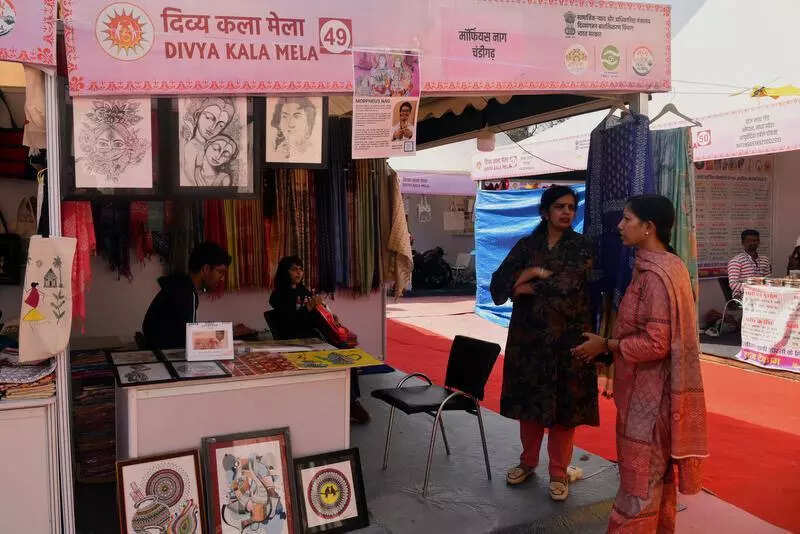
Chandigarh: At the ongoing Divya Kala Mela, rows of handwoven mats, painted canvases, carved woodwork and glass bangles reflect months — sometimes years — of labour. But for many artisans who have travelled long distances to be here, the biggest challenge is not creating the work. It is finding buyers.Held in Sector 34 of Chandigarh, the exhibition brings together artisans with disabilities from across India. Participants from Kashmir, Rajasthan, Uttar Pradesh and Bihar say the turnout has been lower than expected, affecting daily sales — often their only income from such events.Accommodation and travel are supported, but earnings depend entirely on what they sell. For artisans working with handmade goods, unsold products mean lost time, material and effort.Aadil, who travelled from Kashmir, called the mela an important opportunity but admitted fewer visitors mean fewer chances to earn. Shanti Kumari from Rajasthan believes limited publicity may be responsible. “People don’t know the exhibition is here,” she said. Ram Niwas, whose family has practiced traditional craft for generations, described participation as meaningful but financially uncertain.Local visitor Raahat said she entered only after noticing the gate while passing by, with no prior knowledge of the event — a concern echoed across stalls.Yet behind the slow sales are stories of determination that define the spirit of the mela.Eighteen-year-old Morpheus Nag’s paintings draw attention. His mother, Manisha Nag, explains the thought behind his name that felt meaningful rather than common. His autism diagnosis came during pre-nursery years. “We asked why us,” she recalls. “Then we decided it is better to accept.”She left her job to support his therapy and learning. Speech therapy began and they also had a special tutor. Over time, art became his language. “After nursery, I noticed he would draw on his own for long hours. He enjoyed it.”His work has since travelled to exhibitions in Bhubaneswar and the Kutch Contemporary Gallery earlier this year. Now studying at the Government College of Art, he continues to create art despite setbacks during the pandemic that worsened his condition. “The most important thing,” his mother says, “is acceptance at home.”Across the aisle, Yogendra Singh from Firozabad displays glass bangles crafted using skills passed down through generations. Born with locomotive disability, he learnt the trade and today, four to five people work with him, and he now uses metal in addition to traditional materials.From Betul in Madhya Pradesh, 30-year-old Shivati weaves doormats from coir and wool, a skill she learnt in school. Each mat takes about three days. A polio survivor who recently married, she says support from her in-laws is limited. This is her first time at the mela.Nearby, Uma Shankar Singh, 32, from Bhojpur leads a group of 30 disabled artisans working with local wood. A polio survivor himself, he describes the workshop as both livelihood and community.Many artisans say they joined the mela hoping not just for sales, but for visibility and dignity. But with fewer visitors, the gap between aspiration and outcome is growing.For now, they wait, arranging displays, sharing stories, and hoping more people walk through the gates before the exhibition ends.