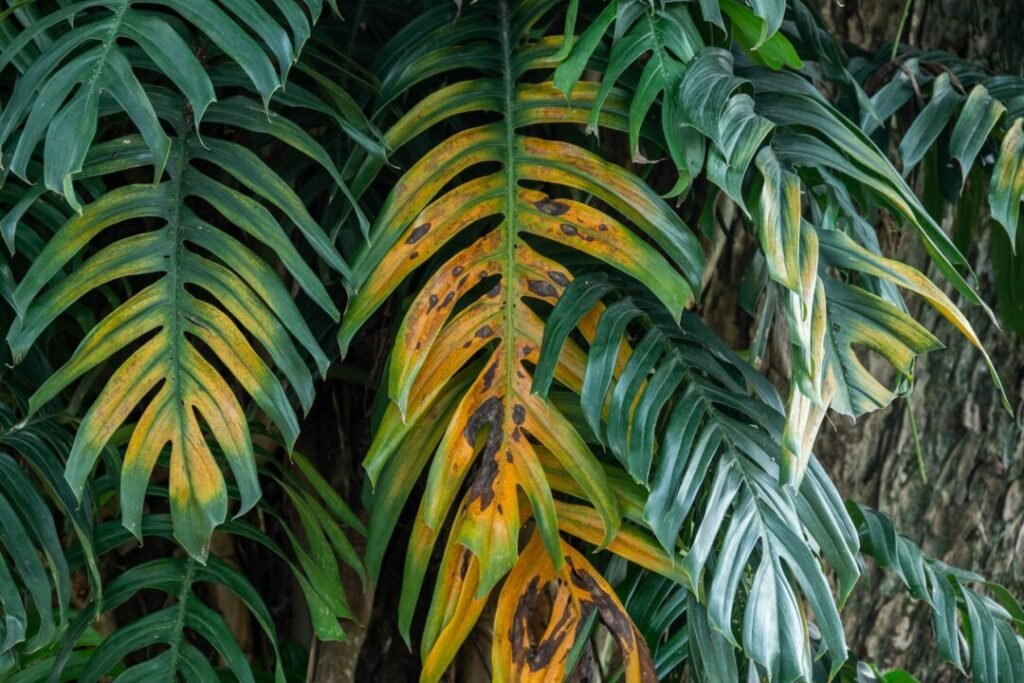
Q: I bring most of my houseplants outdoors for the summer. We have had a lot of wind and rain this summer, but except for a few tattered leaves, they are doing well. However, several different kinds of plants are producing new leaves that are a yellowish green. The leaves don’t turn the normal green of their kind of plant. I have had them moved outside and placed in the same locations on the patio for several years, and they have never done this before. Any thoughts on what is happening?
A: I can think of two things that might be the cause. First, the least likely possibility is that maybe there has been an opening in the tree cover over the patio. Have any branches broken off the trees above the patio that would let in more sunlight? It could be that the plants are getting a bit of sunburn.
What’s more likely is that the plants need to be fertilized. Plants use nitrogen to make chlorophyll. Nitrogen is used up quickly when plants are actively growing. Many blends of potting soil don’t have much nitrogen. Nitrogen washes out of the soil, so the rains may have washed out more of it than usual, even if you fertilized the pots when you moved them out for the summer.
Don’t add too much fertilizer to make up for the deficiency. Just follow the label directions. Too much fertilizer can burn the plant roots, causing more problems.
Q: We hope you can help us with a mysterious ailment on our sugar maple tree. The tree is about 30 years old and is beautiful, especially in the fall. About a month ago, we noticed the leaves developing 1/2-inch-high, green, needle-like spikes. The spikes eventually brown and die. Nothing has emerged from the spikes. Therefore, we do not think it is insect-related. The tree looks healthy otherwise, and the branches are not dying. This has never happened before, and we hope you can help us solve the mystery.
A: I think your maple tree has maple spindle galls, which are caused by a tiny mite. They are harmless, but they can be unsightly. A mite spends the winter on the tree trunk, hidden in cracks under the bark. As the leaf expands in the spring, the mite begins feeding, and it causes a small blister. The mite moves into the blister and secretes chemicals that cause the leaf to create the gall. They reproduce asexually for a while, and then in midsummer, the galls dry up, and the mites move out to the tree trunk.
Related Stories

Since they do no significant damage, controls are unnecessary.
Q: I have exotic lilies in my garden. They grow 4-5 feet tall and have beautiful scented, yellow flowers every year. They are about four years old. I want to move their location, and don’t know what time of year to do this. I do not want to damage them. Is there a good time to move them, and if so, how should it be done?
A: Wait until the leaves on the stems of the lilies turn yellow and die. At that time, you can dig them up and replant them. If there are small baby bulbs, you can move them to even more new places. Different lilies bloom in the spring, summer, and fall, so the digging date depends on the time when the lily dies back to the ground.
Dig around the spot the stem is coming out of the ground carefully, as the bulbs can be damaged by the shovel. Digging a wider hole and then moving in closer is better. Damaged bulbs should be left out of the ground for a few days to dry the cut area before replanting. The bulbs can be stored in a cool, dry location for several months before replanting, but the sooner they are replanted, the better. Replant the bulbs as deep in the ground as they were originally. Mix some organic matter into the hole, especially below the depth of the bulb, so the roots can grow down into the good soil.

Courtesy of Jeff Rugg