


Shanti Meaning: In a world characterized by constant connectivity, relentless demands, and global uncertainty, the human spirit’s longing for peace has never been more profound. We seek tranquility in our relationships, our environments, and most urgently, within ourselves. This universal quest finds a powerful and ancient answer in a single Sanskrit word: Shanti. Far more than a simple translation of “peace,” Shanti represents a profound state of being—a harmonious equilibrium of body, mind, and spirit that remains unshaken by external chaos. From the sacred chants at the close of a yoga session to the whispered greetings in India, Shanti is both an invocation and a lived experience.
The journey to understanding Shanti is a journey to the heart of human well-being. It’s a concept that has been refined over millennia within the spiritual traditions of Hinduism, Buddhism, and Jainism, offering not just a philosophy but a practical toolkit for modern living. This comprehensive guide will illuminate the multifaceted meaning of Shanti, from its deep roots in Vedic scripture to its practical application in your daily life. You’ll discover why the peace you seek is not a distant destination but an inherent state you can uncover through time-honored practices.
The Etymology and Foundational Meaning of Shanti
The word Shanti (शान्तिः) emerges from the ancient and intricate language of Sanskrit, a tongue designed to express subtle spiritual and philosophical truths. Its root is “śam,” which means “to calm,” “to quiet,” or “to pacify.” This is not a passive stillness but an active process of cultivating tranquility. Unlike the English word “peace,” which can denote merely the absence of conflict, Shanti implies a positive, flourishing serenity that comes from within.
In its most essential definition, Shanti is “peace.” However, this peace is specifically recognized as an inner condition rather than an external circumstance. It is the peace that persists when the mind has let go of its relentless grasping after pleasure and its aversion to discomfort. In Buddhist texts, this state is so complete it is sometimes synonymous with Nirvana—the ultimate liberation from suffering.
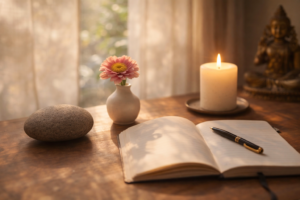
This inner-directed nature is what makes Shanti so universally relevant. It acknowledges that while we may not control the world around us, we have the agency to cultivate a sanctuary of calm within. As the revered Vietnamese Buddhist monk Thich Nhat Hanh reminds us, “Life is available only in the present moment“. Shanti is the practice of fully inhabiting that present moment, free from the agitation of past regrets and future anxieties.
Shanti in Sacred Texts and Spiritual Traditions
Shanti is not a standalone concept but a golden thread woven through the fabric of India’s great spiritual traditions. Its presence in sacred texts underscores its foundational importance to the human quest for enlightenment and liberation.
The Vedic Hymns and Shanti Mantras
The Vedas, among the world’s oldest religious texts, are replete with invocations of peace. The Shanti Mantras, or “Peace Chants,” are profound prayers for universal well-being often recited at the beginning and end of Hindu rituals and study sessions. They typically conclude with the threefold chant of “Om Shanti Shanti Shanti“.
A powerful example is found in the Purusha Sukta of the Rig Veda, a hymn that contemplates the cosmic being from whose sacrifice the universe is formed. The hymn itself begins and ends with invocations for peace: “Sham no asthu dvipade, sham chatush pade,” meaning, “Let there be peace for the two-legged beings and peace for the four-legged beings”. The closing lines offer the ultimate blessing: “Om Shanti, Shanti, Shanti“—peace for the individual, peace for the environment, and peace for the cosmic forces. This illustrates how Shanti is sought not selfishly, but as a universal condition for all life.
The Path of Peace in Buddhism
In Buddhism, peace is not a given but an achievement—the result of a dedicated path known as Santimarga, or “the path of peace”. This path is built on ethical conduct, mental discipline, and wisdom. The Dhammapada, a cherished Buddhist scripture, urges the practitioner: “Santimaggam eva bruhaya“—”Cultivate this very path of peace”.
Here, Shanti arises from the cessation of craving and aversion. It is the quiet mind that sees things as they are, without the distortion of personal desire. The great Buddhist scholar Shantideva, whose name itself means “God of Peace,” expounded on this path in his masterpiece, The Way of the Bodhisattva. He eloquently frames the interdependence of personal and universal peace: “All the joy the world contains has come through wishing happiness for others. All the misery the world contains has come through wanting pleasure for oneself“.

The Jain Commitment to Ahimsa and Shanti
Jainism offers one of the most rigorous and inspiring applications of Shanti through its foundational principle of Ahimsa, or absolute non-violence. For Jains, peace is not an internal feeling alone but must manifest in every action, thought, and word. A practicing Jain meticulously avoids harm to any living being, following a strict vegetarian diet, wearing masks to prevent inhaling insects, and choosing livelihoods that protect life.
In this tradition, “Om Shanti” is a fundamental invocation. As one practitioner explains, “‘Om’ means God. However, as stated, there is no God in Jainism. Therefore, ‘om’ translates into a dedication to whom or whatever one perceives as divine. ‘Shanti’ means peace. Thus, ‘Om Shanti’ is an invocation for peace“. Jainism teaches that every entity, from a human to a water molecule, possesses a soul. Thus, achieving peace for one’s own soul is inextricably linked to fostering peace for all souls.
The Threefold “Om Shanti Shanti Shanti”: A Mantra for Complete Peace
The most recognizable expression of Shanti in practice is the triple repetition of the word in the mantra “Om Shanti Shanti Shanti.” This is not mere repetition for emphasis. In yoga and meditation, each utterance is consciously directed toward a different layer of our existence, systematically removing obstacles to peace.
-
The First Shanti: Peace for the Physical Body (Adhibhautika).
This chant is an invocation for peace in the physical, material realm. It is a prayer to be free from external sufferings and obstacles: illness, accidents, environmental disasters, and harm from other beings. It seeks harmony with the world around us. -
The Second Shanti: Peace for the Mind and Emotions (Adhidaivika).
This chant targets the mental and emotional sphere, which is often influenced by unseen psychic or cosmic energies. It aims to calm the internal storms—fear, anxiety, anger, jealousy, and mental unrest. It is a prayer for relief from psychological suffering and the cultivation of emotional balance. -
The Third Shanti: Peace for the Soul or Spirit (Adhyatmika).
This final and most profound chant is for peace at the deepest spiritual level. It addresses the suffering inherent in the human condition—attachment, ignorance, and the sense of separation from the divine or our true Self. This Shanti connects us with our higher consciousness and is the gateway to self-realization.
Chanting this mantra, whether aloud or silently, acts as a sonic tool to “tune” our system. It helps withdraw the senses from external distractions, sparks deep relaxation, and focuses the mind, making it an ideal preparation for meditation.
Shanti in Modern Practice: Yoga, Meditation, and Mindfulness
The ancient wisdom of Shanti has found a powerful and relevant home in contemporary wellness practices. It moves from philosophy into lived experience on the yoga mat and the meditation cushion.
Shanti Yoga: Movement as a Meditation
Yoga, at its core, is a moving prayer for union and peace. Shanti Yoga is a style that intentionally emphasizes this introspective, harmonizing quality. It utilizes classical Hatha Yoga postures (asanas) not as strenuous exercise, but as a means to balance the solar (active) and lunar (receptive) energies within the body.
The practice is a laboratory for cultivating Shanti. As you move and hold poses, you inevitably encounter physical discomfort and mental resistance. A Shanti Yoga practice teaches you to meet these challenges with “receptive attention“—observing sensations without judgment and learning not to add mental suffering to physical discomfort. This skill, developed on the mat, becomes invaluable off the mat, allowing you to navigate life’s difficulties with increased resilience and kindness.
Meditation: Training the Mind for Peace
If Shanti is the destination, meditation is the vehicle. Modern science now confirms what ancient traditions have long known: meditation fundamentally rewires the brain for peace. Studies, including one from Yale University, show that mindfulness meditation decreases activity in the Default Mode Network (DMN)—the brain network responsible for mind-wandering, self-referential thoughts, and the “monkey mind” that is often linked to unhappiness and anxiety.
Meditation is the practical application of Shanti. It is not about emptying the mind, but as Deepak Chopra describes, “a way of entering into the quiet that’s already there – buried under the 50,000 thoughts the average person thinks every day“. By regularly practicing focused attention (such as on the breath) or open monitoring, you strengthen the neural pathways associated with calm and clarity, making the state of Shanti more accessible in daily life.
Mindfulness: Embodying Shanti in Everyday Life

Mindfulness is the art of extending meditative awareness into every moment. It is Shanti in action. While meditation might be a dedicated 20-minute practice, mindfulness is the ongoing practice of bringing a peaceful, non-judgmental attention to your daily activities.
This could be fully savoring a meal, listening intently to a friend, or feeling the sensation of water on your hands while washing dishes. In these moments, you are not lost in thoughts of the past or future; you are fully present. As expressed in the book Chop Wood, Carry Water, when we pay mindful attention, “everyday life becomes clearer, sharper, and at the same time more spacious“. This spacious clarity is the essence of Shanti manifesting in the ordinary.
The Science of Shanti: Measurable Benefits for Body and Mind
The pursuit of Shanti is not merely a spiritual endeavor; it is a profoundly healthy one. Modern research in neuroscience and psychoneuroimmunology has provided a robust scientific framework for understanding how peace-promoting practices like meditation and yoga benefit us.
Neurological Rewiring: As mentioned, meditation quiets the DMN and strengthens the prefrontal cortex (associated with focus and decision-making) while calming the amygdala (the brain’s fear center). This literally changes your brain’s default setting from “react and worry” to “observe and respond.”
Psychological Resilience: Regular practice is strongly linked to reduced stress, anxiety, and symptoms of depression. It promotes emotional health by creating a space between a stimulus (an event) and your reaction to it. In that space, you find the freedom to choose a peaceful response.
Physiological Harmony: The benefits cascade through the body:
-
Lowers cortisol, the primary stress hormone.
-
Can decrease blood pressure and reduce the risk of hypertension-related illnesses.
-
Improves sleep quality by calming the nervous system.
-
Boosts immune function by reducing chronic inflammatory states linked to stress.
Enhanced Cognition: Practices that cultivate Shanti lengthen attention span, combat age-related memory loss, and enhance self-awareness. They allow you to see your own mental patterns clearly, which is the first step in transforming them.
Integrating Shanti into Your Daily Life: Practical Tools and Techniques
Understanding Shanti is the first step; living it is the true journey. Here are practical, accessible ways to weave the thread of peace into the fabric of your daily life.
1. Begin with a Morning Mantra
Start your day by setting an intention for peace. Sit quietly for two minutes upon waking. Take a few deep breaths and mentally or softly chant “Om Shanti” three times. Feel the first chant relax your body, the second quiet your mind, and the third connect you to a sense of inner stillness.
2. Practice Mindful Micro-Meditations
You don’t need an hour. Take “peace pauses” throughout your day.
-
Before starting your car: Take three conscious breaths.
-
Waiting in line: Feel your feet on the ground and listen to the sounds around you without judgment.
-
Before answering a stressful email: Place a hand on your heart, breathe, and ask, “What is the most peaceful response here?”
3. Create a Shanti Ritual
Designate a small corner of your home as a peace altar. Place a candle, a meaningful stone, or a simple plant there. Spend five minutes there each day in quiet reflection, reading an inspirational quote (like those from Shantideva or Thich Nhat Hanh), or practicing body scan meditation.
4. Cultivate Ahimsa (Non-Violence) in Speech and Action
Follow the Jain inspiration. Practice peace in your communication. Before speaking, ask: Is it true? Is it necessary? Is it kind? Reduce harm in your lifestyle choices, whether through mindful consumption, compassionate eating, or reducing your environmental footprint.
5. Use the “Shanti Response” to Triggers
When you feel anger or frustration rising, pause. Instead of reacting, silently say to yourself, “Shanti.” This one-word mantra acts as an internal circuit breaker, creating the critical moment of choice between a destructive reaction and a peaceful response.
6. End Your Day with Gratitude and Release
Before sleep, reflect on three things you are grateful for. Then, perform a simple release: visualize the day’s worries and tensions as dark smoke, and with each exhale, see it dissipate. Conclude by whispering, “Om Shanti,” offering peace to yourself and the world.
Conclusion: Shanti as the Birthright of Being
The journey through the landscapes of Shanti reveals a profound truth: peace is not a luxury, a passive state, or a fleeting moment of quiet. It is, as the traditions teach, the fundamental nature of a clear mind and an open heart. It is the silence beneath the noise, the stillness within the movement, the clarity hidden by our own thoughts.
In our search for peace, we often look outward—to changing circumstances, acquiring possessions, or controlling others. Shanti redirects that gaze inward, to the only place where true and lasting peace can ever be found: within yourself. It is a peace that does not deny the world’s suffering but meets it with unshakeable compassion and resilience. It is the peace that the Buddha cultivated, that Shantideva wrote about, and that millions seek on yoga mats and meditation cushions every day.
As you move forward, carry with you the ultimate lesson of Shanti: the peace you wish to see in the world must first be nurtured within your own being. Start small, be consistent, and be patient. Chant the mantra, take a conscious breath, observe without judgment. In these simple acts, you are not just learning about Shanti; you are embodying it. You are realizing that, in the words of the ancient sages, you are not just a seeker of peace—you are peace itself.