
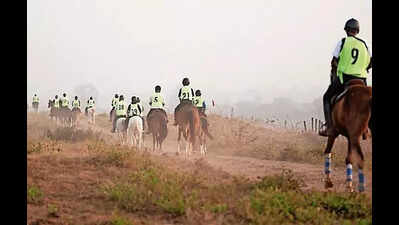
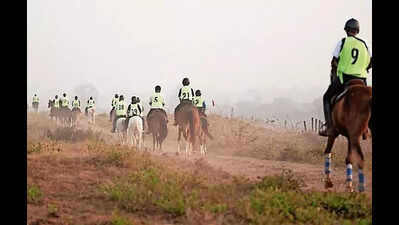
It’s just past 9 am in a makeshift “cooling pit” in a cacti-lined part of Karjat. Like an F1 pit crew, huddles of rustic men sporting stethoscopes over neon reflector jackets hover around blue drums of water and cola bottles filled with brown jaggery solution. Some hold hay, one a carries a carrot in hand. Soon, when the first horses return from a punishing 20-km loop, accents — Tamil, Kannada, Rajasthani, Bambaiya — collide. Saddles are whisked off, bandages peeled away, water poured in hard-won mugs over steaming backs. A stethoscope is pressed to the left side. Watches are checked. Is the pulse under 64 beats per minute within 20 minutes of arrival? Anything higher and they could be eliminated from the 40 km national qualifier at Hoofbeat Marathon – State Open Endurance Championship 2026. “Endurance is won and lost in the vet gate,” says Col Ashok Yadav, president of the ground jury, badges from 21 countries pinned to his hat and lapel. A Rajasthan-based polo player and equine rider, Yadav has judged endurance events in India for three decades under the aegis of the Equestrian Federation of India (EFI), which follows FEI rules. “This is not a race, it’s a ride,” says Yadav about the event organised in collaboration with EFI. “It’s a game of precision. The rider must ensure the horse finishes strong but also cools down fast.”Organised by Hoofbeat heaven, riding club and stud farm, from Feb 6 to 8, the championship featured 20-km and 40-km categories for riders aged 14 and above, with a maximum speed of 16 kmph. The 40-km ride also served as a national qualifier. Fifty-six horses from Tamil Nadu to Madhya Pradesh participated in the event’s third edition and its first in collaboration with the EFI. “This is the first edition with cash prizes,” mused Bhiwandi’s Dnyaneshwar Patil, a veteran participant at 52. Endurance riding began as a military test in the early 1900s, when cavalry horses were required to cover 300 miles over five days. Recognised by the Fédération Equestre Internationale (FEI) in 1978, the sport has since expanded globally, with over 353 FEI endurance competitions held across 49 countries in 2006 alone. In India, rides have reached 120 km in the past and are now rebuilding to 80 km post-Covid.Unlike dressage or show jumping — Olympic equestrian disciplines conducted in arenas — endurance unfolds across open terrain. “In dressage and show jumping, you train in an arena,” Colonel C S Sohal, chief veterinarian and member of the EFI’s executive committee says. “In endurance, you need pathways. Abroad, they have marked trails. Here, we create them.”At Karjat, the track–entailing various water bodies and hills–was marked with red-and-white ribbons and oil paint. Rohan Rasam, championship In-charge and founder of Hoofbeat Heaven, says he spent over 80,000 hiring JCBs to soften the gravelly earth. Sponsors ranged from equine feed and tack companies to riding clubs and a cow ghee start-up, though some early backers withdrew at the last minute.The sport is as technical as it is pastoral. At each mandatory hold, horses undergo rigorous veterinary checks: pulse recovery, respiration rate, mucous membrane colour, capillary and jugular refill time, hydration, gut sounds, muscle tone, gait and overall metabolic soundness. The horse is trotted 20 metres to check for lameness before its heart rate recovery is timed.“You cannot give fluids or painkillers before the event unless recommended by me,” says Sohal, the soft-spoken chief vet with a stethoscope hanging around his neck. Random urine samples are collected to screen for banned substances. Any horse that fails blood screening, shows irregular gait or does not meet metabolic parameters is eliminated. Dr Sandeep Benipal, an A-grade confirmation judge on the veterinary panel, points to local challenges that led to almost 33 of the 56 horses being eliminated. “The main problem here is the heat. Horses are getting high pulse rates and dehydrated faster,” he says. “The horse cannot speak. It cannot tell you how it feels. If we ignore parameters, we risk fatalities.”Many riders are first-timers, unfamiliar with the demands of the vet gate. Indigenous breeds dominate the field. “Our horses are quick in short-distance races,” Benipal explains. Training a horse from 20 km to 120 km, Sohal says, requires at least six months of uninterrupted conditioning, with careful attention to nutrition, vaccination and disease exposure. A 160-km ride runs from one midnight to the next.All participating horses at Karjat were five years old.