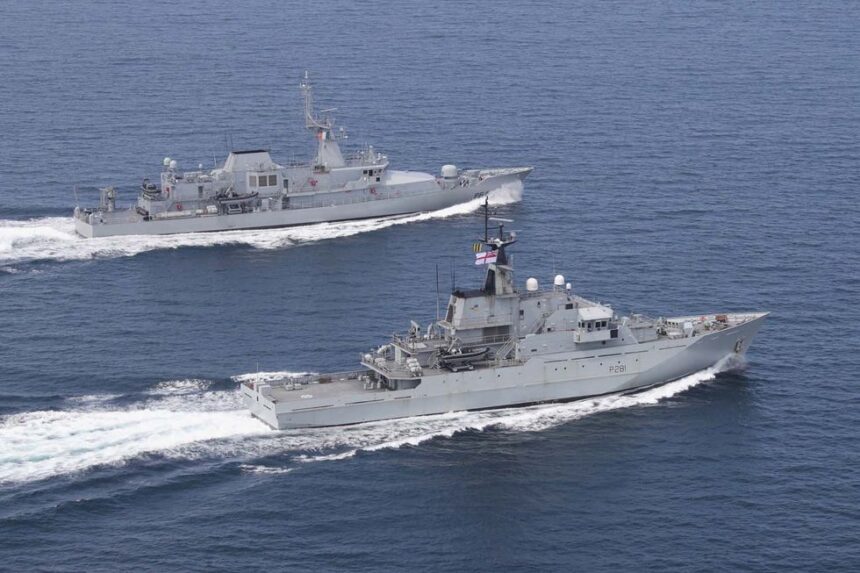
The Royal Navy will patrol Ireland’s waters in a bid to ward off Russian ships as soon as July.
As part of a new partnership with Britain and France, the Republic will be guarded by warships when it assumes the EU presidency this summer.
The UK’s neutral neighbour is said to be wary of the security threat posed by Moscow during its six-month-long presidency – as well as to crucial infrastructure in its seas like undersea cables.
And when it takes up the six-month presidency, Irish liaison officers will be appointed to maritime security agencies in both Britain and France under the new partnership.
The move would not be without precedent – last year, Germany covered northern neighbour Denmark’s air defence when it held the presidency last year.
And Dublin’s security concerns were heightened after a mysterious run-in with drones during Volodymyr Zelensky’s visit to Ireland in December.
Up to five military drones breached a no-fly zone and flew towards his aircraft in what is suspected to be an act of Russian hybrid warfare.
“They had the capability and intent. They could have taken action at any moment of their choosing,” a security source said at the time.
The drones subsequently circled an Irish vessel which had been secretly positioned in the Irish Sea to protect the Ukrainian leader’s state visit.
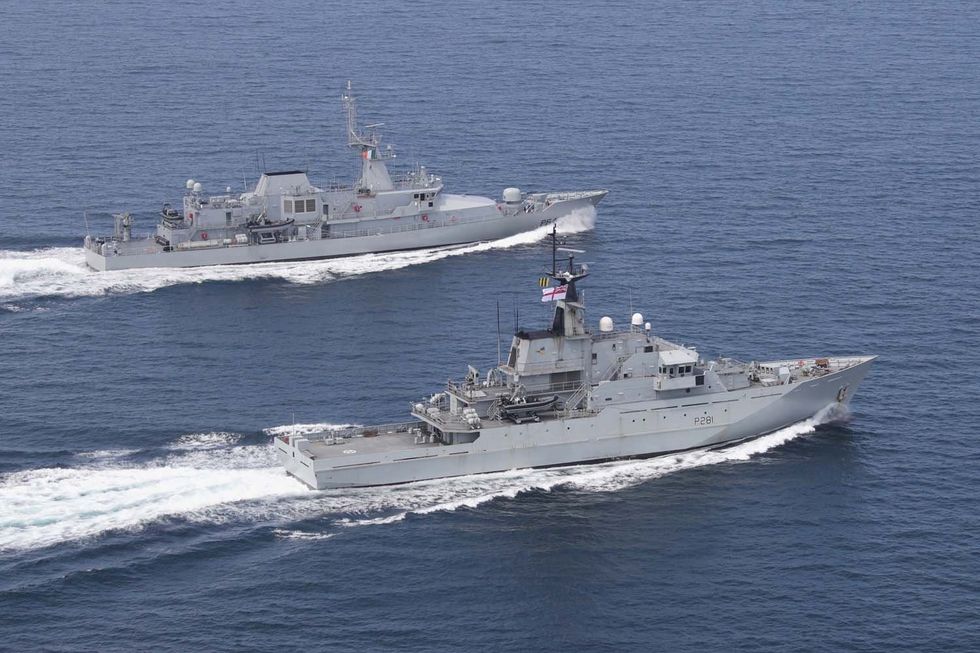
PICTURED: HMS Tyne on a training exercise with the LE George Bernard Shaw in 2020
|
ROYAL NAVY
As well as drones, Ireland is wary of Russia’s shadow fleet – hundreds of vessels which transport sanctioned oil and frequently pass through Irish waters.
Some have even stopped directly over undersea cables.
Pipelines supplying three quarters of Ireland’s natural gas run through these waters.
The Irish Naval Service operates just eight ships, though two remain in operational reserve.
A third ship is currently being fitted out and should begin patrols later this year.
RUSSIA AT SEA – READ MORE:

Volodymyr Zelensky visited Dublin just months ago where he met Taoiseach Micheal Martin
|
PA
But recruitment difficulties mean only two ships can be deployed at sea simultaneously.
Personnel numbers have risen to approximately 850, still falling short of the minimum requirement of 1,094.
Plans to increase the number of vessels at sea are expected to be announced in the coming weeks.
A Policy Exchange report last year accused Ireland of “freeloading” on Britain’s Armed Forces, sparking calls from British peers for Dublin to contribute more to defence efforts.
But Ireland’s National Maritime Security Strategy, released on Wednesday, outlines a five-year plan to bolster Ireland’s defences.
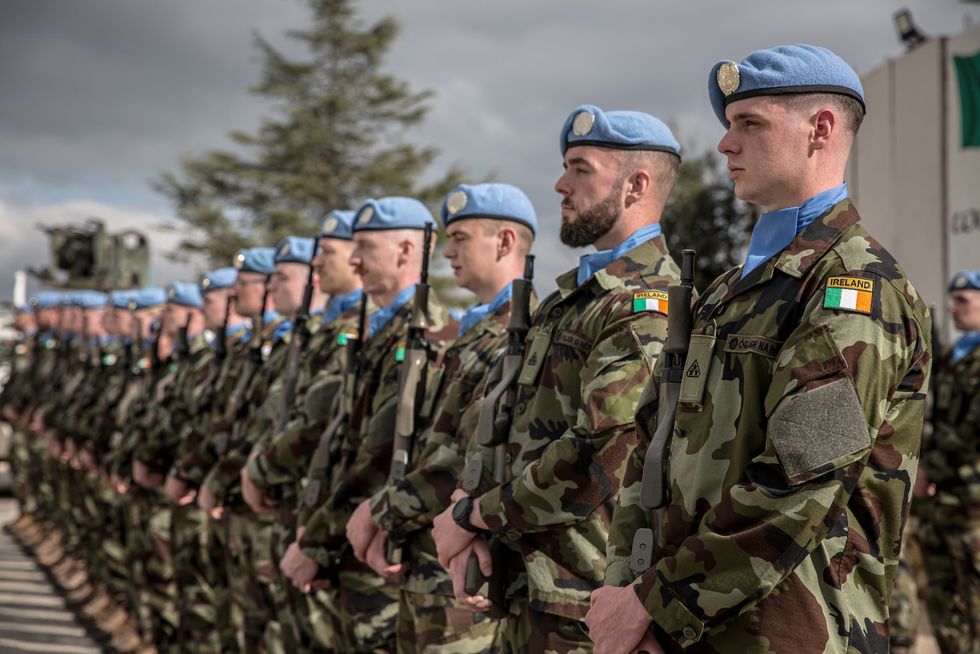
PICTURED: Irish troops at the Camp Shamrock UN base in south Lebanon
|
GETTY
A military radar programme and anti-submarine sonobuoy capability will be rolled out, while the country is also planning to train up a new maritime special forces unit and set down new bases on the country’s east and west coasts.
Ireland aims to improve monitoring of its Exclusive Economic Zone (EEZ), which extends 200 nautical miles from shore.
Dublin will also push for closer ties with the UK-led Joint Expeditionary Force, a 10-member group of northern European countries focused on maritime security.
However, the new strategy could be risk legal challenges, as Ireland’s constitution states any military force should only be raised and maintained by Ireland’s Parliament – and no other “raised or maintained for any purpose whatsoever”.
One solution could see British ships stationed tactically outside of Irish territorial waters, 12 nautical miles from the coast, but inside its larger EEZ.