

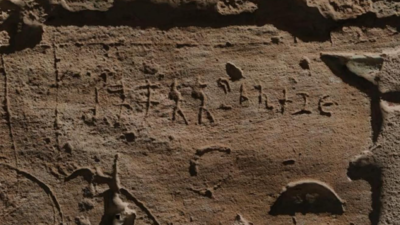
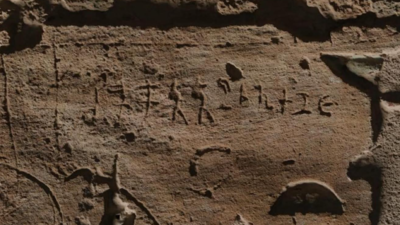
CHENNAI: Around 2,000 years ago, a Tamil trader who visited the rock-cut tombs of Egyptian pharaohs scratched his name in eight places in five of the six tombs in the Valley of Kings in Egypt, which are dated to 1600 BCE. However, his name was not known to anyone until it was found recently by Swiss scholar Ingo Strauch.The Tamil Brahmi inscription of the name “Cikai Korran” (Cikai means tuft or crown, while Korran, read as Kotran, means leader) and a few other names give fresh evidence of bilateral trade between the West and India; and of travel by Tamil merchants on the ancient trade route.Strauch, along with Charlotte Schmid from École Française d’Extrême-Orient (EFEO), or the French School of Asian Studies, deciphered the inscriptions and presented a paper at the Tamil epigraphy conference held in Chennai on Wednesday.“We knew that traders from Tamil Nadu visited Egypt through other inscriptions found in the ancient port cities. But this shows that they did not only come with ships and return, but they also stayed here for a longer period of time. They took time even to visit sites that are far away,” Ingo Strauch from the University of Lausanne in Switzerland told TOI.Charlotte helped him decipher the Tamil Brahmi inscriptions. “The name ‘Korran’ is linked with king or leader. The name was also written in one place as ‘Cikai Korran – vara kanta’, which means he came and saw. It seems to imitate the formula of Greek inscriptions found at the Valley of Kings. It shows that this person might have read the Greek inscriptions and was inspired by them,” Charlotte told TOI.Another inscription at Tomb 1 also read “Kopan varata kantan”, meaning “Kopan came and saw”, and Tomb 8 has Catan, a common south Indian name found in several early Tamil-Brahmi inscriptions. Some of these names were also found in excavations at Berenike, a Red Sea port.Of 30 inscriptions uncovered at the Valley of Kings by Strauch and Schmid, 20 are in Tamil. The rest are from other Indian languages such as Sanskrit, Prakrit, and Gandhari-Kharoshi, indicating traders from north-western India and western India, including Gujarat and Maharashtra, also frequented these parts during the Roman period.One of the Sanskrit texts stated that an envoy of a Kshaharata king “came here,” which is significant as the Kshaharata dynasty ruled in western India in the 1st century CE.“There are more than 2,000 graffiti marks and inscriptions in the Greek language found at the tombs in the Valley of Kings. They came from all parts of the Mediterranean world. But none of them came as far as Indian traders,” Charlotte said.Jules Baillet, a scholar who recorded these inscriptions, mentioned the Tamil Brahmi inscriptions as graffiti from the Asiatic region.“Through the writings of Ptolemy and Pliny, we know that the Romans came to India for trade. But it was not clear whether it was one-way or two-way trade. This new evidence gives proof of two-way trade that happened during the Roman period,” senior epigraphist Y Subbarayalu told TOI.Archaeologist V Selvakumar of the Department of Maritime History and Maritime Archaeology at Tamil University, Thanjavur, said the Nile river valley and the Red Sea are in the connecting point between Rome and ancient India. “So, the Tamil mercantile community might have visited there for sight-seeing. The traders were also exploring the area,” he said.Professor K Rajan, academic and research adviser to the Tamil Nadu State Department of Archaeology, said, “It is important evidence as it brought to light that Tamil traders went to the interior parts of ancient Egypt during the Roman period.”