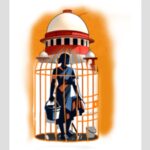


Hyderabad: Barmala Mallaiah of Amaragiri village in Nagarkurnool district was ensnared in bondage long before he understood the meaning of debt. His father, Gajjanna, borrowed Rs 10,000 from a local landlord. Although the family repaid the sum with heavy interest, the landlord refused to release them. Instead, Gajjanna was forced to fish in the Krishna river. He was paid a pittance for his catch and was partly compensated in rice, vegetables and groceries — a system designed to ensure dependence, not repayment.When Gajjanna grew older, the burden passed to his son. Mallaiah was pushed into bonded labour at the age of six and remained trapped until 2016, when he was rescued by an NGO at the age of 18. That year, nearly 180 bonded labourers were freed in two rescue operations across the region. However, Mallaiah’s story did not end with his rescue; it merely changed shape.Now a survivor leader and elected village panchayat vice president, Mallaiah has seen many rescued workers slip back into poverty and, in some cases, even back into bondage. “Rescue alone is not freedom,” he says. “Without release certificates, survivors cannot access compensation, housing, or protection. That paper is not a formality. It is the foundation of rehabilitation.”His concern is echoed across Telangana. Survivors say that, while rescues frequently end the most visible abuses, they fail to address the deeper vulnerabilities that led to exploitation in the first place: poverty, debt, a lack of documents and an absence of livelihood support.Budda Venkataiah, another bonded labour survivor from Mahabubnagar, describes this situation as ‘a freedom that exists only in words’. After being rescued from an exploitative workplace, he was sent back to his village without a release certificate, compensation or access to govt schemes. “Officials say we don’t exist without documents,” he says. “How can freedom exist only on paper?”Under the Central Sector Scheme for the Rehabilitation of Bonded Labourers, survivors are entitled to immediate assistance of up to ₹30,000, followed by rehabilitation support ranging from Rs 1 lakh to Rs 3 lakh, depending on gender, age, and the severity of the exploitation experienced. In practice, however, most of this assistance is tied to criminal convictions, which are rare and often delayed for years.The consequences are stark. Families return home with untreated injuries, lost wages, disrupted schooling and mounting debt. Without compensation or livelihood options, many migrate again the following season, often back into the same high-risk sectors that once trapped them. “Freedom without a livelihood is not freedom,” says Venkataiah, adding: “It pushes people back into the same cycle.”Survivor leaders and unions, including the Trilinga Unorganised Workers Union, are now calling for Feb 9 to be officially observed as Bonded Labour Abolition Day. They are also demanding a state-wide database to track rescued workers, clearer standard operating procedures, stronger inter-departmental coordination and faster trials to ensure accountability.Fifty years after bonded labour was abolished by law, survivors say that the real struggle is no longer against invisible chains, but against a system that frees bodies while leaving lives in ruins. “Extraction is only the first step. Justice begins when the process is followed,” says Mallaiah.