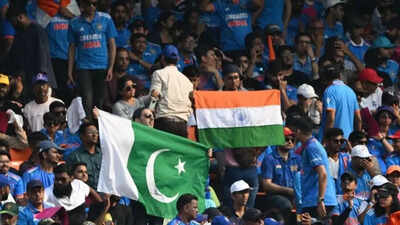
Amid the current standoff over Pakistan’s refusal to play India on February 15 at the ICC Men’s T20 World Cup 2026, cricket once again finds itself grappling with an uncomfortable reality — the incident of teams boycotting matches during global tournaments. While Pakistan have been cleared by their government to take part in the event starting February 7, the decision to skip just one match — against arch-rivals India — has reopened a familiar, uneasy chapter in ICC history.Go Beyond The Boundary with our YouTube channel. SUBSCRIBE NOW!“The government of Pakistan grants approval to the Pakistan cricket team to participate in the Twenty20 World Cup, however, the Pakistan team shall not take the field in the match scheduled on 15th February against India,” said an official government release on Sunday.
The announcement followed high-level meetings between Pakistan Cricket Board (PCB) chairman Mohsin Naqvi and Prime Minister Nawaz Sharif in Lahore. Pakistan will travel to Colombo on Monday to begin their campaign, ending a week of uncertainty triggered by Bangladesh’s removal from the tournament after their venue-shift demands were rejected by the ICC.The ICC, however, has firmly rejected the logic of selective participation. “This position is difficult to reconcile with the fundamental premise of a global sporting event,” the governing body said, adding that such a move undermines “sporting integrity, competitiveness, consistency and fairness”. The ICC warned of long-term consequences for Pakistan cricket and urged the PCB to seek a “mutually acceptable resolution”.Yet, as dramatic as the current row appears, history shows this is far from unprecedented. Here are the past occasions when teams decided to forfeit matches during ICC events:1996 ODI World CupThe 1996 ICC ODI World Cup, co-hosted by India, Pakistan and Sri Lanka, unfolded against the backdrop of Sri Lanka’s civil war. A bomb blast in Colombo just weeks before the tournament heightened security fears. Australia and West Indies refused to travel to Colombo for their group matches, citing safety concerns, and were forced to forfeit points.Sri Lanka not only qualified comfortably for the knockouts but rode momentum all the way to a historic World Cup triumph — beating Australia in the final in Lahore.2003 ICC ODI World CupThe first Cricket World Cup held in Africa produced two walkovers that reshaped the tournament. England refused to play Zimbabwe in Harare due to opposition from the UK government against Robert Mugabe’s regime, while New Zealand declined to face Kenya in Nairobi after a bombing in Mombasa months earlier.Despite requests to relocate the matches, the ICC stood firm and awarded points to Zimbabwe and Kenya. England exited early, New Zealand scraped into the Super Sixes, and Kenya — beneficiaries of the forfeit — made a stunning run to the semi-finals of the home tournament.2025 ICC Champions Trophy: The neutral ground compromiseLast year, the 2025 Champions Trophy revived the India–Pakistan impasse. Despite Pakistan hosting their first ICC event in 29 years, India refused to travel, citing lack of government clearance. After prolonged negotiations, the ICC brokered a neutral-venue model for the 2024–27 cycle. India played their matches in Dubai — and went on to win the tournament.That compromise now underpins the current T20 World Cup arrangement, with India and Pakistan avoiding travel to each other’s countries. Yet Pakistan’s refusal to play India even at a neutral venue in Colombo marks a significant escalation.2026 T20 World Cup: How India will get a walkoverUnder ICC playing conditions, a walkover is not automatic simply because a team declares it will not play. A match is officially forfeited only if one side fails to present itself at the venue at the scheduled time for the toss. Until then, the fixture is deemed to be on. Consequently, India must follow all match-day protocols, with captain Suryakumar Yadav expected to arrive on time and walk out for the toss as scheduled. If Pakistan do not appear, the match referee will formally award India a walkover, earning them two group points.