

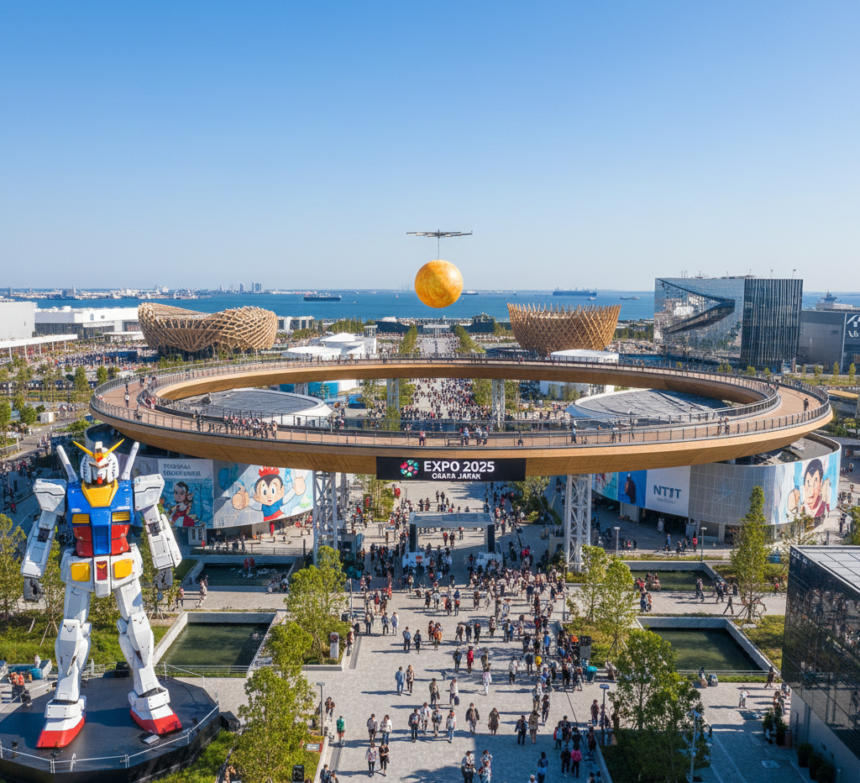
I have visited 11 Expos so far, visiting 98 of the 99 pavilions, excluding Miyaku Myaku House. To help organize my records, I have compiled a list of the pavilions I have visited. In addition to the pavilions, I have also included the daily shows, the large roof ring, and four facilities with official stamps (although not pavilions). (I have tried to make the layout viewable on smartphones, but if you have trouble viewing, you can download a PDF version here .)
The pavilion numbers and names are based on the information on the ” official sensory map ” (since the numbers have recently disappeared from the main map). The official map also numbers buildings other than pavilions (stages, rest areas, event halls, etc.), so there are some missing numbers in the list.
Clicking the triangle on the top row will sort by that column. You can also slide the table left or right to see the whole table.
The table can be read as follows:
- Name : Due to space limitations, some names have been omitted. ▲ indicates pavilions with a row house structure (known as Type B) that are located side by side with other pavilions and have a smaller floor area. The pavilions marked with * offer different experiences depending on the course, but the author visited each one on the following course.
- Gas Pavilion, Playground of Life, Sumitomo Hall: Areas where reservations are not required
- Better Co-Being: Free Night Viewing
- null2: Installation mode
- Adventure of Life: 499 seconds My Fusion・ANIMA!・No reservation required area
- Osaka Healthcare: Reborn Experience
- Fountain show: Blue and Night Rainbow Parade (there are also daytime shows)
- Category : To make it easier to understand the highlights of the pavilions, I have roughly categorized them into genres based on my own interpretation of the most important elements of each pavilion . For example, the Italian Pavilion has not only art but also elements of science and technology, but I think its biggest selling point is its art, so I have placed it in the “Art” category. An explanation of each genre is as follows.
- Art : A pavilion selling artworks such as paintings and sculptures (similar facility: art museum)
- Culture : Pavilions focusing on humanities exhibits such as history and folklore (similar facilities: Tokyo National Museum, etc.)
- Science : Pavilions focusing on science-related exhibits such as science, nature, and SDGs (similar facilities: National Museum of Nature and Science, etc.)
- Industry : Pavilions that focus on introducing traditional industries and new technologies from each country and company (similar facilities: corporate exhibitions)
- Atra : Theme park attraction pavilion (similar facilities: Universal Studios Japan, Tokyo Disney Resort)
- Show : Pavilion for performing arts such as music, singing, dancing, and theater (similar facilities: various concert events)
- Space : A pavilion that provides a space where you can enjoy just being there (similar facilities: TeamLab events)
- Experience : A pavilion that offers experiences using dedicated devices (similar facilities: same as above)
- Features and highlights : I have written my own summary in about 20 characters. I have intentionally kept it short because a long explanation would be difficult to read, and above all, I think that if you research the exhibits too much and end up with a big head, the impression of being there will be diminished. If you want to know more, click ■ on the right side of the table to jump to the corresponding visit report.
- Admission : This is based on my own experience of the difficulty of admission. Of course, admission conditions vary depending on the day of the week, time of day, and weather, so please use this information as a guide only.
- ●: Generally, only those with reservations are accepted, and it is impossible or very difficult to enter without a reservation.
- ◎: Reservations are required, but you can enter without one (though there will be a long wait). There may be limited time slots for entry without a reservation. Pavilions that require reservations but can often be entered immediately without a reservation are marked unmarked.
- ○: Not available for reservations, but there is a high possibility that you will have to wait for more than 30 minutes or that reservations will be suspended during the day.
- Duration : This is the time it took me to exit the pavilion after entering it. (This is different from the time stated on the official website.) Judging from the surroundings, I think my speed at viewing the pavilions was about average. If you take your time, it’s probably best to assume it will take about 1.5 times longer.
- ◆: This is a pavilion where you move between rooms according to the instructions of the staff, so the travel time is almost fixed.
- ~:After entering the pavilion, you need to line up to experience the activities inside. If you want to experience everything, you should plan on waiting at least an hour.
- *In Canada, the Netherlands, and Japan, the museums were crowded and we had to wait a long time after entering, but if you go in the morning when there are fewer people, the wait may be shorter.
- Recommendations : These are the pavilions recommended by the author, based on his own personal opinion. Taking into consideration not only pure enjoyment but also “Taipa,” the judges were stricter on popular pavilions that are difficult to enter, and more lenient on places where you can enter immediately. Since pavilion preferences vary greatly from person to person, please use this list as a guide only.
- ☆: Pavilions recommended by the author (☆☆ are especially recommended). See the reasoning on the next page .
- △: Although not included in the ☆, this pavilion is likely to provide a certain level of satisfaction for anyone.
- ?: I was unable to rate Miyakumiyaku House, which I had not visited, or Gas Pavilion, Playground of Life, and Sumitomo Hall, which I had only visited in the areas that did not require reservations.
- Children : Pavilions recommended for children are marked with a ” child ” symbol. Although we generally refer to children, junior and senior high school students probably have similar experiences to adults, and conversely, it may be difficult for preschool children to fully enjoy the Expo Pavilions, so we have targeted elementary school children here. We believe that attractions and hands-on experiences will generally be well-received, so we have chosen pavilions based around that.