There are many brilliant old movies which, when you discover them, will make you wonder how you’ve never heard of them before. This is especially true of film adaptations of literary classics made during the Golden Era of Hollywood. These movies can be amazing pieces of film history, as well as respectable versions of the classics.
One innovator in film turned his creative genius to one of the greatest novels in the English language—“Jane Eyre” (1943).
Just four years after “Gone with the Wind” (1939) swept the Oscars and flooded the box office, its producer, David O. Selznick, sold the rights to a production of “Jane Eyre” he’d been formulating. Ever a strong-minded leader, Selznick had definite ideas about how this film should take shape.

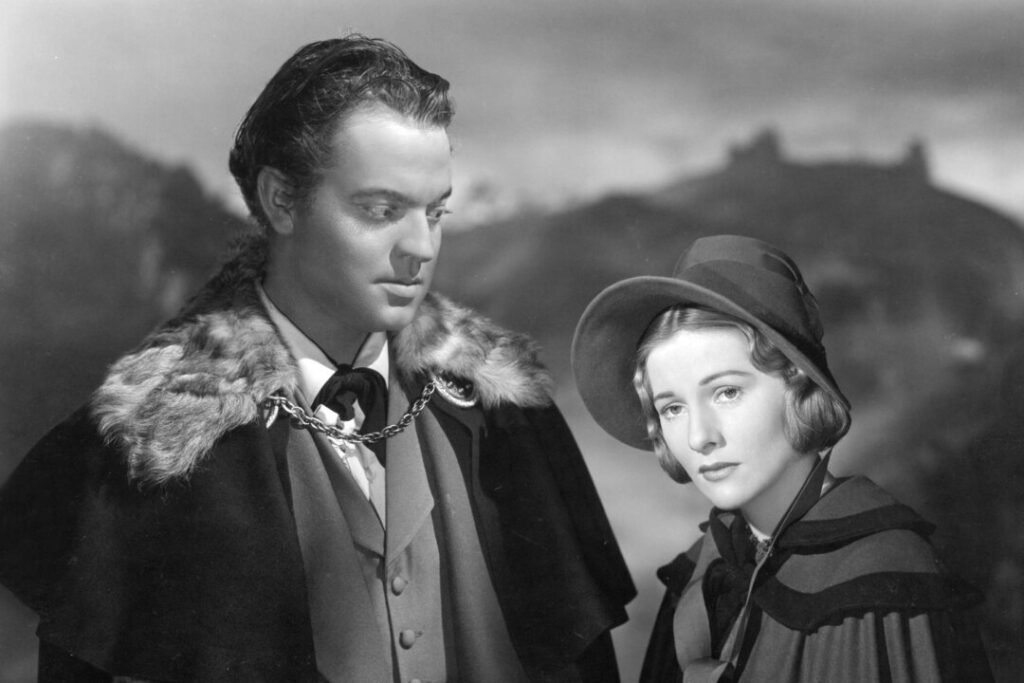
Jane Eyre (Joan Fontaine) and Edmund Rochester (Orson Welles), in “Jane Eyre.” 20th Century Fox
One idea he had from the start was to have Orson Welles play Edward Rochester, but it seemed impossible because of Welles’s contract at RKO. Ironically, when Selznick released the project to 20th Century Fox, Welles had parted ways with RKO that allowed the dream to be realized.
Welles, the eccentric boy genius who produced, directed, co-wrote, and starred in “Citizen Kane” (1941), had already made two radio adaptations of Charlotte Brontë’s 1847 novel.
Welles wanted control of the project, so he would only agree to play the role if he could be associate producer as well as star in the film. This was his third feature film appearance but the first film that wasn’t his solely funded production.
Related Stories
Although this wasn’t a Welles production, nor was it released by RKO, it reteamed several key artists from “Citizen Kane.” John Housman was Welles’s friend and collaborator in his pre-Hollywood stage and radio projects; he was also one of the screenwriters for “Jane Eyre” as well as “Citizen Kane.”

Jane Eyre (Joan Fontaine) and Mr. Brocklehurst (Henry Daniell), in “Jane Eyre.” 20th Century Fox
Bernard Herrmann, who had made his Hollywood debut in scoring Welles’s breakout film, wrote one of his best scores for “Jane Eyre.”
The cast featured Erskine Sanford and Agnes Moorehead, both Mercury Theatre players who made their film debuts in “Citizen Kane.”
A Classic Story
“Jane Eyre” is subtitled “An Autobiography,” and the book was groundbreaking because of its intimate first-person narrative style. The viewpoint is from the title character, an English orphan, who leaves her harsh aunt’s loveless home for Lowood School.
Sadly, she finds this girls’ orphanage even harsher, as her only friend, Helen, dies from the austere conditions. Once Jane reaches womanhood, she accepts a teaching position at Lowood for two years before going out into the world to become a governess at a private estate.

Dr. Rivers (John Sutton) and Jane Eyre as a child (Peggy Ann Gardner), in “Jane Eyre.” 20th Century Fox
Jane travels to Thornfield Hall, a forbidding manor in the moors, where she is to be governess to a little French girl, Adèle. Although the other servants are pleasant to her, Jane finds the whole place gloomy and steeped in mystery.
Eventually, she meets the lord of the manor, the brooding Rochester. He’s as unattractive as he’s wealthy, but Jane finds a strange kinship with him. However, the simple yet sincere young lady has rivals for his possible affection: an aristocrat who has her sights set on his wealth, not to mention someone behind a locked door.
On the Screen
The 1943 film was surprisingly faithful to the book for a film of this time. The idea that the movie is Jane’s biography is conveyed by the title character’s reading passages of the book throughout, while we see the page onscreen.
However, the supposed quotes aren’t from the book at all. They were total inventions of the screenwriters. This contrasts with the dialogue, much of which came directly from the book. For the most part, the screenplay stayed close to the book’s plot.
One of the most notable changes was the invention of the character of Dr. Rivers (John Sutton), a sympathetic ally for Jane. Scenes were also added and some events reordered.
For instance, the film has Jane leaving Lowood immediately upon becoming an adult; the novel describes her teaching for two years. Most of these changes or omissions were to streamline the movie, which couldn’t possibly contain all the events of the book in just 97 minutes.
The last segment of the film is particularly hurried, as a good deal of the novel’s plot is glossed over to wrap up the story as quickly and neatly as possible.
Joan Fontaine played Jane Eyre, and brought refinement and a tender sincerity to the title character. Peggy Ann Garner gives a very emotional performance as Jane in childhood. Her sickly but virtuous friend, Helen, is played by an uncredited Elizabeth Taylor. Agnes Moorehead plays her heartless aunt. Henry Daniell plays Lowood’s cruel director, Mr. Brocklehurst. Margaret O’Brien feigns an adorable French accent as Adèle, Jane’s ward.

(L–R) Edmund Rochester (Orson Welles), Adèle (Margaret O’Brien), and Jane Eyre (Joan Fontaine), in “Jane Eyre.” 20th Century Fox
The most memorable and discussed performance in the movie, of course, is Welles as Rochester. For those familiar with his many appearances throughout “Citizen Kane,” he looks quite different here due to the heavy makeup he wears, including a prosthetic nose to hide his turned up real one.
Rather than make him “ugly as sin,” the transformation gives him a more striking appearance. Upon the film’s original release, Welles was heavily criticized for being overly theatrical in the part. Yet the power of his deep voice and piercing eyes make this interpretation unforgettable.
While the 1943 movie took some liberties with Brontë’s masterpiece, it managed to create a captivating onscreen world, filled with mystery, stirring music, and some of the most talented actors of the day.
Whether you’re a devoted fan of the novel already or have never explored the story, this film is worth watching.