

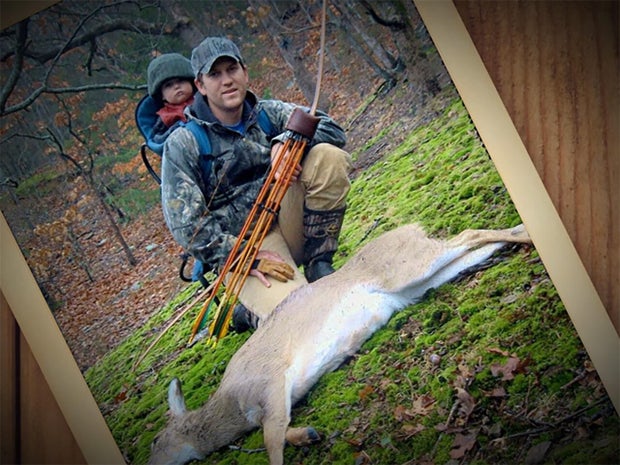
Consider this treasured family photograph as something of a national Rorschach test. What do you see? A proud, young father introducing his infant son to the joy and satisfaction of a successful hunt? Or, alternatively, something vaguely inappropriate?
Family Photo 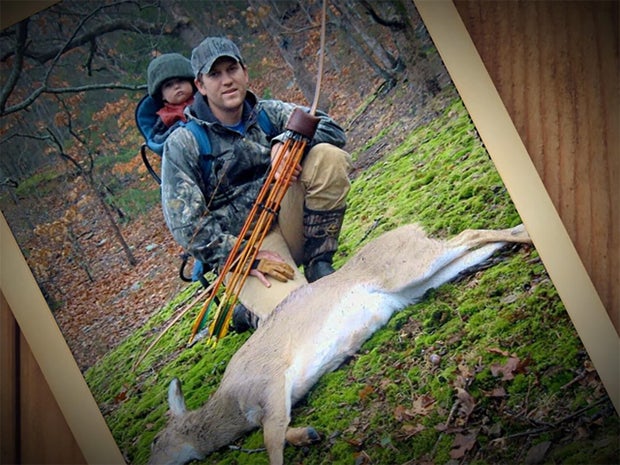
“I was just a couple of months old, and he’s over a deer that he’s shot with a traditional bow,” said Bear Newcomb.
“And I went home and got him, put him in the pack and retrieved the deer,” said his father, Clay Newcomb. “And that’s an iconic photo of us.”
Fair warning: this family you’re about to meet – their friends, that infant, now fully-grown – all come down overwhelmingly on the side of the hunters.
Clay, a lifelong hunter and historian of bear hunting in North America, said, “The tangible nature of hunting and the responsibility that comes from hunting, to be able to use a firearm, to go into the wild, the land ethic that has to be understood to be a hunter, is a really unique way to raise up a child.”
Bear Newcomb (and “Bear” is not a nickname, it’s his legal first name) is 20 now. He’s been tracking bear in the woods of Arkansas and beyond since he was 11. What he learned those first few years was an incredible degree of patience: “It’s a very low-odds hunt. So, it took me five years and then eventually I said, ‘I just need to go out there and stay for a couple of days.'”
And that’s what he did. Bear was 15.
I said, “I’ve seen the video. And when you said goodbye to your dad – and he was being a very proud father and you were a very embarrassed son at that point – by the time you came back and you had the bear, it was different.”
“I would say so, absolutely,” said Bear. “It was an accomplishment of a five-year goal. I’ve never really gotten super-emotional after killing an animal, except that one. I did tear up a little bit on that one. It was just so fulfilling.”
For the Newcombs and their friends, bear hunting in September is tradition.
High up on the mountaintop
Tell me what you see
Bear tracks, bear tracks
Looking back at me.
From “Ole Slew Foot”
CBS News 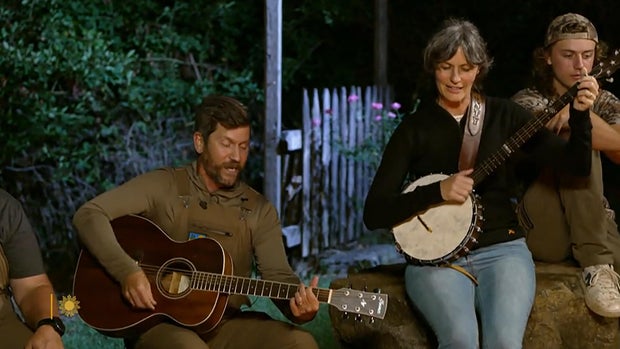
To be clear, though, while the music around the campfire was intended to pleasantly pass a little time, it was also meant to cover an awkward period of waiting. One of the visitors, Lake Pickle, an experienced bow-hunter from Mississippi, had never hunted bear before, and just a couple of hours earlier, he shot a black bear.
The arrow passed through, though, but he’s bleeding.
“A bear that’s shot well will expire very quickly, very quickly, in less than two minutes,” said Clay.
Tonight, they went in search, though it was soon clear that this bear had not been “well shot.” Good news for the bear, a bitter pill for Lake Pickle. “I think I shot him too high,” he said.
Clay said, “We believe that it really just clipped the top of his back. And it ended up being a non-mortal wound. That’s the part of hunting that we don’t like to talk about. It’s the part of hunting that we have nightmares about, because the last thing we want to do it is to shoot an animal that we don’t recover. That’s not something we’re not proud of.”
Even so, there was more than one hunter around the campfire that evening who wondered why those of us who harvest our food in a supermarket would be so concerned about the survival of a bear, Josh Spielmaker for one: “They attribute feelings towards a bear that they wouldn’t necessarily attribute to a chicken in a chicken house somewhere. And that makes them feel differently about us harvesting a bear to eat. When the fact of the matter is, it’s not Winnie the Pooh that we’re out killing.”
Bear said, “What a lot of people miss is that, like, the beef that you’re getting at the store is coming from a cow that has a terrible quality of life.”
There’s nothing casual about the Newcombs’ commitment to bear hunting. Bear Newcomb spent 60 hours fashioning his bow out of Osage orange, a wood that’s strong in tension and comprehension. He also used sturgeon skins, water buffalo horns on the tips, deer antler, moose leather from Alaska, and a seashell he picked up in Texas.
CBS News 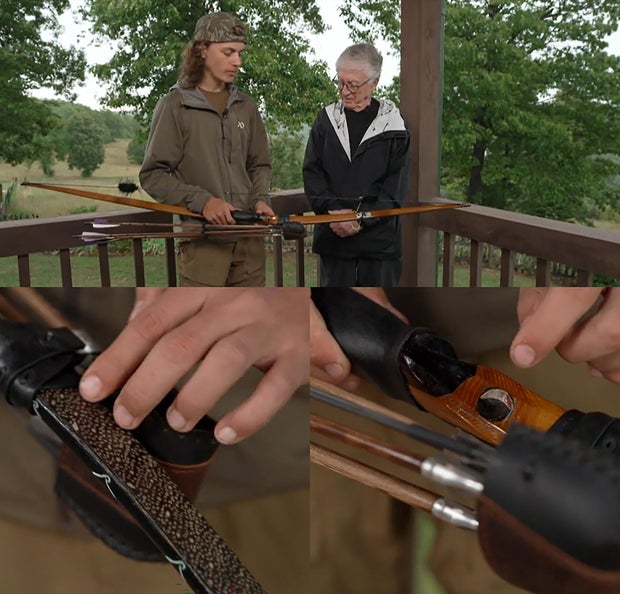
There is something deliberate about every phase of bear hunting, from crafting that bow to rendering a bear’s fat. “It renders down into some of the finest oil on Planet Earth,” said Clay. “We will use this bear grease for anything that you would use oil for.”
Strong taste? “No taste; that’s what makes it good,” Clay said. “And it was so good back on the American frontier and with indigenous people, because it didn’t go rancid as quickly as pork fat or beef fat.”
At one time, the Mississippi River was a major highway through the black bear range. In the mid-1700s, 14% of the entire exports going out of New Orleans was bear fat.
A jar of bear grease bisects into a clear olive-oil liquid, and then a thicker, opaque, lard-like substance. “Native Americans in the Southwest believe that you could forecast the weather based upon the line in the bear oil,” Clay said.
He calls bear grease a metaphor: “Things forgotten but relevant. And those are the stories that we tell.”
Unregulated market hunting – shooting bear for commerce – for the sale of meat and hide all but wiped out the black bear in Arkansas and beyond.
On his podcast “Bear Grease,” Clay Newcomb profiled what may have been the most prolific bear hunter of all time: Holt Collier, a former slave who, at one point, worked as a hunting guide for Teddy Roosevelt, who wrote that Collier killed 3,000 bears – not for sport, but to sell.
Those days are long gone. Hunting and the hunters have totally changed.
“We had a tough century in the 1800s,” Clay said. “But hunters have really been the champions of wildlife and preservation of wild places. Hunters were the people in 1954 that brought back in bears during a ten-year period, restocked bears into Arkansas.”
“It sounds counterintuitive: ‘We love the wildlife, but we get out there and we kill it,'” I said.
“And that’s why it’s a complicated story,” said Clay.
What finished off market hunting, of course, what satisfied our national appetite for fresh meat, has been the mass production of chicken, cattle and hogs. But that’s another story for another day.
To Clay Newcomb and his fellow hunters, what they do and how they do it stands up well to any comparison with the modern alternative.
To Clay, then, the last word: “To me, when I take wild game, I know exactly where that animal lived, I know what it ate, I know how it was processed. But if you eat meat that you buy from the grocery store, and you want to compare that to the ethics of me eating a bear that came out of these mountains, you’re gonna lose that argument every time. I would say it’s far more ethical, far more sustainable than confinement agriculture.”
For more info:
Story produced by Dustin Stephens. Editor: Ed Givnish.