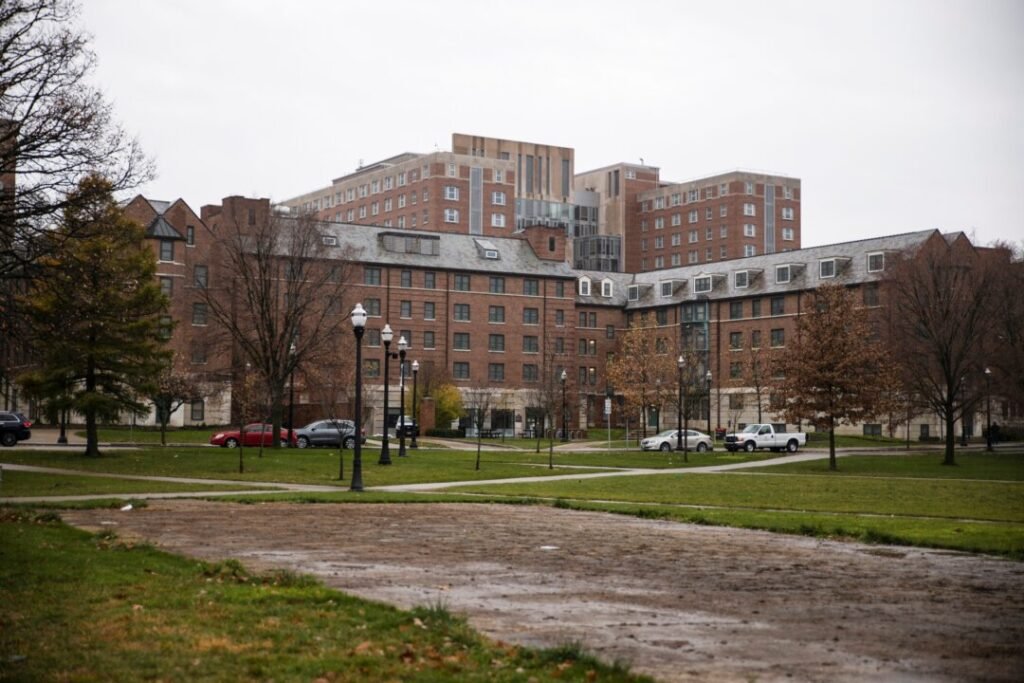
Ohio State University has agreed to pay $2.1 million to resolve federal allegations that it failed to disclose researchers’ affiliations with and support from entities in China on NASA and National Science Foundation grants.
An Aug. 31 settlement agreement identifies former Ohio State professor C.K. Shum and another member of his laboratory, Yu Zhang. The United States alleges that they had affiliations with Chinese institutions, were listed on Chinese grant applications, or received funding from China while working on NASA and NSF grants.
The government alleges that Shum held guest, adjunct, visiting, or advisory positions with Chinese universities and state-run research organizations that he reported in annual Faculty Activity Reports to his Ohio State department since at least 2014.
Ohio State denies the allegations. The agreement contains no admission of liability, and the Justice Department said there has been no determination of liability.
Shum Listed China Affiliations
Related Stories

A 2019 curriculum vitae hosted by Ohio State listed Shum as an adviser to the National Astronomical Observatories of the Chinese Academy of Sciences beginning in 1999 and as a guest professor at the Chinese Academy of Sciences’ Purple Mountain Observatory in Nanjing beginning in 2002.
It also listed him as a guest professor at Southwest Jiaotong University beginning in 2006, the Chinese Academy of Sciences’ Institute of Geodesy and Geophysics beginning in 2012, and Hohai University in Nanjing beginning in 2016.
A 2018 Chinese Academy of Sciences document listed Shum with both its Institute of Geodesy and Geophysics and Ohio State.
Ohio State Revised Disclosure Process in 2019
Ohio State says it revised its research disclosure process in 2019 to require disclosure of external relationships related to foreign talent programs.
The settlement does not state why Ohio State did not notify NASA and NSF until 2023.
Ohio State’s current rules require approval and disclosure for foreign talent recruitment programs and bar federally funded researchers from participating in malign foreign talent recruitment programs.
The settlement also cites NASA’s statutory restriction on using agency funds for certain bilateral collaboration with China or Chinese-owned companies.
Settlement Leaves Other Liability Open
The $2.1 million payment is designated as restitution. Ohio State had already repaid $254,661 in January 2024, including $215,369 toward the grants covered by the settlement. The agreement requires payment of the remaining $1,884,631.
The settlement resolves civil monetary claims against Ohio State under common-law theories including fraud, breach of contract, payment by mistake, and unjust enrichment.
It does not resolve False Claims Act liability, criminal liability, certain administrative remedies, or liability of individuals, including Shum.
The NASA and NSF grants at issue funded Ohio State research from November 2012 through August 2023.
The settlement refers to an “Attachment A” listing the covered grants, but the attachment is not included in the nine-page document posted by DOJ.
NASA Office of Inspector General Senior Official Robert Steinau also referred to an “accompanying compliance agreement,” which DOJ did not link with the settlement.
Under the agreement, Ohio State must cooperate with federal investigations of individuals and entities not released by the settlement, including by providing nonprivileged records and making personnel available for interviews or testimony.