

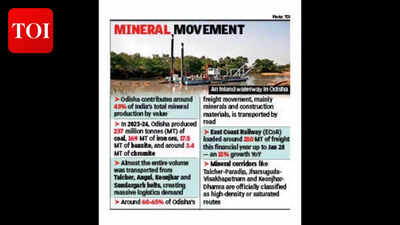
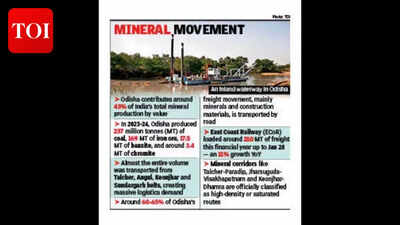
Bhubaneswar: The Union Budget proposal to operationalise 20 new national waterways over the next five years, beginning with NW-5 in Odisha, is expected to ease the movement of minerals from mines to ports and reduce pressure on road networks.By linking mineral-rich Talcher and Angul belts and industrial hubs such as Kalinga Nagar with Paradip and Dhamra ports, the proposed waterway is expected to lower logistics costs, strengthen bulk cargo supply chains, and decongest highways.
NW-5, covering the Mahanadi-Brahmani delta, the Matai river, and the east coast canal, was notified in Nov 2008 with a total length of about 588 km. A detailed project report later split the route into three stretches: Talcher to Mangalgadi (237 km), Dhamra to Paradip (95 km), and Dhamra to Geonkhali (256 km).An Inland Waterways Authority of India (IWAI) document said feasibility studies and the DPR submitted in 2016 led to a decision to initially develop 332 km of “economically and commercially viable” stretches between Paradip/Dhamra and Talcher in two phases, while the Dhamra-Geonkhali stretch was not feasible for development.In 2023, the then state govt said work on both phases of NW-5 on the Mahanadi was in progress, with development work for the first phase underway and preliminary work for the second initiated.Under the National Waterways Act, two waterways are planned on the Mahanadi — NW-5 and NW-64. NW-5’s first phase spans 201 km, connecting Jokadia and Pankapal (Kalinganagar) to Dhamra and Paradip via Mangalgadi. The second phase covers 131 km, linking Jokadia/Pankapal to the coal-rich Talcher region. The NW-64 is planned to connect Sambalpur with Paradip.Although NW-5 had an earlier completion target of 2017, the project did not take off. The Budget announcement has renewed expectations of faster implementation in Odisha.In her Budget speech, Union finance minister Nirmala Sitharaman said national waterways will be operationalised to promote environmentally sustainable cargo movement. She also announced that training institutes will be upgraded as regional centres of excellence to build manpower for the sector.R K Panda, former professor and head of the School of Infrastructure at IIT Bhubaneswar, said roads are already overcrowded and expansion alone will not meet future freight demand. He said inland waterways can reduce pressure on road and rail networks and help cut accidents.Transport expert Dilip Kumar Samantray said inland water transport is cheaper than road and rail and will be critical as Odisha’s coal and iron ore sectors expand. He said waterways can reduce accidents, air pollution and transport costs, and called for a mission-mode development.Samantray said the Centre’s proposed coastal cargo promotion scheme, aimed at incentivising a shift from road and rail and raising the share of inland waterways and coastal shipping from 6% to 12% by 2047, could support the transition.