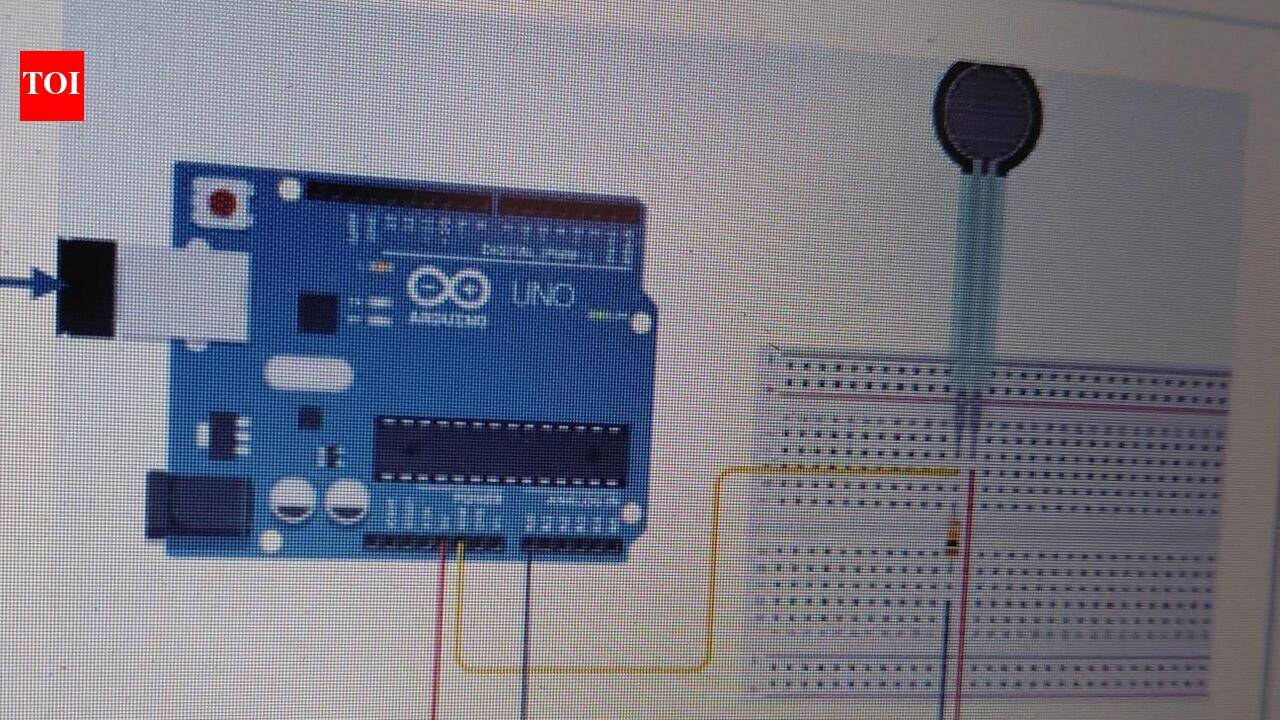
Kanpur/Lucknow: Just a tap of the fingers, and the orchestra follows. For musicians, keeping the rhythm going could soon be as simple as a few well-timed finger taps. IIT-Kanpur researchers have developed a sensor-based Smart Virtual Orchestra that can read a musician’s gestures and instantly generate matching percussion accompaniment in real time. So, even when an entire orchestra isn’t at hand, a musician’s fingers can call the beat into action.When the musician taps his fingers at a defined tempo or rhythm, the sensors pick up the input, and the system instantly adjusts the speed and structure of the accompaniment. The system has been developed by Vipul Arora of the department of electrical engineering and researcher Himanshu Jindal. It has also received a patent.Talking to TOI, Arora said, “Singers are often accompanied by percussionists, who follow the rhythmic structure set out by the singers. This work presents a smart accompaniment that emulates a human percussionist. A mathematical framework that uses finite-state transducers and linear time-invariant filters is presented to model percussion sound generation and control in real time. The framework is capable of generating creative improvisations. Fine control of tempo is achieved by estimating the singer’s tempo through tapping, which is a natural action of singers synchronised with their singing rhythm.”“We have developed a low-cost and portable sensor setup on which a singer can tap to communicate the tempo. Experiments show better efficacy of the proposed system in tracking the singer’s tempo, in terms of accuracy and latency, compared with several baselines. Experiments have been conducted for a set tempo as well as transitioning tempo,” he said.The two fundamental components of music are melody (or harmony) and rhythm. While computers are increasingly used for music composition, pedagogy and performance, comparatively less work has focused on rhythm generation. Musicians are often accompanied by percussionists, but such accompaniment is not always available during solo practice or performances. Digital percussion generators are commonly used, but most operate at a fixed tempo and stroke pattern. This is limiting for singers who improvise, particularly in Indian music, where the percussionist follows the singer and also improvises, he added.The work develops a percussion accompaniment generator that allows singers to control and synchronise its tempo in real time. It combines a mathematical framework based on finite-state transducers with sensors that track natural gestures, such as tapping. The framework can accommodate different percussion instruments and rhythm patterns.The system also offers cruise control for maintaining a constant tempo. It is portable, lightweight and made with inexpensive components, making it suitable for new and experienced singers while providing a platform for further research into percussion generation.