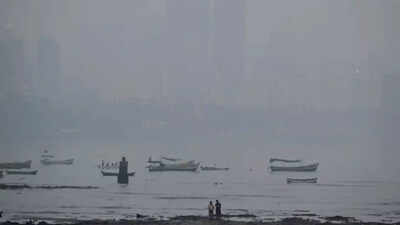
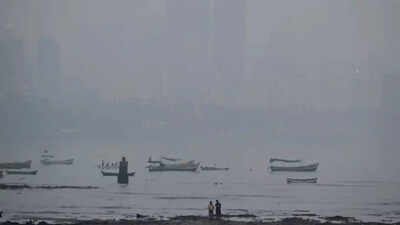
MUMBAI: A thick, stubborn layer of smog blanketed large swathes of the city on Thursday and Friday, triggering a sharp deterioration in air quality levels within a single day. The Air Quality Index (AQI) rose to 127 from 94 recorded on Wednesday, officially placing the city in the “moderate” category but raising serious alarms due to the sudden spike. The haze, which usually dissipates by late morning, persisted well into the afternoon, severely reducing visibility and sparking health concerns among residents.The sudden drop in visibility turned the morning rush hour into a challenge for commuters, particularly on major arterial roads. Yash Tiwary, who travels daily by app bike from Borivli to Mira Road for work, described the atmosphere as “unusually grim”. He noted that the visibility on the road was so poor he initially mistook the heavy smog for an impending rainstorm, adding that the haze made navigating through the morning traffic far more hazardous than usual.While the city-wide average remained in the moderate range, localized monitors near the airport and redevelopment sites in Andheri (East) recorded “severe” spikes. An AQI monitor installed within the airport premises recorded a staggering reading of 300 at 8.30 am on Thursday. Nearby, another monitor located within a residential society undergoing redevelopment displayed an AQI of 260 on Friday morning, highlighting the hyper-local impact of construction activities.Experts point to a worrying trend where the city’s changing skyline is physically blocking the natural wind. Nivit Yadav, programme director at the Centre for Environment and Science, noted that dense smog is a relatively new phenomenon for coastal Mumbai and requires study. He explained that while sea breeze usually clears pollutants, the extensive construction of tall skyscrapers along the coast has disturbed natural wind flows, creating a barrier that prevents pollutants from escaping.This “skyscraper wall” effect was further aggravated by weather conditions. Wind speeds recorded on Thursday were just 11.1 kmph — nearly half of Wednesday’s 22.2 kmph — limiting the dispersion of pollutants. Additionally, the minimum temperature recorded at Santacruz was 22°C, which was 4.9 degrees warmer than normal, creating a stagnant atmospheric “lid” that trapped dust and smoke closer to the ground.Locals in Sahar village and Chakala reported that dust from nearby infrastructure work has become unbearable. Sabina D’Souza said the air has become so difficult to breathe that many are suffering from chronic coughs, forcing citizens to wear masks just to walk on the road.