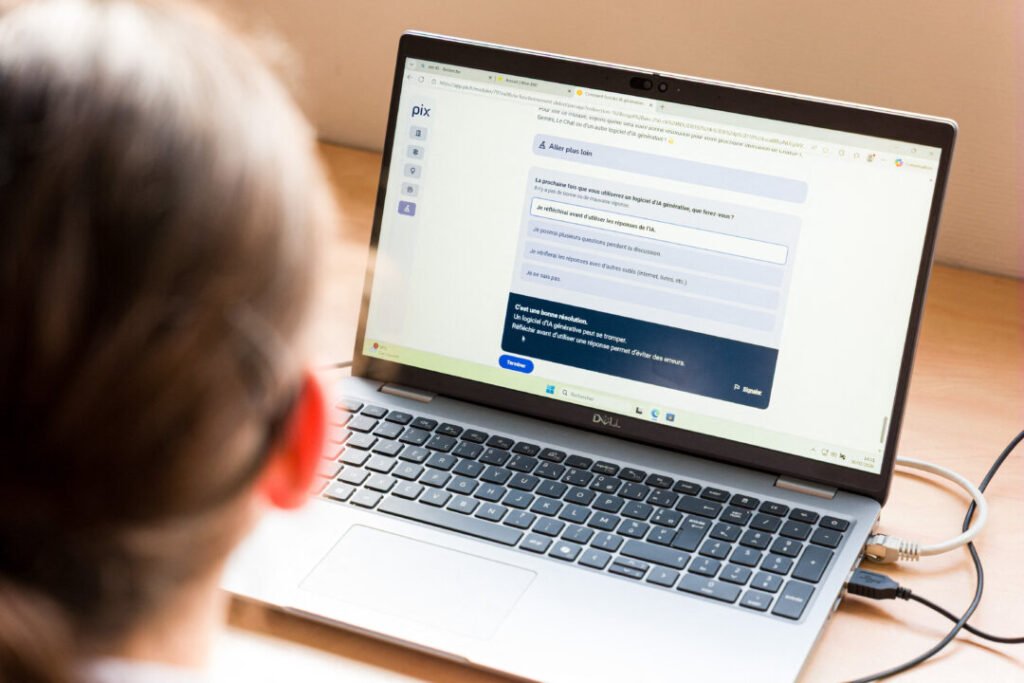

A student uses a Dell laptop on the pix platform showing a question about using a logiciel de IA generative in Saint-Jean-de-la-Ruelle, Loiret, France, on Jan. 30, 2026. Romain Gautier/Hans Lucas/AFP via Getty Images
The New South Wales (NSW) Labor government has moved to limit take-home assessment tasks to 15 percent of school-based marks in a bid to combat the impact of AI on learning.
Under the current system, half of the student’s High School Certificate (HSC) comes from school-based assessment.
Schools decide how much of that component is completed at home versus in class.
From 2027, schools across the state will be capped at one take-home task worth no more than 15 percent of the school-based assessment mark. This equates to 7.5 percent of a student’s total HSC result.
The cap applies to the Year 12 class of 2027, which begins HSC studies in Term 4, 2026, as well as students starting Year 11 in Term 1, 2027.
Acting NSW Premier and Education Minister Prue Car said school communities were concerned about the “tide of AI technology” impacting classrooms, warning that it was undermining learning, thinking, creativity, and hard work.
Related Stories


“The message this sends to schools and communities more broadly is that we are committed to protecting the teaching and learning happening in schools.”
A Moral Obligation to Restrict AI
NSW Education Standards Authority CEO Paul Martin said generative AI may offer students a “short-cut” to complex schoolwork. However, he noted that it bypassed opportunities to build knowledge and develop learning skills.
“It is not an overstatement to say the consequences of that could be severe over time,” he said.
“We have a moral obligation to the students and teachers of NSW to protect the learning process, the integrity of assessments, and to maintain confidence in the HSC credential.”
The US Approach to AI in Schools
The United States is also addressing the use of artificial intelligence in classrooms. In August, the U.S. Department of Education issued guidance urging states to weigh the instructional value of classroom technology against its potential for distraction, rather than restricting specific tools or types of assignments for students.
Assistant Secretary Kirsten Baesler said instructional technology should be “judged by their impact on learning, not simply whether they happen on a screen.”
“The Trump Administration hopes that as states ground their decisions in evidence and educational value, technology is a meaningful tool to improve student outcomes.”