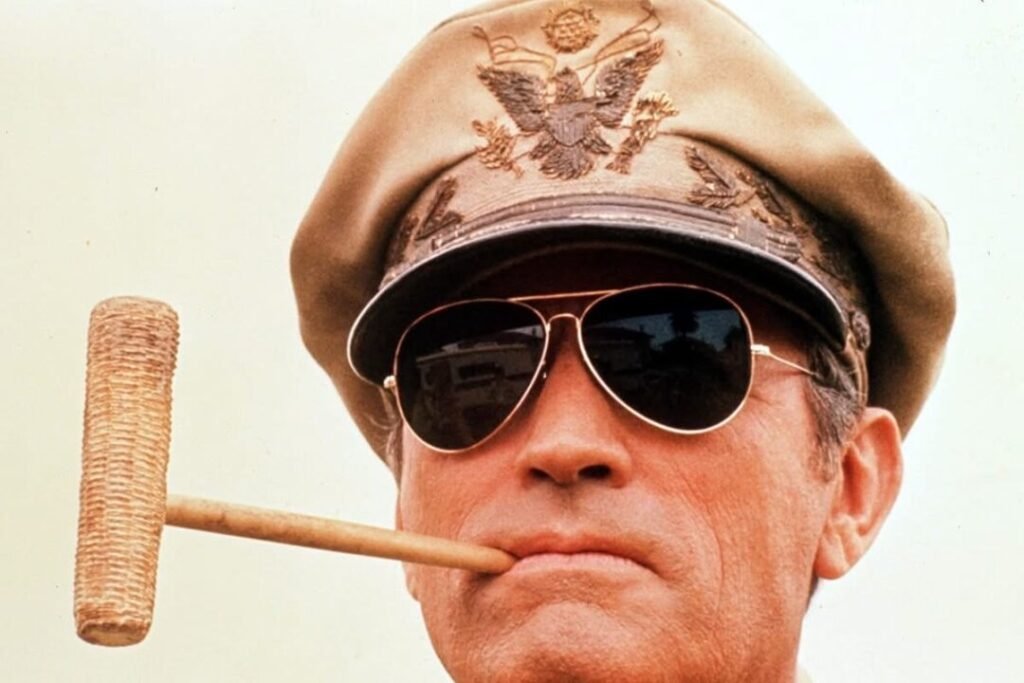
The biopic “MacArthur” depicts a leader who, over five decades straddling two world wars, led soldiers in battle on four continents.

Gen. Douglas MacArthur (Gregory Peck, L) shakes hands with President Franklin D. Roosevelt (Dan O’Herlihy), in “MacArthur.” Universal Pictures
He leads Allied acceptance of Japan’s surrender, then shapes the socio-political and cultural aftermath in Japan. His devoted wife Jean (Marj Dusay) accompanies him throughout, thrilled that he’s been awarded a Medal of Honor.
When belligerent North Korea invades South Korea, MacArthur is again the sharp edge of America’s rebuke, except he is now under the direction of President Harry Truman (Ed Flanders).
No Warmonger
It’s fashionable to imagine generals as warmongers; MacArthur here is anything but. As he presides over the Japanese surrender, his words bear not a whiff of triumphalism. He reminds friend and foe that they have learned from both victory and defeat.
He insists, “We must … preserve in peace what we have won in war.” War itself? He calls it a “scourge.”
Related Stories
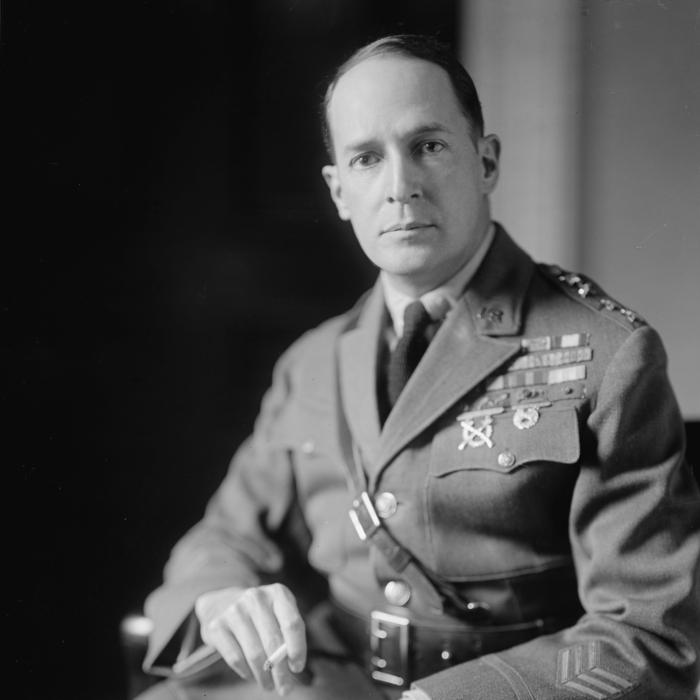
But MacArthur is no pacifist. Bringing his career to a close, he clarifies that war is indisputably about victory, not appeasement. Why? Appeasement merely provokes newer, bloodier conflict.

Gen. MacArthur (Gregory Peck, C) in a strategy session, in “MacArthur.” Universal Pictures
Like blackmail, it triggers newer, increasingly bolder demands until, as in blackmail, violence becomes “the only” alternative. That’s the reality. If states are forced to use their power to restrain erring citizens, won’t they do the same to restrain other erring states?
MacArthur reminds wide-eyed West Point cadets that three hallowed words—duty, honor and country—shape what they ought to, can, and will be. They instill in men a temperament of “courage over timidity, an appetite for adventure over love of ease.” Looking them in the eye he explains, that’s how those words will “teach you to be an officer and a gentleman.”
Self-doubt plagued him, as it did other leaders. His Inchon strategy was considered daring; only he and a few others knew that it was also dangerous. Here, he confides to a colleague how, for all his bravado before fawning snappers and scribblers, he secretly worries that he might shamefacedly lose an entire fleet in those fraught waters.
That’s leadership. Not denying doubt, but dealing with it, through a smarter strategy. Not to have a plan for every occasion, but to at least to have a vision that’ll allow space for a plan to form.
As he drives through the rubble in Japan, his peers believe nothing is left of the nation to salvage. MacArthur, however, dares to imagine rebuilding a new nation with “new ideas but preserving the best of the old.”
He warns that he’ll judge his troops not only as soldiers but also as men. The vanquished Japanese must be treated with courtesy and respect. He deals with failure, too. When his ambitious run for the presidency backfires spectacularly, he shrugs it off.
Foe of Communism
MacArthur here hates communism, perhaps because he perceives its vacuous center more clearly than others do. He’s soft on South Korea, the Philippines, and Japan and hard on China, the Soviet Union, and North Korea.

Gen. Douglas MacArthur (Gregory Peck), in “MacArthur.” Universal Pictures
The White House sees him as a maverick and loose cannon. They think his contempt for communism might undo the niceties underpinning international relations. Champing at the bit when he’s denied the tactical elbow room he seeks, he laments, “It is my destiny to defeat communism, and only God or those Washington politicians will keep me from doing it.”
Style without substance is disastrous, especially in a leader. MacArthur had both. If he hadn’t had his A-2 leather bomber-jacket, corncob pipe, and trademark sunglasses, he’d still be MacArthur. He’d get the job done, when others balked.
What irritated critics wasn’t his fondness for flourish; it was his hunger for headlines. That made his every move seem monumental. Without that eagerness to exaggerate, his aura may have never dimmed.
Great leaders aren’t perfect. They’re human. It is in their ever-frail humanity that one catches glimpses of perfection; thankfully, in the likes of MacArthur, America and the world caught more than a glimpse.
Check the Internet Movie Database website for plot summary, cast, reviews, and ratings. You can watch “MacArthur” on Apple TV and Prime Video.
These reflective articles may interest parents, caretakers, or educators of young adults, seeking great movies to watch together or recommend. They’re about films that, when viewed thoughtfully, nudge young people to be better versions of themselves.