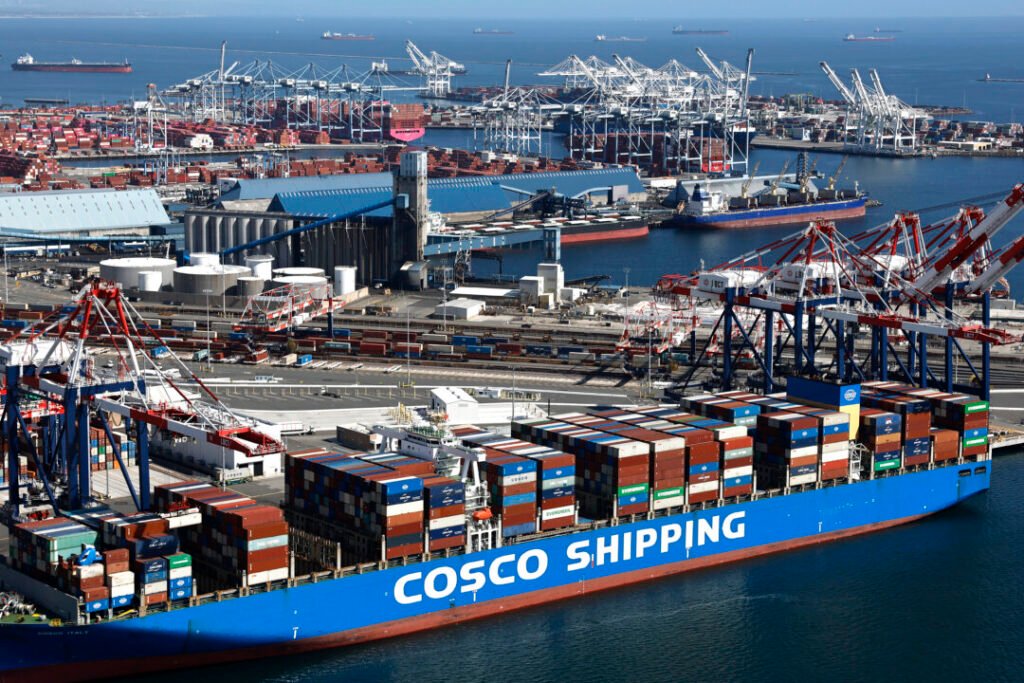

A Cosco Shipping container ship, China’s largest shipping line, in the Port of Long Beach, Calif., on April 3, 2025. Mario Tama/Getty Images
Three House committee chairmen are urging the Department of Homeland Security (DHS) to end reduced Coast Guard inspections for vessels operated by Chinese state-owned shipping giant COSCO, citing its ties to China’s military and allegations of espionage near U.S. coastlines.
In an Oct. 14 letter, Reps. John Moolenaar (R-Mich.), Rick Crawford (R-Ark.), and Carlos Gimenez (R-Fla.) asked DHS Secretary Markwayne Mullin to remove COSCO vessels from the Coast Guard’s Qualship 21 program.
The program rewards foreign commercial ships with strong safety and compliance records by allowing them to undergo fewer routine inspections at U.S. ports. Enrollment does not exempt ships from security checks or other law enforcement inspections.
The lawmakers questioned why ships operated by a company the Pentagon has designated as a Chinese military company should continue receiving those benefits.
They urged DHS to revoke COSCO vessels’ enrollment, refuse renewals, and increase scrutiny of other shipping companies operating on behalf of China’s People’s Liberation Army (PLA).
COSCO’s Military Ties and Inspection Benefits
Related Stories


The Pentagon placed COSCO on its list of Chinese military companies in January 2025.
A June 2026 Pentagon document identified COSCO as controlled by the Chinese regime and acting on behalf of the PLA. It also cited the company’s ties to China’s defense industry and participation in Beijing’s military-civil fusion program, which uses civilian industries and technologies to support military development.
According to the congressional letter, at least 10 COSCO vessels were enrolled in Qualship 21 as of July 15. Six had certificates scheduled to expire in August 2026, while four had certificates extending into August 2027.
The Coast Guard updated its program rules in January, adding grounds for removing vessels involving certain criminal investigations and sanctions-related connections. The agency publicly announced the changes in May.
The published guidance summary does not expressly list the Pentagon’s Chinese military-company designation as an automatic reason for exclusion.
Lawmakers Seek Greater Security Scrutiny
The lawmakers also asked whether the Coast Guard received intelligence about potential security risks involving COSCO before allegations of espionage became public in September.
They want to know whether that information was considered when COSCO vessels were allowed to remain in Qualship 21 and whether the Pentagon’s designation prompted a review.
The letter also calls for greater scrutiny of COSCO vessels, including additional boardings, investigations of possible intelligence-related activity by crew members, and reviews of ship movements near U.S. coastlines and territories.
In September, Reuters reported allegations, citing two unnamed U.S. officials, that COSCO vessels carried concealed equipment used to intercept military communications near U.S. and allied coastlines.
The Coast Guard told The Epoch Times at the time that it does not comment on intelligence matters.
Contacted again on Oct. 15 about COSCO’s current enrollment, eligibility criteria, and the congressional request, the agency had not provided a substantive response by publication time.
The lawmakers also asked whether the Coast Guard has sufficient legal authority to counter suspected surveillance by COSCO vessels in U.S. waters, and whether additional coordination with other federal agencies is needed to investigate such activities.