In a flat in Lucknow, a woman who has been fasting since sunrise checks the clock for the tenth time in an hour. Twenty minutes to midnight. Her mother-in-law folds a tiny silk dhoti no bigger than a handkerchief, and the smell of dhaniya panjiri, a coriander-seed-and-ghee sweet made only for this one night, drifts in from the kitchen. Her son, seven and under strict instructions to stay awake, is losing the fight against his own eyelids on the sofa. Nobody here would call this a religious deadline. They would call it waiting for someone to be born.That waiting is the real subject of Janmashtami, the festival marking the birth of Krishna, the eighth avatar of Vishnu, whom Hindus revere as a complete manifestation of the divine. The date splits calendars this year: Smarta households mark it on 4 September, while the Vaishnava tradition and ISKCON temples observe it on 5 September. But the mechanics of the night itself are identical wherever you stand. Here are the five that carry it.
The bath that comes before the first cry
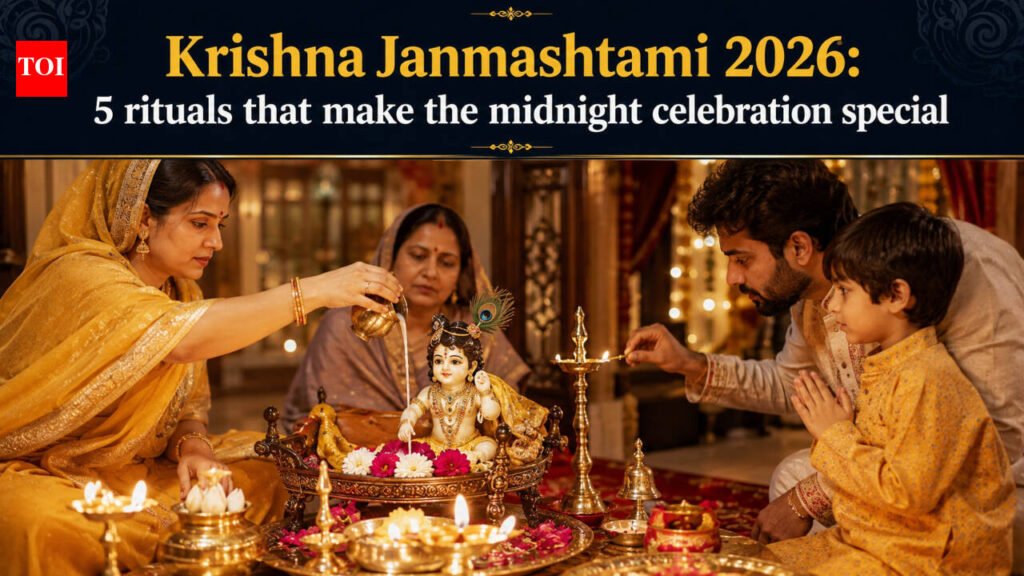
During Nishita Kaal, the deep midnight hour treated as the moment of birth, the murti, the small consecrated image of infant Krishna, is undressed and bathed in panchamrit, the five nectars: milk for purity, curd for prosperity, honey for sweetness of speech, ghee for strength, and sugar for joy.Each ingredient is poured over the image in turn while someone chants Krishna’s names. Plain water then rinses the mixture off before the murti is dried and dressed. It is a rehearsal of the first thing Yashoda, the woman who raised him, is believed to have done for him.
Why the sound arrives before the sight
The instant midnight strikes, before the curtain lifts on the decorated cradle, a conch is blown and bells are rung, in homes as much as in the great temples of Mathura and Dwarka.At Udupi’s Krishna Matha in coastal Karnataka and at Guruvayur in Kerala, where the deity is worshipped as Guruvayurappan, the same midnight aarti unfolds before gathered crowds, with temple bells layered over drums instead of a household’s single conch. Devotees light lamps and call out Krishna’s names into the noise.There is a reason the sound comes first. A birth is announced, not witnessed quietly, and the shankh’s low note carries the news outward the way a newborn’s cry would, calling everyone in the room to attention before their eyes have even adjusted to the light.
Every hand in the house takes the cradle
Once bathed, dressed, and offered makhan mishri, butter and rock sugar, the very food he is famous for stealing, the murti is laid in a jhula, a small decorated cradle, and rocked.Many homes rock it exactly twenty-one times to a lullaby, and every person present, from grandparent to toddler, takes a turn at the cord. It is closeness, not ceremonial politeness. Devotees believe a wish made while rocking that cradle stands a better chance of being heard, and in Vrindavan and Mathura temples, the same scene plays out on a larger scale, with priests rocking silver cradles before crowds who have waited hours for a glimpse.
The morning nobody outside Braj celebrates
Ask someone outside north India what Nandotsav is, and you will mostly get a blank look, which is a shame, because in the Braj region, the cluster of towns around Mathura and Vrindavan where Krishna is believed to have spent his childhood, it may be the warmer festival.It falls the morning after and re-enacts the moment Nanda, the man who raised him as a son, learned of the birth and simply could not contain himself. Temples in Gokul and Vrindavan fill with singing and dancing, sweets are pressed into every hand that passes, and there is none of midnight’s hush left in it.Where Janmashtami is anticipation held tight, Nandotsav is that same feeling let loose in daylight.
A pot, a pyramid, and a story about getting caught
It would be dishonest to call dahi handi a nationwide midnight ritual. It is neither observed at midnight nor observed everywhere. It belongs, in its loud modern form, to Maharashtra and Gujarat, particularly Mumbai, Thane, Pune, and Ahmedabad, and happens the following morning, not in the dark hours of the birth itself.Teams called Govinda pathaks build human pyramids to reach a clay pot of curd and butter hung high above a street, competing for prize money that runs into crores in Mumbai’s biggest mandals.The pot re-enacts makhan chori, Krishna’s boyhood habit of raiding neighbours’ butter pots with his friends, a mischief Hindus recall fondly rather than as anything to correct. The organised version only dates to 1907, a village event near Navi Mumbai that grew into today’s spectacle. It is regional custom layered onto scripture, not scripture itself.Back in that Lucknow flat, the clock turns. The conch sounds, thin against the traffic outside, and the boy jerks awake just in time to watch his grandmother’s hands cup panchamrit over a murti smaller than his own fist.He will not remember, years from now, the exact minute of Ashtami tithi or which sampradaya his family follows. He will remember the sound arriving in the dark, and being allowed, for once, to stay up and hear it.