In Bundelkhand, where water scarcity has traditionally been one of the biggest constraints on agriculture and rural livelihoods, Jhansi is emerging as a testing ground for a new approach to water management—one that combines conservation, scientific storage, solar energy, micro-irrigation and modern farming practices.At the centre of this transformation is the India-Israel Bundelkhand Water Project, being advanced by the Yogi Adityanath government with the objective of demonstrating how every available drop can be conserved and used more efficiently. The project’s mini pilot at Gangawali village in Baragaon development block is being implemented at a cost of around Rs 19.1 crore and is designed to create a replicable model for the water-stressed Bundelkhand region.
Jhansi becomes the laboratory for a new water model
The significance of Gangawali lies beyond the village itself. The project seeks to address one of Bundelkhand’s most persistent challenges: limited water availability coupled with the need to sustain agricultural production.Rather than treating irrigation, water conservation and farming as separate activities, the Jhansi model brings them together into a single integrated system. Water storage, canal-fed reservoirs, solar-powered pumping, micro-irrigation, modern agricultural infrastructure and farmer training are being developed as interconnected components.The objective is straightforward but transformative—produce more with less water while improving the productivity of the water that is available.The model is particularly relevant for Bundelkhand, where erratic rainfall, prolonged dry periods and limited irrigation resources have historically placed pressure on agriculture. By demonstrating technologies under local conditions, the project aims to provide farmers with practical solutions rather than merely theoretical recommendations.
Infrastructure taking shape at Gangawali
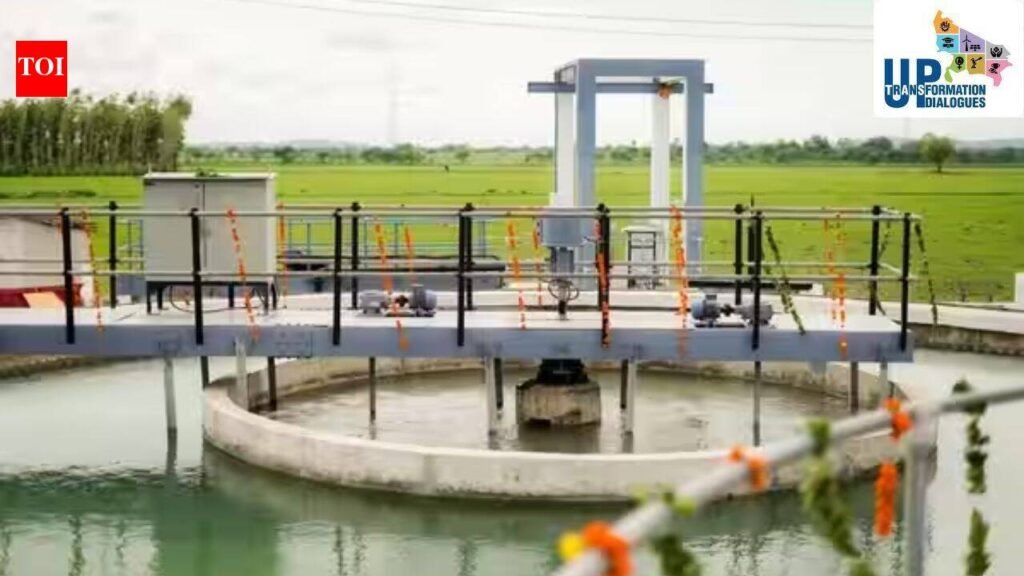
The progress at Gangawali has already become visible on the ground. Demarcation and fencing of the reservoir area have been completed, while earthwork and geomembrane lining of the reservoir have also been finished.A major feature of the project is the system designed to bring water from the canal into the reservoir. The intake pipe and intake well have been constructed, while a solar pump has also been installed. This integration of solar energy with irrigation infrastructure is expected to reduce dependence on conventional energy sources while making water pumping more sustainable.PUF panel-based buildings have been completed and CCTV arrangements have been installed. A natural sewage treatment plant, or natural STP, has also been constructed to ensure that wastewater generated in the village does not flow untreated into the reservoir. The road is also under construction around the reservoir.Together, these interventions reflect a shift from fragmented water infrastructure towards an integrated water-management system in which storage, treatment, pumping and irrigation efficiency are planned as parts of the same chain.
Saving water begins on the farm
The most important test of the project, however, will take place beyond the reservoir. Under the mini pilot, modern agricultural practices are proposed across approximately 8.5 hectares.The next phase will introduce drip and sprinkler-based micro-irrigation, along with greenhouses, tunnels, pipelines and an irrigation automation-SCADA system.These technologies are intended to demonstrate a basic but critical principle: crops should receive water according to their actual requirements rather than through conventional methods that can result in excessive use. Drip irrigation can deliver water directly to the crop root zone, while sprinkler systems can improve the uniformity of irrigation. Automation can further enable irrigation operations to be managed scientifically.The project will assess the impact of these interventions on water consumption, irrigation efficiency, crop production, costs and overall water productivity. Such data can provide an evidence base for determining which technologies are most suitable for wider adoption in Bundelkhand.
From water management to farmer empowerment
The Yogi government’s approach places equal emphasis on infrastructure and knowledge. Farmers are not expected merely to use the new facilities; they are being brought into the process of understanding how and why these technologies work.A programme of 72 practical training sessions has been proposed, with around 100 farmers participating in each session. Training will cover water budgeting, fertigation, crop planning, irrigation operations and the use of agricultural machinery.Water budgeting is particularly significant in a region where availability is limited. Farmers can use information on available water to decide which crops can be cultivated, over what area and with what irrigation requirements. This approach has the potential to connect cropping decisions directly with water availability. Instead of asking only how much land can be cultivated, the focus shifts towards a more sustainable question: how much can be cultivated with the water that is actually available?
Gangawali model to reach 24 more villages
The larger ambition of the project is to take the lessons of Gangawali beyond the pilot site. Preparations are underway for a detailed demonstration project covering 24 other villages downstream of the Pahuj Canal in Baragaon development block. The idea is to use the experience generated at Gangawali to identify technologies and practices that can be replicated in other villages.This makes Jhansi particularly important in the broader Bundelkhand water strategy. The district is not merely receiving a water-management project; it is becoming a field laboratory where an integrated model can be tested, evaluated and subsequently scaled up.If successful, the model could demonstrate how canal water, reservoirs, solar pumping, treated wastewater, precision irrigation and scientific farming can collectively improve agricultural resilience in water-stressed areas.Technology meets Bundelkhand’s ground realitiesThe India-Israel partnership also brings an important technological dimension to the initiative. But the emphasis of the project is not technology for its own sake. Its success will depend on adapting modern systems to the actual conditions of Bundelkhand.That is why the pilot approach is important. Technologies such as automated irrigation, fertigation, greenhouses and micro-irrigation can first be assessed under local soil, climate, cropping and water conditions. The resulting experience can then guide larger investments.The model also reflects a broader change in the Yogi government’s development strategy: water conservation is being linked directly with economic productivity and farmers’ incomes.
A roadmap for water-secure Bundelkhand
The current construction and implementation phase is likely to be completed by the end of this year. Thereafter, the project is proposed to continue with operation and maintenance activities until June 2029, while the expanded demonstration and farmer-training programme is proposed to run from October 2026 to May 2029.For Jhansi and Bundelkhand, the importance of the initiative extends well beyond the physical infrastructure being created at Gangawali. Its real measure of success will be whether farmers can achieve higher agricultural productivity while consuming less water, and whether the lessons can be transferred successfully to other villages.The Yogi government’s modern water-management model therefore represents a move from simply managing water scarcity to building water security through technology, conservation and community participation.In a region where every drop matters, Jhansi is showing how the future of agriculture may depend not merely on finding more water, but on learning to use the water already available with far greater precision. If the Gangawali experiment delivers the intended results, it could become a blueprint for a more resilient, technology-driven and water-efficient Bundelkhand.