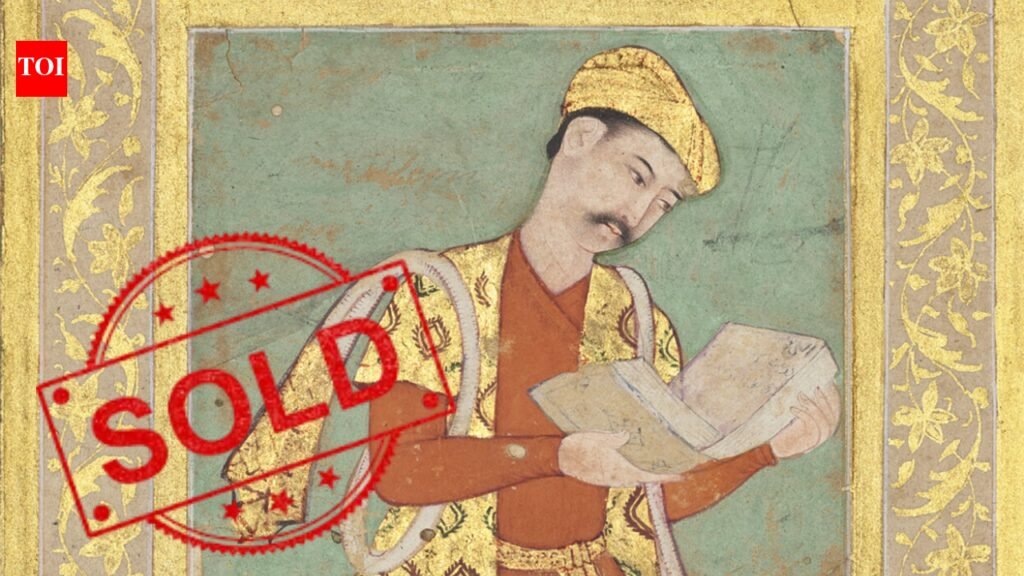
A Mughal-era album page featuring a portrait of a courtier holding a book and calligraphy signed in 1608-09 has sold for £571,500 at an auction in London. The page, created more than four centuries ago, had entered the collection of a British baron by 1937 and later passed through several auctions before becoming the leading lot in a sale of Indian paintings and calligraphy in April 2026. According to the official website of British auction house Christie’s, the painting is attributed to Manohar, a Mughal artist active in the early 17th century, while the calligraphy on the reverse is signed by Abdullah al-Husayni and dated AH 1017, corresponding to 1608-09. The work was offered with an estimate of £80,000 to £120,000 and ultimately sold for £571,500, nearly 4.8 times its highest estimate.The sale took place on April 28, 2026, as part of The Mary and Cheney Cowles Collection of Indian Paintings and Calligraphy. According to Christie’s results announcement, the collection achieved a total of £5,278,882, equivalent to about $7.1 million, and all 84 lots sold.
A small portrait surrounded by detailed decoration
The central painting depicts a courtier holding a book. Christie’s attributes it to Manohar, whose name appears in the lower-left corner of the painting. The image measures just 10.4 by 5.4 cm, while the complete album page measures 38.9 by 25.2 cm. The painting uses opaque pigments heightened with gold on paper. It is surrounded by gold-illuminated inner borders, with decorative margins showing mammals and waterfowl in a landscape of flowers and streams, rendered in gold and multiple colours.The calligraphy adds another layer of detail. One border contains eight couplets, or bayts, written in nasta’liq script against a gold-illuminated background. The reverse carries 11 lines of black nasta’liq script set diagonally, along with two additional lines arranged vertically to the left. Blue and buff borders, flowers and stylised clouds complete the decoration. According to official website of Christie’s, the text on the reverse includes verses from a ghazal by the Persian poet Hafez. The signature reads: “katabahu ‘abdullah al-husayni ghafara dhunubahu 1017,” which Christie’s translated as “‘Abdullah al-Husayni, may [God] forgive his sins, wrote it. 1017 (1608-9).” The date therefore comes from the calligrapher’s inscription rather than from a separate signature on the portrait itself.
Who was Abdullah al-Husayni?
The name Abdullah al-Husayni appears on other calligraphic works associated with Mughal albums. According to Christie’s, the same name is found on two other pages sold in the 1973 Sotheby’s auction of the Brabourne-Ardeshir album. One of those pages is now held by the Rietberg Museum in Zurich. The name also appears on a folio in the Dara Shikoh album, dated AH 1018, or 1609-10, just a year after the inscription on the page sold in 2026.As per Christie’s, Abdullah al-Husayni contributed calligraphic panels to a royal album from the reign of Akbar, which sold at Sotheby’s in London in October 2020. These links place the signed page within a wider tradition of Mughal album-making, in which paintings and carefully executed literary passages were brought together in decorated folios.
The portrait may once have faced another Mughal painting
Christie’s believes the page was originally paired with another album page depicting a prince reading from a scroll. That work was almost certainly lot 18 in the 1973 Sotheby’s sale of the Brabourne-Ardeshir album, according to the auction house. The two pages share a similar arrangement of nasta’liq verses and illuminated borders. The earlier catalogue described the margins of the other page as featuring birds and deer in colourful landscapes with gold, a design comparable to the flowers, streams and animals surrounding the portrait sold in 2026.Christie’s notes that matching borders were typical of Mughal albums of this kind, where related paintings could be arranged as a pair. The courtier portrait’s attribution to Manohar also fits the artist’s known practice of producing single-figure studies against pale blue backgrounds.
From a British baron’s collection to the auction room
The page’s documented ownership history begins with Michael Knatchbull, the 5th Baron Brabourne, who owned it by September 2, 1937. By 1939, it had entered the collection of A.C. Ardeshir in England. It was later offered at Sotheby’s in London on July 10, 1973, as lot 12, and then at Christie’s in London on October 16, 1980, as lot 62. The work appeared on the UK art market again in 2019 before joining the Mary and Cheney Cowles collection.The 2026 auction was part of the sale of the Indian paintings and calligraphy collection assembled by Mary and Cheney Cowles, collectors based in Seattle. According to Christie’s press release, the sale attracted registrants from 21 countries, and 14% of bidders were new to the auction house.
The highest-selling work in the collection
The courtier portrait and signed calligraphy became the sale’s top lot, selling for £571,500 against its estimate of £80,000 to £120,000. As per Christie’s, the bidding was “fiercely competitive”. The entire collection sold for £5.28 million, more than three times its pre-sale estimate, according to the auction house’s official website.