
What is the world’s most popular musical instrument? Guitar? Drums? Violin? Nope. In spite of its high price tag and formidable size and weight, it’s the piano.
A modern piano has 52 white keys and 36 black ones, for a total of 88. It’s built from about 12,000 parts, of which 10,000 are moving parts. An instrument of such technical complexity wasn’t born in a day. Its roots go back to ancient stringed instruments like the harp and the lyre, which appear in Egyptian and Mesopotamian art as early as 3,000 B.C.

An ancient Egyptian vertical harp is an early example of using strings to make music. Public Domain
A Long Gestation
The psaltery, often mentioned in the Bible, probably consisted of metal or gut strings strung across a wooden box that added volume and resonance. It was strummed or plucked.
“Take a psalm, and bring hither the timbrel, the pleasant harp with the psaltery.” (Psalm 81:2)
The psaltery was likely used in worship and ceremonies, and to accompany psalms, since there are at least eight mentions of it in the Book of Psalms.
The Middle Ages saw the birth of the harpsichord, which became the leading keyboard instrument in Europe, right up into the 18th century. It looks like a small piano. Pressing a key causes a device to pluck a string, producing a sound loud enough to carry in a ballroom or a small theater.
Related Stories
The harpsichord’s limitation was its lack of expressiveness. No matter how hard or softly you pressed a key, the plucked sound was the same.
Organs had keyboards, too, but no strings. They have been standard in churches from the 10th century to the present.
The great Johann Sebastian Bach was more famous during his lifetime as an organist than as a composer, but his favorite instrument was the clavichord. This was a wooden box with strings and a keyboard, often so compact it could be placed on a table. Small metal blades struck the strings, allowing a musician to play a little louder or softer, and even add some vibrato.

The clavichord marked a major step toward the modern piano, but its sound was too quiet to be appreciated anywhere larger than a drawing room.
Around 1700, an Italian craftsman, Bartolomeo Cristofori, built an instrument with strings struck by felt-covered hammers. This allowed players to control volume and expression like never before. Cristofori’s innovations got little attention until other builders experimented and refined his device. Soon, this new instrument was challenging the supremacy of the harpsichord across Europe.
The next big advance in the mid-18th century was the fortepiano. Its name means “loud-soft” in Italian. Here finally, was an instrument where a note’s volume was controlled by how hard one pressed the key. The fortepiano featured a wooden case, thin strings, and a bigger keyboard, expanded to 60 notes. The composers Haydn and Mozart wrote for this instrument, as did Beethoven in his youth.
According to music educator Melissa Mauro, “Composers increasingly embraced the fortepiano because it offered expressive possibilities unavailable on earlier instruments. Mozart’s piano concertos, in particular, reveal how beautifully the fortepiano could sing, sparkle, and respond to touch.”

This 1868 painting by Moritz von Schwind depicts composer Franz Schubert playing piano for friends. This is how music brought people together in the 1800s. Public Domain
In the early 19th century, Beethoven led the march away from the graceful elegance of 18th-century music—the kind that lords and ladies danced their minuets to. The music of what we now call the Romantic era was more powerful and emotional, with big contrasts of volume and tone.
Builders set to work creating bigger, more muscular and responsive instruments, with keyboards expanded to 88 keys, to handle the demands of this new music by Beethoven, Chopin, and Franz Liszt. This was the birth of the modern piano.
Piano.org calls a piano’s mechanism “one of the most intricate machines ever built. [… It] turns the small downward push of your finger into a felt hammer striking a steel string at exactly the right moment, with exactly the right speed, and then catches the hammer cleanly.”
About 230 strings are located in a piano’s case, each with its own tuning pin. Each key is connected to a wooden hammer. Treble hammers (the right side of the keyboard) strike three identically-tuned strings to play high notes. Bass hammers (left side of the keyboard) strike strings wrapped with copper wire, to give extra heft to low notes.
In German, a grand piano is called a Flügel, which means wing. It is indeed shaped like a wing. With the keyboard on one end, the other end curves in from the left, since the strings get shorter as the notes get higher.
This is where uprights come in. An upright piano is usually less expensive and takes up less space by turning the case on its end.
The strings of any piano are strung very tight, under as much as 180 pounds of pressure. A major advance in piano design was replacing the wooden case frame with a cast iron plate to prevent the tension of the strings from pulling the instrument to pieces.
On top of the iron plate lies a wooden board that amplifies the sound from the strings. This sound board is ideally fashioned from Sitka spruce, an evergreen tree that grows along the northwest coast of the United States. Its wood is light, flexible, and strong enough to do the job.

It’s hard to imagine now, but for thousands of years, to hear music, you had to play it yourself or have someone else play it.
By 1900, just in America, hundreds of companies were producing pianos, bringing prices down, making them affordable for middle-class families. At this time, over half of all pianos sold worldwide were made in America. Some of the great 19th-century firms are still around today: Steinway & Sons, Baldwin, Bechstein, and Mason & Hamlin.
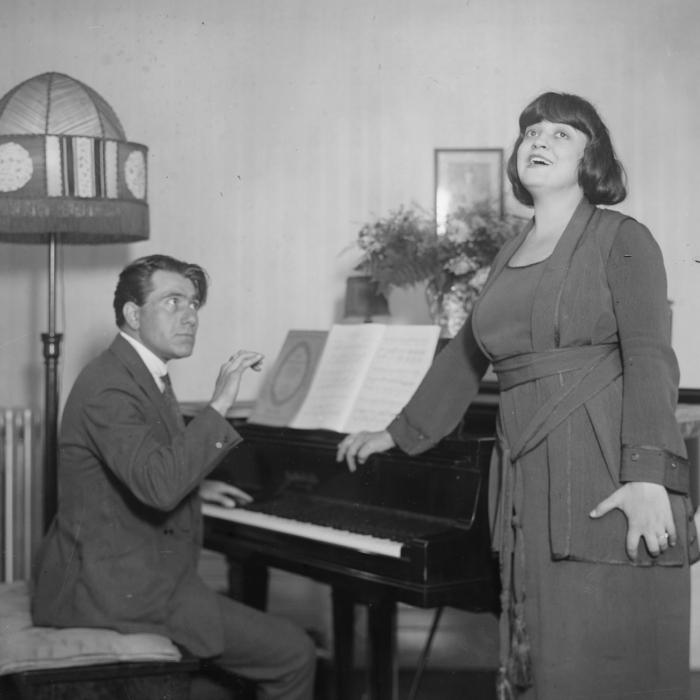
By the dawn of the 20th century, no middle-class parlor was complete without an upright piano. It was a status symbol that brought a wide variety of music into the home. A daughter could play Mozart or the latest popular songs. She could accompany her mother’s singing or her brother sawing on a violin.
Americans went crazy for pianos. In 1923, they bought 350,000 of them in a single year. By this time, companies from Germany to Japan were manufacturing them, but handcrafted American pianos led the way.
Professor Kenneth Miller writes: “The United States has a long history of high-quality piano manufacturing. American brands have produced some of the finest musical instruments ever made for centuries. […] From the prestige of Steinway to the boutique craftsmanship of Mason & Hamlin, most American-made pianos are works of art and incredible instruments.”
Early in the last century, piano sales took a hit with the introduction of radio and records. Now families didn’t have to play instruments. They could just turn a dial.
Americans still buy a lot of pianos every year, but only a third as many as in 1923. Most of those old parlor uprights now gather dust in basements and second-hand stores, or end up in landfills. They’re broken-down, damaged, often no longer playable, but decades ago, each one brought joy and music into an American home.