

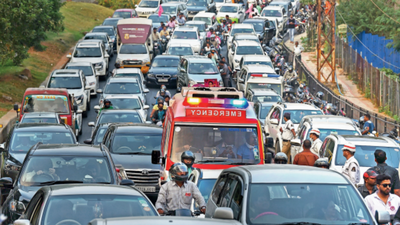
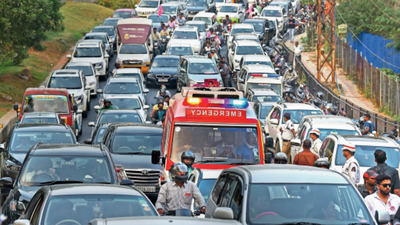
HYDERABAD: In trauma care, the first 60 minutes — the ‘golden hour’ — can mean the difference between life and death. But on Hyderabad’s choked roads, that critical window is increasingly being eaten up by traffic snarls, stalled signals and unyielding motorists, resulting in even emergency vehicles being held up in traffic jams.“We waste nearly 20 minutes in traffic during every trip,” said M Krishna, an ambulance driver from Amberpet. “There is massive congestion in Afzalgunj, Abids, near NIMS, and at Lakdikapul Metro station. We struggle to cross signals because motorists fear they might get challaned if they move ahead to give way,” Krishna rued.That 20 minutes could one day prove to be the difference between a life saved and a life lost in traffic, warn doctors, urging stakeholders to ensure top priority for ambulances carrying live organs or critical patients.
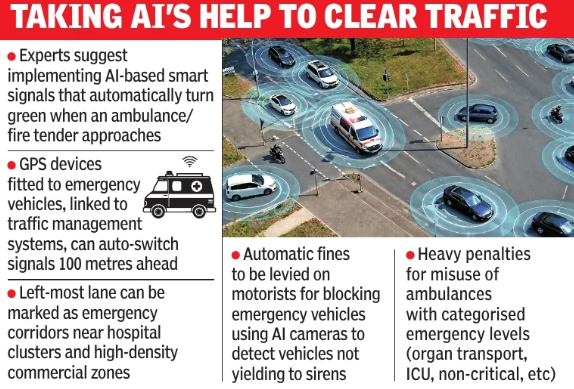
Emergency cases prioritised: CopsWith nearly 6,000 ambulances operating amid over one crore vehicles across Hyderabad, traffic police say it is practically impossible to monitor the movement of every ambulance on the road at all times. Officials, however, clarified that top priority is given when hospitals alert the traffic control room in advance. In such cases, green corridors are created and junctions cleared in real time to ensure swift passage.Motorists fail to yield wayFrom Madhapur and Gachibowli in the IT corridor to busy stretches in Mehdipatnam, Dilsukhnagar and Secunderabad, motorists frequently fail to give way to siren-blaring ambulances, significantly delaying critical response times. Fire department officials echo similar concerns, pointing out that several residential pockets and commercial areas lack adequate access roads, while indiscriminate parking on both sides of the streets leaves little room for large fire tenders to pass.A recent study conducted jointly by IIT Hyderabad and TCS over a two-week period assessed the city’s traffic patterns, infrastructure gaps and their impact on emergency vehicles. Field observations were carried out at major congestion hotspots including Hi-Tec City junction, Masab Tank–Virinchi Hospital stretch, Jubilee Hills Check Post, KBR National Park Junction and Mehdipatnam. The study also collected feedback through Google Forms circulated among three key stakeholders — daily commuters, emergency responders and traffic engineers/urban planners.The key findings include ambulances taking between 2.7 to 6.5 minutes to cross a single traffic signal, depending on traffic intensity and time of day. Drivers were often reluctant or unsure about how to yield to emergency vehicles and traffic signals failed to prioritise ambulances, forcing them to wait through regular signal cycles. Despite sirens, many motorists hesitated or blocked lanes either due to confusion or lack of physical space.
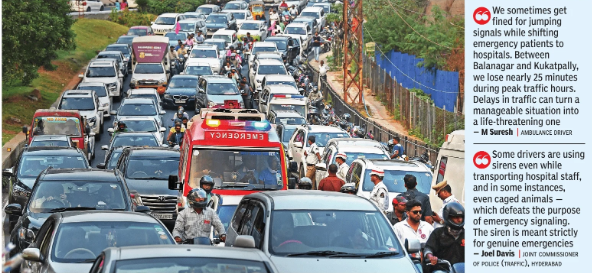
Ambulance drivers share woesAmbulance drivers say the ground reality is far worse than numbers suggest.At Chaderghat signal alone, ambulances lose eight to ten minutes during peak hours, says ambulance driver, M Suresh. “Emergency responders often face the added burden of penalties even while trying to save lives. We sometimes get fined for jumping signals while shifting emergency patients to hospitals. Between Balanagar and Kukatpally, we lose nearly 25 minutes during peak traffic hours,” he said.Suresh said many emergencies do not initially receive priority clearance. “Not every case looks critical at first. But delays in traffic can turn a manageable situation into a life-threatening one. By the time we reach the hospital, the patient’s condition may have worsened,” he added.
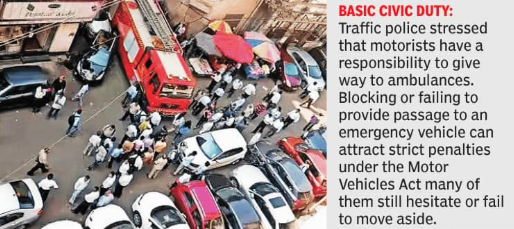
Fire tenders struggle in trafficFire officials point out that in several colonies, especially older parts of the ciwty, roads are too narrow for fire tenders to manoeuvre. In high-density commercial areas, encroachments and roadside parking further restrict movement.Officials say that even when traffic police create green corridors, the lack of cooperation from motorists often defeats the purpose. “Though traffic police provide green channels at junctions, people do not move aside to give us space. That hampers our speed and delays our arrival at the destination,” said P Dattu, station fire officer. He said the Nanal Nagar–Tolichowki stretch was one of the most problematic. “That stretch is heavily congested throughout the day. Even when traffic police intervene manually to clear the way, commuters hardly obey. Many refuse to reverse or adjust their vehicles. We end up stuck in the middle,” he rued.How global cities are handling emergency servicesSingaporeAll emergency calls (995) in this city are routed to a central command centre. GPS-enabled ambulances are dispatched automatically based on a combination of factors with an average dispatch time of <;60s. Motorists must immediately give way to siren vehicles as there would be heavy fines. Drivers are trained during licensing on how to respond to emergency vehicles.BerlinGermany’s capital combines fire services, ambulance services, and technical rescue under one central command centre. Ambulance must reach the patient within 8 minutes in 80% of life-threatening cases. Drivers failing to yield for emergency vehicles are fined up to €320 ( ?34,000) and two penalty points on driving licence and possible licence suspension.ParisFor critical cases, Paris deploys an ambulance, equipped like a mini ICU with a doctor, nurse & paramedic. Advanced cardiac and trauma care can begin on-site. French traffic law requires motorists to yield immediately to siren vehicles failing which a fine up to €135 ( ?14,400) along with penalty points on license would be imposed. One key advantage in Paris is ambulances can legally use bus lanes.TokyoAmbulance services in Tokyo are operated by the Tokyo Fire Department under 119. Tokyo handles over 800,000 ambulance calls annually, one of the highest in the world. Ambulance stations are located close to residential clusters and are strategically distributed to reduce response radius. Japanese motorists are trained to immediately pull to the left and avoid blocking intersections. Tokyo ambulances use electronic sirens, loudspeaker announcements saying ‘Emergency vehicle approaching. Please give way’.