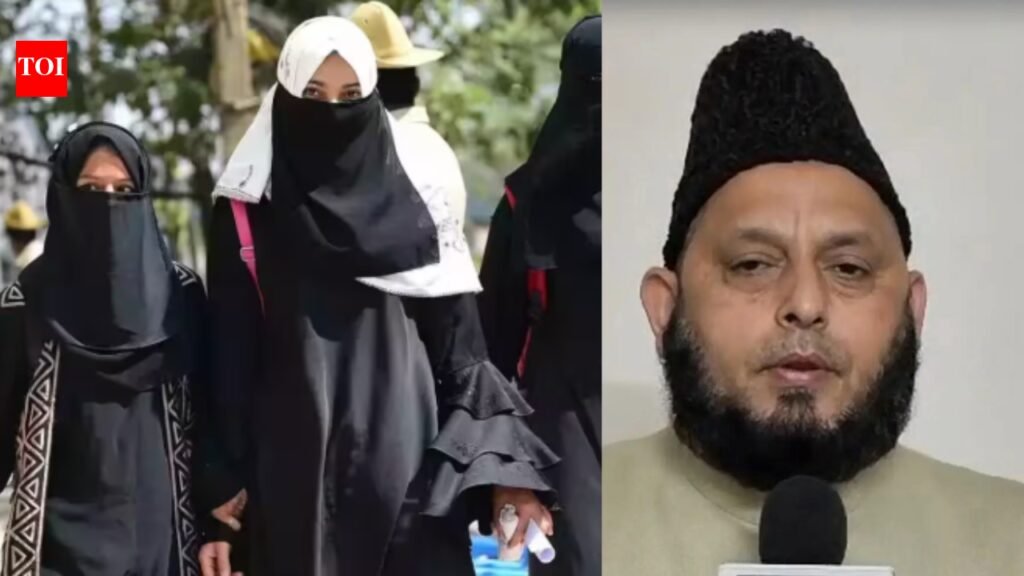
LUCKNOW: Muslim clerics on Tuesday criticised the Allahabad High Court’s decision to dismiss a petition by a minor student seeking permission to wear a hijab with the prescribed school uniform, insisting that the headscarf is an integral part of Islam and should be allowed alongside the dress code.The court had rejected the student’s plea after observing that she had failed to produce religious scriptures or other material establishing that wearing a scarf was an “essential” part of her faith.It also noted that photographs showed other students from the same religious community attending the school without scarves.Islamic Centre of India chairman Maulana Khalid Rasheed said hijab was an integral part of Islam and that Muslim girls should be permitted to wear it in schools while following the prescribed uniform, ANI reported.“Hijab is an integral part of Islam, and there is no confusion about it. Allah himself gave the order for pardah in the Quran. So, saying Hijab is not an integral part of Islam is not correct. School uniforms should be worn by all students; however, girls should be allowed to wear Hijab, just as children from other religions wear items of religious significance when attending school. I don’t think hijab is against any rules and regulations; moreover, it fosters modesty.”Shia religious leader Saif Abbas also questioned the reasoning that hijab could not be considered integral to Islam merely because some Muslim women do not wear it.“We are not opposing school uniforms; the dress code should be followed. But if a student is asking permission to wear the Hijab, she should be allowed to do so as per the Constitution. Quran asks women to wear the Hijab, and it is an integral part of Islam. If some women don’t wear Hijab, it cannot be said that Hijab isn’t a part of Islam. A large percentage of women wear Hijab. The counsel in the court, I believe, could not make it clear that Hijab is integral to Islam. The matter should be taken to the Supreme Court,” Abbas said.The Allahabad High Court, meanwhile, held that where a dress code is uniform, framed in good faith, non-discriminatory and intended to maintain discipline and institutional identity, deciding the uniform primarily falls within the school’s jurisdiction.The court also said that the fact that the student had worn a scarf in earlier classes without objection did not create a permanent or enforceable right to compel the school to alter its uniform policy.A division bench comprising Justice JJ Munir and Justice Indrajit Shukla observed that the school was not restricting the student’s freedom of faith but was enforcing institutional discipline, of which the uniform was an essential component.The petitioner had passed Class 10 from the same school and sought admission to Class 11. She claimed that she had been wearing a scarf over her school uniform since Class 6 without facing any objection.However, when she sought admission to Class 11, the school management told her that wearing a scarf violated its dress code and refused admission on that ground.(With agency inputs)