

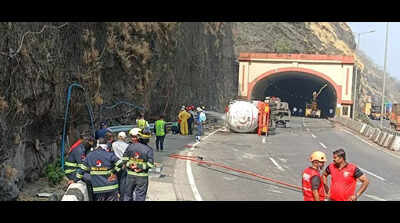
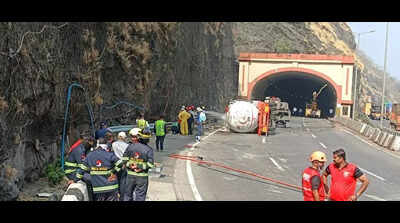
Pune: The toppled propylene gas tanker on the Pune-Mumbai Expressway on Tuesday evening, which disrupted traffic for several hours stretching till Wednesday night, exposed serious gaps in Maharashtra’s preparedness to handle hazardous material emergencies, disaster management experts warned.Propylene, a highly flammable hydrocarbon gas widely used in petrochemical and plastic manufacturing, presents unique and severe operational challenges when a tanker carrying it turns on its side.
Unlike conventional fuel spills that can often be contained using standard firefighting protocols, a propylene leak can escalate rapidly into a catastrophic explosion, making rescue, containment and recovery operations extremely complex.According to experts, the most critical challenge during such incidents is the absence of specialised hazardous materials (HazMat) response teams trained and equipped to deal with pressurised gas tankers. Propylene is transported in a liquefied form under high pressure, and when a tanker topples, even a minor crack in the valve or shell can trigger a rapid release of gas.Major General P K Shrivastava (retired), a chemical, biological, radiological and nuclear (CBRN) expert, said the incident should serve as a wake-up call for the state govt. “Maharashtra urgently needs dedicated HazMat units along major highways such as the Pune-Mumbai Expressway to ensure a quick and professional response to chemical transport accidents,” he told TOI.Bhalchandra Chavan, director of the state disaster management department, admitted that they currently lack the technical expertise required to handle such hazardous material emergencies.“We acknowledge that we do not have the specialised capability to operate and manage such incidents. We will look into this seriously and take necessary corrective measures in the coming days. Our personnel will also be trained in coordination with other specialised agencies,” Chavan told TOI.Shrivastava stressed the need for regular drills involving chemical tankers, improved coordination between transport companies and emergency services, and specialised training for local fire brigade personnel.“Local fire teams are often the first responders, but without proper training and equipment, their task becomes extremely risky. Only sustained preparedness can prevent such situations from turning into major disasters,” he said.Experts warned that unless the govt acts swiftly to establish dedicated HazMat response units, upgrade training, and enforce stricter safety protocols for chemical transporters, similar incidents could have far more serious consequences in the future.The leaked gas forms an invisible vapour cloud that can travel swiftly and ignite with a single spark from vehicle engines, mobile phones, electrical equipment, or even static electricity, they said.“The gas spreads silently and quickly. You don’t see flames, but you are standing inside a potential fireball,” said a senior industrial safety consultant who handled multiple chemical emergencies across the country.Experts also said the movement of chemical tankers on Maharashtra’s highways is extremely high due to the state’s dense industrial belt, yet specialised response infrastructure does not keep pace with this reality.“We transport hazardous chemicals daily through populated corridors, but we are still reacting to incidents in an ad hoc manner,” said another disaster management professional.This invisibility makes it extremely difficult for untrained responders to assess the real danger zone.Experts pointed out that standard firefighting measures such as water sprays or foam are ineffective in stopping the leak itself and, in some cases, can even worsen the situation by dispersing the vapour cloud over a wider area.As a precaution, authorities were forced to halt traffic on one of the busiest highways in the state for hours, leading to massive congestion and inconvenience to commuters. However, experts cautioned that traffic disruption was the least dangerous consequence of such incidents.They warned that unless the govt acts swiftly to establish dedicated HazMat response units, upgrade training, and enforce stricter safety protocols for chemical transporters, similar incidents could have far more serious consequences in the future. “The question is not if such an accident will happen again, but when and whether we will be ready,” an expert said.