

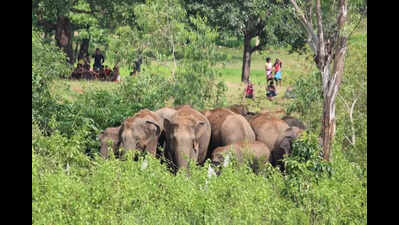
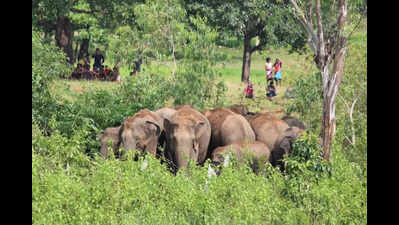
Bhubaneswar: The state govt wrote to the ministry of forest, environment and climate change, disputing the elephant number counted by the Wildlife Institute of India (WII) at 912 in Odisha’s habitat.The number is far less than the state’s own census, conducted in Nov 2024, which put the figure at 2,103. The govt disputed the DNA sampling method that was done through dung analysis, the letter written in Nov revealed.“In 2017, there were 1,976 elephants in Odisha habitat. In the summer census in 2024, the count was 2,098, and in November it rose to 2,103, as counted by the wildlife wing. Unlike tigers, which are elusive and solitary animals, mega herbivores like elephants are easily visible, and hence the direct sighting method was used to count them for accurate results in the most cost-effective manner. But the DNA method is more complex and involves high cost. Therefore, we request the WII to re-look at the census, including the methodology used,” the govt letter to MoEFCC revealed.The letter said the state expressed strong reservations regarding the elephant count that put the number at 912. “We request a team of scientists or experts or observers may be deputed from WII for a reassessment of the elephant census,” the letter further said.The May 2024 census that reported the presence of 2,098 elephants included 313 adult tuskers, 13 adult ‘makhna’, 748 adult females, 148 sub-adult males, 282 sub-adult females, 209 juveniles, and 385 calves. In 2017, there were 299 calves; this year there were 86 more calves. Broadly, there were 474 males, 1,030 females, and 594 adults.“There was a significant increase in elephant numbers in Angul, Athgarh, Dhenkanal, Baripada, Chandaka, Khurda, Bonai, and Keonjhar divisions. The dung method used by WII is not accurate. I discussed with the MoEFCC regarding a re-look at the census. Significant change in the movement pattern of elephants was noticed in Angul, Rourkela, and Baripada circle,” said Prem Kumar Jha, principal chief conservator of forests, Wildlife.Biswajit Mohanty from the Wildlife Society of Odisha (WSO), a private organisation working for wildlife conservation, said, quoting their own observation, that though the results of this new (DNA) methodology are not comparable to past results, Odisha recorded a sharp population decline of nearly 1,100 elephants, or 57%, in 1 year. “Elephant movement in corridors is severely affected as they are degraded by quarrying and development. The forest department did not notify 14 identified corridors, though a decision was taken by govt in 2012. Though the National Green Tribunal issued final orders for notification of 14 corridors, the state govt challenged this and obtained a stay order from the high court,” Mohanty observed.