


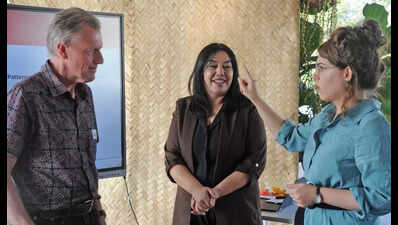
Bengaluru: As the city continues to attract global talent in technology/manufacturing sectors and startups, the challenge of integrating expatriates into India’s business, regulatory and cultural ecosystem is becoming increasingly visible. Aiming to address this gap, the Expat Business Council’s 2026 Strategy Summit brought together more than 50 expatriates and foreign nationals in Indiranagar Saturday to discuss what it truly takes to live, work and do business in India.Participants from countries including Singapore, Poland, Luxembourg, Germany and Sweden, shared experiences of navigating India’s complex trade environment, cultural differences and regulatory systems. The discussions ranged from market entry barriers and govt processes to workplace culture and communication styles. Anna Kuhnt, a German citizen and founder-president of Expat Business Council, spoke about the importance of cultural acceptance and adaptability for foreign nationals living in India. She highlighted that beyond business challenges, everyday processes such as visas, immigration, legal compliance, financing, banking, market entry and logistics often prove daunting. “Getting a trade licence or even setting up an office is not easy for a foreigner — either in India or vice versa,” Kuhnt told TOI. An interactive session followed, where participants were given yellow and orange cards and asked to engage with those holding the opposite colour to discuss individual challenges. One recurring issue was the lack of clarity in govt communication. “Trade licences and methods of working with govt agencies are challenging because there is often no clarity on processes, and communication becomes a challenge,” said Annette Morheng from Luxembourg. Several attendees also spoke about cultural nuances, particularly communication styles. While a direct “no” typically means rejection in many Western countries, in India it often carries contextual meanings and can change depending on the situation, they pointed out. The session concluded with Lars Johansson, an automotive expert, who spoke on the theme, “Moving from a Scandinavian automotive OEM tradition to an Indian startup OEM.” Drawing from his experience, he highlighted stark contrasts in work culture. “In Sweden and much of Scandinavia, work-life balance is taken very seriously, while in India it is often secondary,” he maintained.