

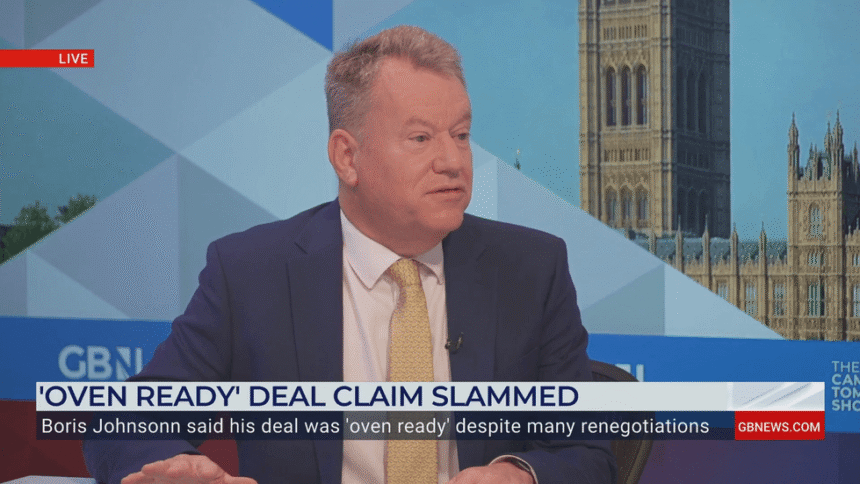
In his first major speech since his appointment as Director-General of the Institute of Economic Affairs, Lord David Frost last night launched a blistering attack on Britain’s Net Zero strategy — warning ideological zeal is driving up bills, destroying jobs and putting lives at risk.
Addressing the influential Westminster think-tank, the former Brexit chief negotiator said ministers have abandoned economic reality in favour of what he called a “collective madness”.
The former Cabinet minister warned Britain’s shift away from oil and gas is rooted in ideology rather than economics or engineering, which will have “real human consequences” for families struggling with rising costs.
“Why has this collective madness seized so many Western economies?” he asked. “Why have we allowed ourselves to be taken over by an ideology? The pushback is beginning, yet there is no evidence of change and we are about to start a new era where we have to deal with reality as it is.”
Lord Frost also attacked the Labour Government’s claim the UK must lead by example on climate policy to persuade other major economies to cut emissions. He argued there is no sign of global heavyweights such as China, India or the United States scaling back fossil fuels in response to Britain’s actions, meaning citizens are shouldering high costs at home.
He said: “No one is following us. The example we are setting is making no difference.”
His intervention came as the IEA published a stark new paper warning Britain cannot simply “just stop oil” and doing so would make the nation poorer, dirtier and less secure.
The analysis states: “There are no credible forecasts that do not show some demand for oil and gas in 2050, even under net-zero compliant scenarios…”
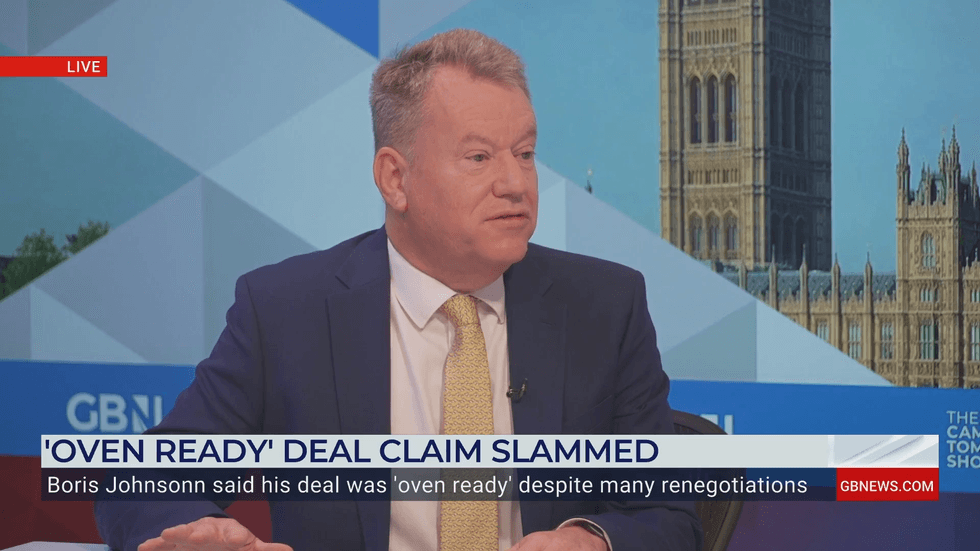
Lord Frost currently sits in the House of Lords
|
GB NEWSIt adds: “Oil and gas are essential to modern life, not just for use as fuels but also as key ingredients in plastics, fertilisers, medicines and many other things we take for granted in everyday life.”
The report also argues: “It is deeply misleading to suggest that renewables are cheap. It is necessary to build and maintain equivalent amounts of backup generation or storage to be available when wind and sun are not.”
It criticises Labour’s case for ending North Sea oil production, warning this would damage the economy, drive up emissions and threaten the country’s energy security.
The report’s author, energy expert Kathryn Porter, echoed Lord Frost’s concerns, warning the country cannot rapidly wean itself off oil without serious consequences.
Net Zero policies have come under fire
|
GETTYShe told the audience: “The notion that we should stop using oil is born from a position of privilege. It is difficult to identify anything that is not made out of petroleum. Almost every drug licensed for use is made out of oil… If we stop oil it will effectively stop modern life.”
Ms Porter, founder of consultancy Watt-Logic, warned overly aggressive decarbonisation measures could trigger economic dislocation similar to Sri Lanka’s ill-fated fertiliser ban in 2021 when their government banned chemical fertilisers and pesticides in a bid to cut pollution and reduce reliance on imports.
Instead crop yields collapsed and farmers were unable to grow enough food. Within a year, the country was facing spiralling inflation, severe shortages and nationwide unrest. Protesters stormed government buildings and the president fled the country. The fertiliser ban was later reversed but the economic damage had already been done.
Ms Porter warned sweeping policy changes in essential sectors such as energy or agriculture can trigger unintended and destabilising consequences.
“When you tamper too quickly with systems that underpin food, power and heating, you cause enormous harm,” she said. “We have wholly relied on oil and gas for decades and will still need to rely on these for decades to come. The barrier isn’t geology – there is plenty of oil and gas in the North Sea – the barrier is ideology.”
Lord Frost and Ms Porter both argued current energy policy is already hitting British households and workers.
“There are 1,000 job losses a month due to the North Sea closure,” Lord Frost said, adding while territorial emissions have declined, “no one is following us”.
He cautioned against what he described as a “cult-like” attachment to renewables, saying public debate has become closed to dissenting views about cost, reliability and grid security.
Both speakers also highlighted the human toll of rising energy prices, with Ms Porter citing historic official figures showing thousands of premature deaths linked to fuel poverty.
“Six to eight thousand people are dying because they cannot afford to heat their homes, and the risk of death in blackouts is increasing,” she said, urging policymakers to account for human impact rather than abstract carbon targets.
Ms Porter further accused ministers of refusing to engage with contrary evidence on energy costs and the performance of renewables.
“We are dealing in terms of religion and not science,” she said, calling for a return to reasoned debate.
A spokesman for the Department of Energy and Net Zero told GB News: “Issuing new licences to explore new fields will not take a penny off bills, cannot make us energy secure, and will only accelerate the worsening climate crisis. We’re giving the sector and its investors the long-term certainty to invest and support jobs through our plan for the North Sea and by replacing the Energy Profits Levy when it ends by 2030, or earlier if its price floor is triggered. This will protect jobs now and create the next generation of skilled roles, including over 40,000 new clean energy jobs in Scotland by 2030.”