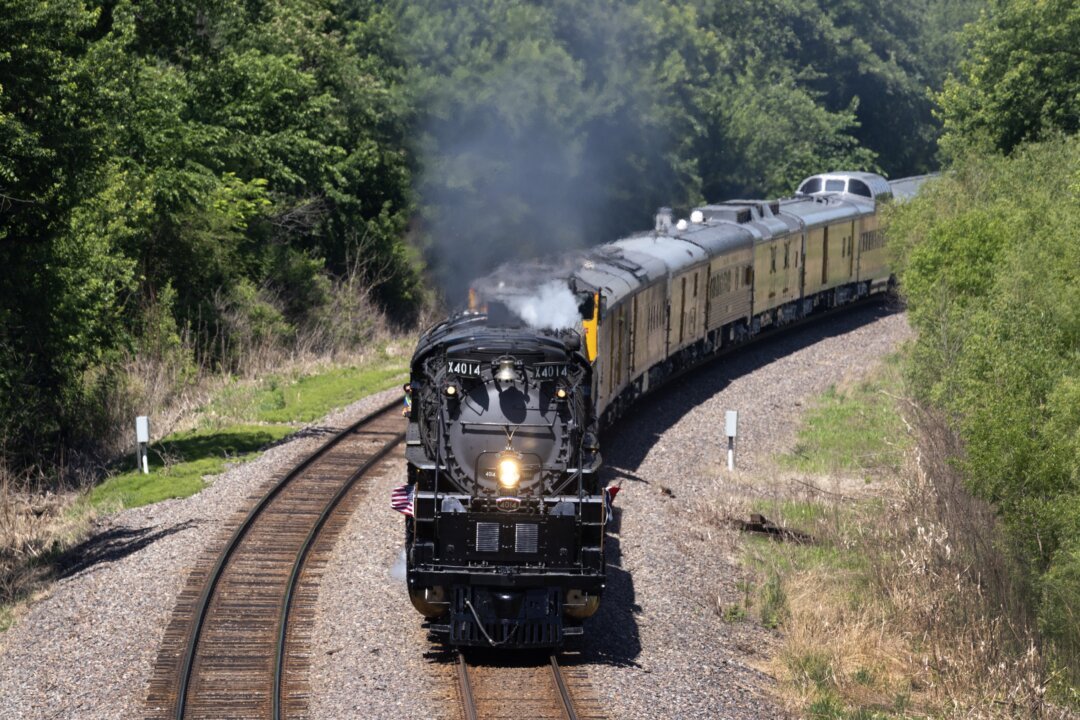
Union Pacific “Big Boy” No. 4014, the world’s largest operating steam locomotive, travels through the countryside during its cross-country journey to celebrate America’s 250th birthday, near Tama, Iowa, on June 1, 2026. Between 1941 and 1944 Union Pacific commissioned 25 Big Boy locomotives, eight still remain, but the restored 4014 is the only one that is fully operational. Scott Olson/Getty Images
The agency that regulates America’s railroads denied motions by opponents of the largest proposed rail merger in history to stop it in its tracks.
Several interested parties, including the BNSF and CSX railroads and the American Chemistry Council, had filed motions with the federal Surface Transportation Board asking that agency to reject the joint application by Union Pacific and Norfolk Southern.
Union Pacific proposed and Norfolk Southern has agreed to an acquisition for $85 billion. If regulators allow it to go through, the new railroad would be called the Union Pacific Transcontinental Railroad.
The combined entity would be a $250 billion enterprise. Union Pacific and Norfolk Southern are selling it as the first coast-to-coast, single-line freight railroad in the United States.
The rail regulatory agency decided on Sept. 18 that “although the motions and comments raise important questions and issues, the Board will exercise its discretion,” allowing things to proceed.
Critics Not Done Yet
Opponents and skeptics of the merger saw a few silver linings in the rejection.
Zak Andersen, BNSF vice president of communications, told The Epoch Times that his railroad was “encouraged by [the regulator’s] acknowledgment that the motions made” had already raised “important questions and issues that will continue to be raised during the merits phase of the process.”
Diana Moss, vice president and director of competition policy at the Progressive Policy Institute, told The Epoch Times that while motions for summary denial “are not uncommon in big railroad mergers,” those motions “are rarely granted.”
She said that the fact that “major players” in freight, including other railroads, shippers, and trade groups, “filed motions tells you something about how anticompetitive the deal is.”
The American Chemistry Council, a trade group, sent a statement saying that it would continue to press the case that a “healthy freight rail network” needs significant “competition and customer choice, not increased market concentration and monopoly power.”
The industry trade group highlighted one concurring opinion in the document, by Republican member Richard Kloster, that it hopes shows the merger will face serious regulatory scrutiny.
In his concurrence, Kloster expressed concerns about a “lack of transparency and depth in the application.” He wrote that Union Pacific and Norfolk Southern “do not offer a very robust plan for how they will address competitive concerns or mitigate potential harms.”
The Epoch Times reached out to Union Pacific and Norfolk Southern. A spokesperson for both said that they do not have anything to add at this point in the process.
The next step in the regulatory merger process involves comments, protests, and petitions.
Approved parties can submit those to the agency through Nov. 18.
Rail Regulation
The Surface Transportation Board is an independent regulatory agency of the executive branch of the federal government.
The president nominates members to the five-member board, and, according to the United States Code, “not more than 3 members may be appointed from the same political party.”
One of seats on the board was reserved for the opposition party and is currently unfilled—President Donald Trump fired Democratic board member Robert Primus in August 2025.
Primus was the member of the regulatory agency who was widely regarded as the most skeptical of rail mergers.
The fired board member attempted to get his job back through litigation, but a decision by the Supreme Court in another matter foreclosed that possibility this June.
It is unclear when and if the Trump administration will fill that vacancy.
Vacancies can paralyze some regulatory agencies, but the railroad regulator has no legal requirement of a quorum.