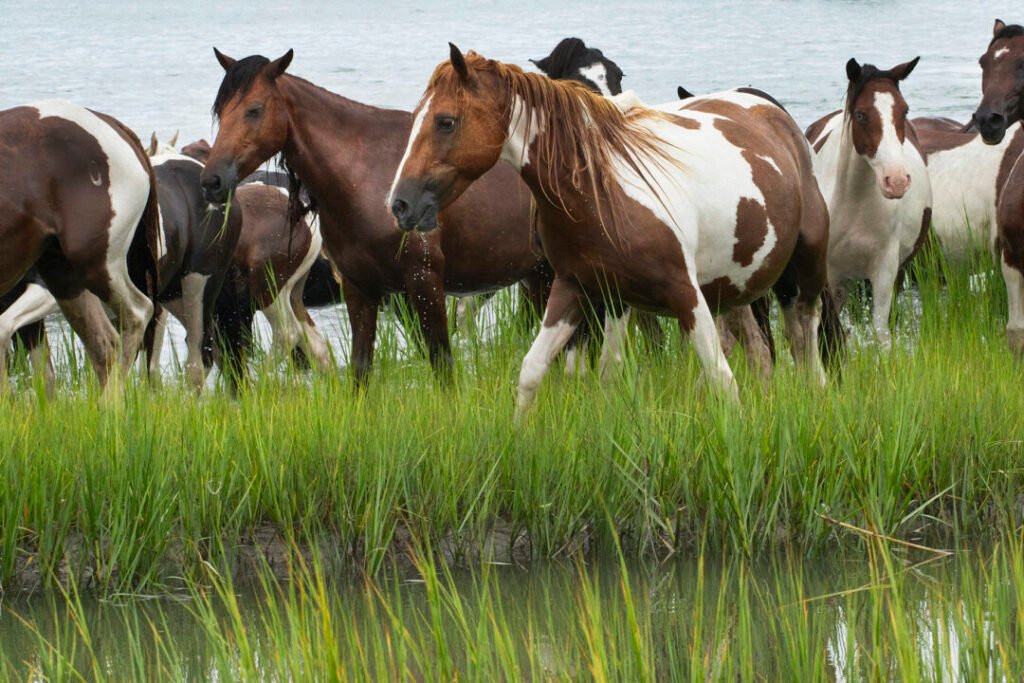
Richard Moore stood for four hours in the muddy, brackish water, waiting for the wild horses to come at him.
“I was splashing about in the water for about four hours, and when the horses came on shore, it got a bit hairy at times,” Moore, a staff editor for Epoch Times, told American Essence magazine, with a kind of quiet understatement. “They look all nice and peaceful, but the stallions can get very protective of their herds, so that’s something I did have in the back of my mind.”

The wild ponies set off on their swim to Chincoteague. Richard Moore/The Epoch Times
As Moore stood there in the sluggish water in the face of the oncoming herd, various cameras hung across his shoulders like the ammunition and weaponry of a gunslinging cowboy.
Except, in this case, his aim was to photograph cowboys—not be one. Specifically, he was there to photograph the famous “saltwater cowboys” who, every year, drive the wild ponies of Assateague Island to neighboring Chincoteague Island—a spectacle of water-logged wrangling that draws tens of thousands of onlookers. The swimming ponies and the subsequent baby pony auction is a 100-year tradition that helps support the local Chincoteague Volunteer Fire Co.
In addition to funding local police and firefighting efforts, the pony roundup and transfer to Chincoteague also keeps the wild pony population of Assateague Island in check.

Richard Moore taking photos during the annual wild pony roundup, swim, and auction in Chincoteague, Va. Courtesy of Leslie Moore
Around the World
Richard Moore’s 48-year journalism career has led him around the world, and standing knee-deep in marsh, facing down wild stallions isn’t the first tight spot he’s gotten into during the pursuit of the perfect photograph.
Related Stories


Handlers carefully keep the wild ponies from escaping during the auction in Chincoteague. Richard Moore/The Epoch Times
Working as photographer, reporter, and editor, he has headed into the thick of the chaos during a number of historic events, including hurricanes, shipping disasters, the Troubles in Belfast, and the fall of the Berlin Wall to mention but a few.
Living in New York, he has also taken his cameras out on to the streets to document the homeless of the city.
He’s worked extensively in his native Australia, New Zealand, the Cook Islands, Britain, and, most recently, the United States, and his resume is studded with prestigious news organizations: BBC World Service, Australian Broadcast Corporation, the Daily Telegraph in London, and the Melbourne Age newspaper.

Missing out means emotional times at the horse auction in Chincoteague. Richard Moore/The Epoch Times
Putting on His Boots
Like many, his interest in Chincoteague began with a beloved book.
“I remember when I was a lad reading ‘Misty of Chincoteague,’ and my colleague Nanette Holt was talking about it. My wife mentioned the fact that she read Misty as a kid as well and loved the story and loved everything about it. And so, I thought, ‘Oh, we should go down and cover this.’”

After the swim a horse waits in the marshy ground on the Chincoteague coastline. Richard Moore/The Epoch Times
Moore describes himself as a city boy, so for him “to put on boots and chaps and sort of go sauntering off into the prairie doesn’t really interest me that much.” And yet, he admitted, “I do like horses. I do a lot of writing on the Napoleonic Wars, but that’s about the closest I get to horses … Napoleonic cavalry.”
In addition to the glossy-coated, majestic animals themselves, Moore was also struck by the sense of strong community that has arisen around the pony roundup. Witnessing the community coming together to celebrate its heritage and supply for its own needs has compelled him to want to return (that, and the true professional’s desire to cover the event from even more angles, to capture even more photographs).
“When a community is so united that they work together to do something good for the community, I think it’s a wonderful thing,” he said, noting also that such occurrences are rare.

A mother stands over her colt in a corral after the swim to Chincoteague. Richard Moore/The Epoch Times
In addition to getting more coverage of the pony roundup itself, Moore hopes to capture something of the community spirit behind the event through images of those who keep things running behind the scenes. In his words, “I think they’re often the unsung heroes of events like this.”
“Unsung hero”—that’s not a bad description of the photographer himself. Photographers are an invisible yet vital component of a news story or magazine article. The “Story by” credit gets a lot of attention. “Photographs by” receives less notice, even though, as Moore pointed out, most people’s attention is initially captured through the images in a story more than the words.
The Invisible Professional
The photographer becomes everyone’s eyes, relinquishing something of his own identity in the process. Readers see the event through the lens of the photographer, but like our own eyes, the man holding the camera is invisible to us.

Handlers carefully keep the wild ponies from escaping during the auction in Chincoteague. Richard Moore/The Epoch Times
“One of the saddest things about journalism today is the fact that photographers are less valued because everyone has a phone,” Moore said. Photographs may be ubiquitous, but there’s still something uniquely valuable about the pictures a professional can capture.
Professionals know how to tell stories through images. They know how to frame shots, and how to get the right shot—even when that means, sometimes, going off the beaten path, or noticing details others would miss.
Words and images form an intricate dance in news media, and hitting the right beats requires planning, dedication, and care. For the photographer, that process begins with thinking through the event ahead of time so that he can be in the right place at the right time.

A stallion turns and waits for his mares to reach the shore on Chincoteague. Richard Moore/The Epoch Times
“It’s a one-off chance,” Moore explained. “If I’m writing something, I can always go back to it. I can always get the information off the internet. But when you’re a photographer, you have the time you have on scene, and that’s it.” That’s why pre-planning is so important. At the same time, a crucial complementary skill is adaptability. “You’ve got plan A, B, C, D, E, F, G. You’ve got to constantly keep an eye on the crowd or whatever’s happening around you … You’ve got to be light on your feet.”
Like a director crafting a film scene, Moore likes to have many options to select from when he looks over the day’s shots so that he can put together the most compelling visual story possible. “No. 1 rule: Get a photograph. No. 2 rule: Get five photographs. No. 3 rule is get 50 if you can.”
With a large stockpile of photos, it’s possible to curate the very best images to pass on to the writer or editor of the story.
Moore has developed expertise on both sides, writing and photographing, though he would not have predicted his own career path. He stumbled into journalism after his mother, a broadcaster, told him that if he wanted to be on the radio he should begin as a cadet reporter.
“My journalism tutor told me at age 17, ‘You’ll never make a journalist,’” Moore laughed. “So, 48 years later, here I am still.”
And Moore’s work suits him. “People who know me well go, ‘It’s the only career you could have done.’” When pressed on why people say this, Moore answered with a wry smile, “I think some people suit their jobs. Of all the old journalists I know, we’re all pretty much the same types. We’re all salty, and we’re all a bit grumpy, and we’re all very cynical.”
The Power of an Image
A bit of cynicism would be understandable for a man who once witnessed bloodshed firsthand while on the job.

Handlers carefully keep the wild ponies from escaping during the auction in Chincoteague. Richard Moore/The Epoch Times
Moore was photographing a funeral in Belfast in Milltown Cemetery, where the IRA was burying three of its members who had been killed by the British SAS. He stood at the edge of the grave, snapping photographs. Then, suddenly, chaos broke loose: Someone began hurling grenades at the mourners and opened fire with a pistol. Up to 60 people were injured, and three were killed.
Amidst the flare of the bombs, Moore managed to capture in incredible image: Gerry Adams, an IRA leader, protecting a young boy who was a nephew of one of the deceased, shielding him with his own body.
Thirty years later, Moore got an email from the lad he had photographed, Sean Murray, now a grown man and a filmmaker, asking to connect and to make a documentary about their strange link across time. Moore quickly agreed.

Happiness is becoming the owner of a Chincoteague wild pony. Richard Moore/The Epoch Times
And that speaks to the power of images. Crystallized, eternalized moments of suffering and chaos but also self-sacrifice and heroism. Bridges across time. Links between generations.
As Moore himself said, “And that’s where photography and real-life sort of merge in a strange way, in my view. I mean, 30 years and half a world apart, and he wanted to catch up.”
A single image bonded the two men across a chasm of 30 years. It encapsulates what photography can do—and the legacy of a great photographer like Moore.