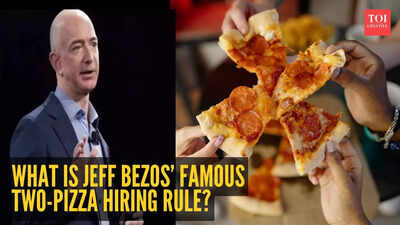
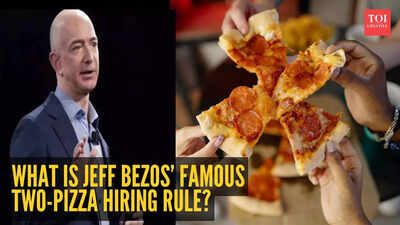
If you are a corporate employee, then you might have come across situations where sometimes 20+ people sit in a meeting but nothing gets decided. The worst: Everyone’s just nodding along? Well, you’re not alone. Amazon founder Jeff Bezos tackled this common workplace organisational problem with his famous “two-pizza rule”: No team should be larger than what two large pizzas can feed. Typically, that means 5-10 people. It’s a simple and straightforward idea born from Bezos’ push to keep Amazon more productive as it grew into a global giant. Introduced early in the company’s history, it’s less about literal pizza and more about cutting bureaucracy to spark real work. Leaders everywhere have since adopted this idea, and here’s what it means and why it still works today:
The two-pizza rule in plain terms
Picture this: You order two large pizzas – about 8 slices each. That feeds 6-8 employees in a team comfortably, maybe 10 if they’re polite. Bezos’ point? Teams bigger than that grind to a halt. Massive groups mean endless debates, too many opinions, and decisions dragged out over weeks. We’ve all been on those chaotic Zoom calls with 50+ “team members” where ideas drown in chatter. But, when the same is done with small teams– Everyone knows their role, speaks up, and moves fast. It’s practical wisdom: Shrink the circle, speed up results.
Benefits of the two-pizza rule
1. Better collaborationIn a small team, hiding isn’t an option. With just 6-8 people, every voice counts, and no one lurks in the shadows while two talk over each other. Collaboration flows naturally between people because it’s easy to share ideas, build on them, and reach consensus. Think workshops: You don’t cram 100 people at one table; you split into groups of 8-10 for real discussion. Bezos knew big teams breed bystanders; small ones create owners. The result? Ideas stick, people’s participation rises, and work feels shared, not dictated.2. Real agility and more productivityA 10-person team can hop on a quick call– be it for discussing a new direction they need to work on or to find solutions to a new problem. Such meetings are often, short and to the point. But, imagine the same with a group of 50-100 people, and it’s utter chaos: Scheduling nightmares, pushback from some employees, and confusion. It’s logical then that small teams are like speedboats– they have quick turns, and aren’t dragged. While big teams are like rigid battleships– slow to steer amid waves of tech changes or market shifts. In today’s fast world – with AI tools, remote work, and constant disruption – agility wins. And Jeff Bezos’ two pizza rule helps build organisations full of these speedboats, not one lumbering giant.
The bigger philosophy
Jeff Bezos envisioned Amazon as a fleet of small, autonomous teams tackling specific problems, not a corporate giant which is bogged down by layers. This helps companies grow amid tech influxes, where innovation demands quick experiments. Large teams silo knowledge and stall progress; whereas multiple small ones scale solutions. And so, the simple philosophy is: Empower fewer people deeply, rather than spread thin across crowds.
What leaders can learn from this
Ready to try the two pizza rule in your team too? Audit your teams: Can two pizzas feed them all? If not, then split them up into smaller sub-teams and more manageable teams. Bezos proved it at Amazon – from startup to trillion-dollar empire. Benefits stack: Managers connect personally with individuals, boosting engagement. Trust grows as people know each other well. Collaboration deepens without egos clashing. Few downsides exist – maybe initial restructuring – but gains in speed and morale outweigh it.What are your views on this? Tell us in the comments below.