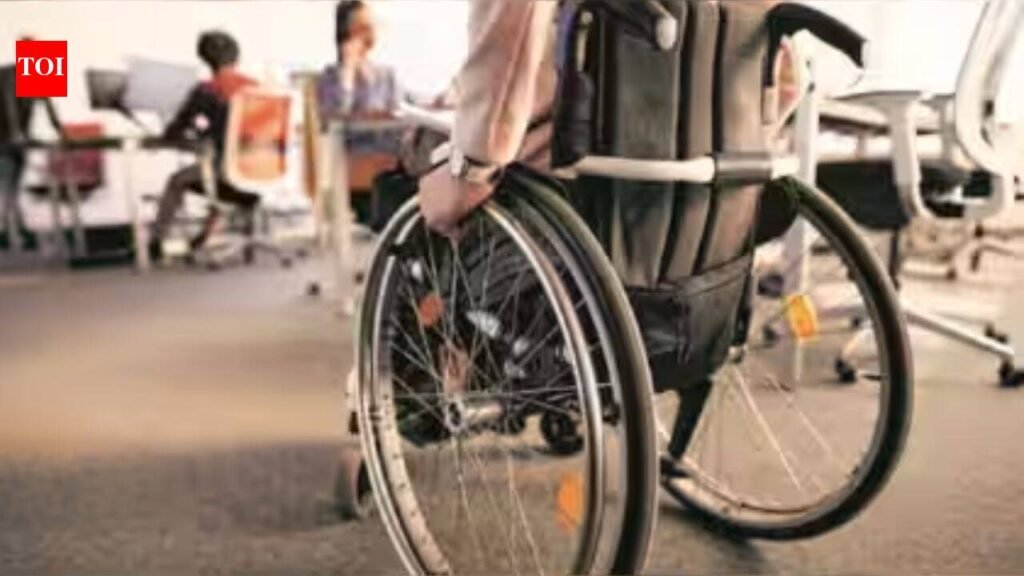
NEW DELHI: Disability rights organisations and activists have raised concern over the categorisation for enumeration of persons with disabilities under Census 2027, highlighting that the nine-category framework “fails to adequately capture this legal and social reality” of the 21 disabilities recognised under the law.The statement issued by National Platform for Rights of Disabled and backed by 405 signatories, states that “apart from leaving enumerators clueless, this exercise will produce inaccurate data and render entire groups of persons with disabilities invisible in official statistics.”They have demanded that the disability questionnaire in Census 2027 should individually capture all 21 disabilities recognised under the RPwD Act, 2016.“Whereas the Schedule under the Rights of Persons with Disabilities (RPwD) Act, 2016 recognises 21 conditions as “specified disabilities”, reports indicate that in Census 2027 disability will be recorded under nine categories only: seeing, hearing, speech, mobility, intellectual disability, mental illness, acid attack, chronic neurological disease and blood disorder,” the statement highlights.The signatories note that except for a name change from “mental retardation” to “intellectual disability” the first six categories were there in the 2011 enumeration as well. The new additions are – acid attack, chronic neurological diseases and blood disorders.The statement goes on to list the 21 specified disabilities recognised under the RPwD Act are: locomotor disability; leprosy-cured persons; cerebral palsy; dwarfism; muscular dystrophy; acid attack victims; blindness; low vision; deaf; hard of hearing; speech and language disability; intellectual disability; specific learning disabilities; autism spectrum disorder; mental illness; multiple sclerosis; Parkinson’s disease; haemophilia; thalassemia; sickle-cell disease; and multiple disabilities including deafblindness.“The proposed nine-category framework fails to adequately capture this legal and social reality. It is deplorable that conditions like autism spectrum disorder, specific learning disabilities, dwarfism, leprosy-cured persons and multiple disabilities, including deafblindness, have not been distinctly placed,” they state.
Share your thoughts in the comments
Be respectful · TOI community guidelines
They further state that equally unacceptable is the fact that conditions like cerebral palsy, muscular dystrophy, multiple sclerosis and Parkinson’s disease are subsumed under broader categories, whereas three distinct disabilities — thalassemia, haemophilia and sickle-cell disease, are reduced to the single category of “blood disorder.”Those who have endorsed the statement include Disability Rights Alliance, National Association for The Blind, Politics and Disability Forum, Sense International India, Muskan Foundation, Action for Autism, Autism Society for India and Enable India among others.The second phase of Census 2027 population enumeration began on August 17, with online self-enumeration in Ladakh, snow-bound areas of Jammu & Kashmir, Himachal Pradesh, and Uttarakhand. This early start covers remote, mountainous regions before winter. Door-to-door counting runs from September 1 to September 30, 2026, ahead of the rest of India.