

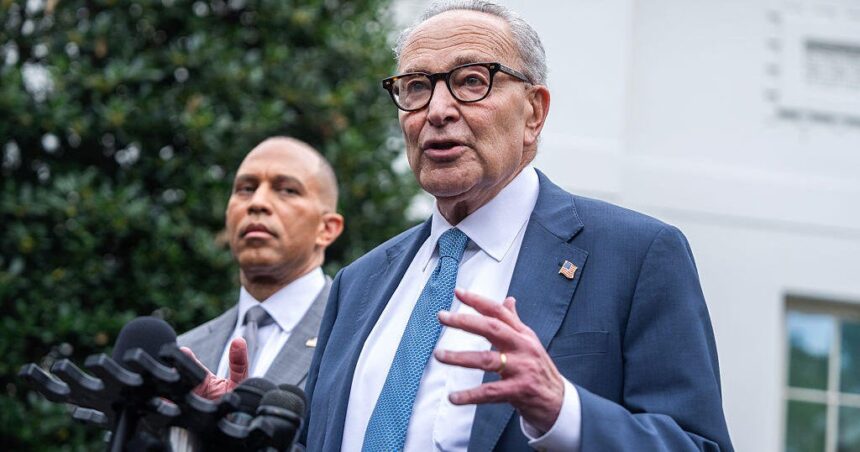
Washington — A partial government shutdown centered on the Department of Homeland Security began Saturday amid a stalemate over the Trump administration’s controversial immigration enforcement policies.
It’s the second time in as many weeks that funding has lapsed for part of the government as Democrats and the White House remain at odds on restraints for federal immigration agents. DHS oversees Immigration and Customs Enforcement and Customs and Border Protection, whose conduct has been increasingly scrutinized since federal agents fatally shot Renee Good and Alex Pretti in Minnesota.
Though the impasse has revolved around immigration enforcement, the shutdown will impact other agencies under DHS’ umbrella, including the Transportation Security Administration, the Coast Guard and the Federal Emergency Management Agency. Republicans have noted that ICE and CBP received an infusion of $140 billion in last year’s One Big Beautiful Bill Act, enough to carry them through the rest of President Trump’s term.
Disagreements over DHS funding led to a four-day partial shutdown that ended earlier this month with an agreement to fund most of the government, except DHS, through September. Funding for DHS, which employs more than 260,000 people, was instead extended at current levels for two weeks, expiring Friday.
On Thursday, Senate Democrats stood firm in opposing legislation to fund DHS through September without additional reforms to ICE and CBP. Sen. John Fetterman of Pennsylvania was the only Democrat to vote with Republicans in favor of advancing the legislation. Democrats also blocked an effort to extend DHS funding for another two weeks while negotiations continue.
“Our caucus is passionate about this. If you sat in on our caucus meetings, you’d see how strongly people feel,” Senate Minority Leader Chuck Schumer, a New York Democrat, told reporters after the vote. “And you know who are among the strongest? Some of the very people who didn’t vote with us last time.”
Congress left town Thursday without any agreement on DHS funding and isn’t expected to return until Feb. 23, a day before Mr. Trump is scheduled to deliver the State of the Union address. Leaders could call back members before then if a deal is reached.
But it’s unclear how close negotiators are to ending the impasse.
Mr. Trump said Thursday afternoon that some of the Democrats’ demands are “very, very hard to approve.”
Requiring immigration agents to wear body cameras and identification, banning them from wearing masks and mandating judicial warrants for arrests on private property are among Democrats’ demands.
Schumer said Thursday that Democratic negotiators “will be available 24/7” to continue discussions once the White House and Republicans are ready to “get serious.”
The White House sent a legislative proposal for full-year funding to Democrats late Wednesday, days after Democrats sent their own draft bill. But Democratic leaders have dismissed the White House’s offer as insufficient, though specifics of the proposal have not been disclosed. House Minority Leader Hakeem Jeffries, a New York Democrat, said Friday afternoon that Democrats planned to respond to the White House’s plan.
“It’s my expectation that at some point, Democrats in the House and the Senate, jointly, will respond to the latest unserious offer formally, and then it will once again be in the hands of Donald Trump and Republicans to decide what’s next,” Jeffries said.
Earlier Friday, Mr. Trump said negotiations are ongoing, while adding that his goal is to “protect our law enforcement.”
“We’ll see what happens,” he said of cutting a deal with Democrats.
Before Thursday’s Senate vote, Mr. Trump’s border czar Tom Homan announced a surge in federal immigration enforcement in Minnesota would come to an end, one step that Democrats have demanded. But Schumer said Thursday on the Senate floor that “ICE’s abuses cannot be solved merely through executive fiat alone.”
“We first and foremost need legislation,” Schumer said, noting that Mr. Trump could decide to reverse course without legislative guardrails.
In a memo Friday directing DHS to “execute plans for an orderly shutdown,” Office of Management and Budget Director Russ Vought said the Trump administration “is currently engaged in good faith negotiations with Congress to address recently raised concerns.”
“The Administration will continue to seek good-faith, bipartisan solutions to complete the appropriations process and avoid another damaging government shutdown,” Vought wrote.