
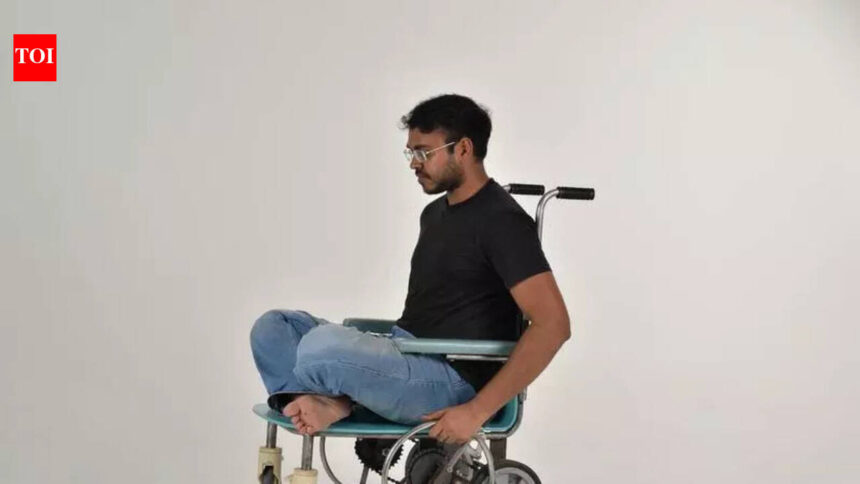
Ahmedabad: For Nandini Sharma, a BDes student who received her National Institute of Design (NID) degree at the recent convocation, the rise in cardiac arrest cases was the starting point of her project on a wearable monitor.“The smart ring monitors vitals, detects abnormal cardiac activity such as arrhythmia, and sends alerts to relatives or caregivers. Interviews with survivors and medical professionals gave me insights, and helped me understand the need for such a system,” says Sharma.While design is often associated with how a product looks, several graduation projects by NID students — solutions for the medical care and now part of a website — underline the functionality and the utility aspect of design. Take, for instance, a water blanket-integrated chair for haemodialysis patients designed by Kriti Jalihal. The project brief highlighted the long hours patients spend on the chair during the dialysis process. “By creating a deeply relaxing environment, the chair-bed seeks to improve the quality of life for patients undergoing frequent, stressful treatments,” mentions the project brief on the website.Likewise, Dhyanaditya Baruah’s project is a neonatal hypothermia monitoring device, and the one by Praveen Kumar S is a neonatal transport incubator. Gayatri Menon, senior faculty at NID who guided several of the projects, said that some of the students worked on solution-based design interventions with organizations such as the Ford Foundation. “The students assessed the problem, devised multiple ways in which it can be addressed, and came up with design-centric solutions. Some are in an advanced stage of development,” she said.Mohammed Naim Shaikh, senior faculty at NID, who guided several of the medical sector-specific projects, said that projects motivate students to seek out-of-the-box solutions. “For instance, Trupti Bhadane’s design aimed at creating an affordable insulin pump rooted in biomedical device design, whereas Khushi Desai’s project explored a portable slit-lamp-mounted camera for retinal imaging for conditions such as diabetic retinopathy,” he said.Gajendra Pratap Singh, a BDes student, designed a self-mobility device for persons with lower limb disabilities. The device aims to provide independence and dignity, as it would prevent the need for dragging the vehicle.