
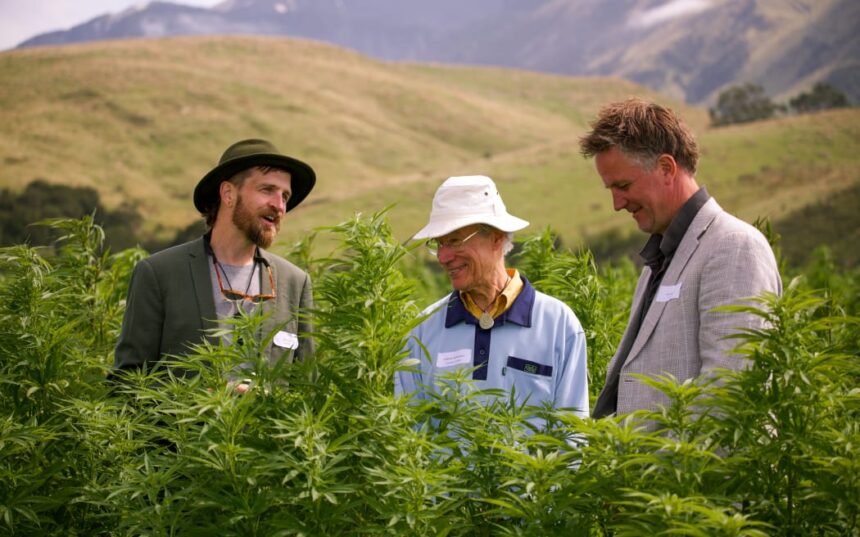

Tom Forrest, Dr Graham Gulbransen and Sank McFarlane at Puro’s Kekerengu farm.
Photo: Supplied / Niki Macfarlane
The country’s largest medicinal cannabis grower is about to harvest its biggest crop, and is working with iwi on plans to increase its production in Kaikōura.
Puro New Zealand has been growing medicinal cannabis since 2018 and has two facilities in Marlborough, one in the Waihopai Valley and another at Kekerengu on the Kaikōura Coast.
Co-founder and chief development officer Tom Forrest said staff were about a month away from harvesting around 65,000 plants from across 15 hectares, which would produce around 100 tonnes of material that would be dried or formulated into oils for medicinal use.
He said while cannabis could be grown almost anywhere, Marlborough was chosen because its environment was ideally suited to growing a high grade product.
“[Cannabis] has a genetic plasticity that allows it to grow from the mountains of the Himalayas to deserts to tropical islands but not all of those places grow [plants] in a way that is suitable for high quality medicine.”
He said the Kekerengu farm was special because it had an optimal soil profile, the right aspect, gradient and the elevation from sea level along with protection from the mountains.
“There’s a really, really perfect melting pot of agronomic traits that work to grow cannabis here.”
On Thursday, Puro opened the gates of its Kekerengu farm to academics, growers, buyers and prescribers.
“In an industry where factory farming is a bit of the norm, we want to show why our plants and our crops and our medicines are grown differently and we’ve invited other farmers from around New Zealand and the world so we can share knowledge and we can collaborate and build really lovely partnerships.”
Local iwi Te Rūnanga o Kaikōura established a strategic partnership with Puro. Two years ago, the business, which is owned and operated by the local tribe Ngāti Kūri of Ngāi Tahu, invested in the company and together had established cadetships to build talent in the industry.
Managing director Rāwiri Manawatu said it was working to establish a contract growing model similar to the wine industry.
“We could have our own piece of land, we could be growing the product ourselves and then sell it on to Puro or for processing.
“The idea is building that capability and capacity, training and supporting [the cadets] to learn everything they need to know about the farm and how it works so that we can start building this growth model.”

Colin Nuckolls, Rawiri Manawatu and Tom Forrest at the Puro farm in Kekerengu on the Kaikōura Coast.
Photo: Supplied / Niki Macfarlane
Columbia University professor and organic chemist Colin Nuckolls, who visited the Kekerengu farm on Thursday, had spent the better part of the last decade studying the chemical differences between indoor and sun-grown cannabis.
He originally thought cannabis was mainly just THC (tetrahydrocannabinol) and CBD (cannabidiol) but found “a whole plethora of really interesting compounds” were present, often into the thousands, particularly in cannabis that was grown in soil and under the sunlight.
He said cannabis in the United States was tested for a certain number of cannabinoids and terpenes, so on paper, the certificate of analysis for different cultivars looked the same.
“Based on that you can’t tell any difference between them but the effect that a patient or a consumer has when they try one versus the other can be night and day, so what that’s telling you is that there’s many, many components in there that are having a big effect.
“It’s probably a fool’s error to think that you can actually reproduce what nature gave you in soil and sunlight in an indoor environment, the vegetative equivalent of a death camp.”
Auckland based GP Dr Graham Gulbransen started the first medical cannabis service in New Zealand nine years ago and said until recently, the products he prescribed had to be imported from Canada, Australia or Europe.
“Since 2022, we’ve had the option of organically grown CBD from this site here at Kekerengu and patients will often choose New Zealand grown or organically grown for the fact that it’s sustainable, using sunlight as the energy source rather than lights indoors.
He mainly prescribed medicinal cannabis to those with persistent pain, neurological conditions, those suffering from emotional distress, or with side effects from cancer treatment but at a cost of between $5 to $10 a day, the cost remained a barrier for many.
“We’d love to see subsidies where clearly we’re reducing the cost of standard medicines when patients are not responding to standard treatment.”
He said the Medicinal Cannabis Agency required a very high level of research in the form of clinical trials that showed the pharmaceutical benefits, which was tough when there were so many different strains of cannabis.
“It’s very difficult to do research where one variety may work better for a particular group of patients and other varieties are going to suit other people and some respond to low doses, others to high doses.”
He said research was happening around the world, but it was very expensive and work was ongoing to encourage the government to consider subsidising medical cannabis.
Sign up for Ngā Pitopito Kōrero, a daily newsletter curated by our editors and delivered straight to your inbox every weekday.