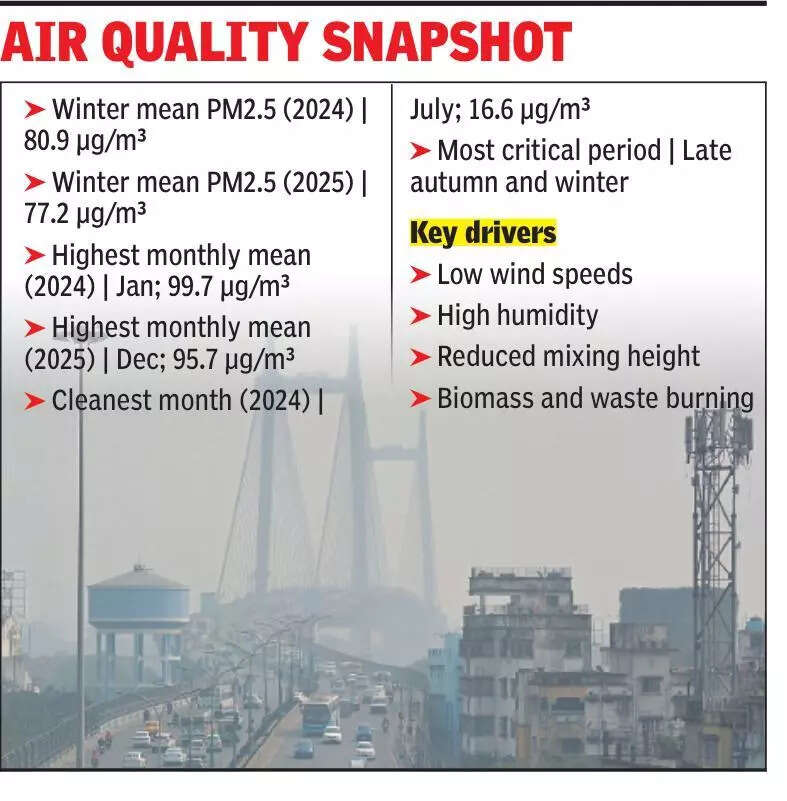
Kolkata: The city’s winter air turned toxic as a Climate Trends study flagged meteorology and climate change as key pollution drivers. Even as Delhi and Patna grab headlines for choking smog, a new multi-city analysis by environmental think tank Climate Trends shows that Kolkata’s air pollution story is more complex and increasingly worrying.According to Climate Trends director Aarti Khosla: “The data is clear — on a stagnant day, even if emissions are controlled, pollution will remain high. Our clean air policy needs to stop treating every day as the same. Integrating weather into NCAP is not just a scientific necessity; it is the only path to creating realistic, effective, and sustainable air quality improvements for Indian citizens.” “The study examines how short-term weather patterns and long-term climate change influence air pollution levels across India,” she added. The study finds that atmospheric stagnation — low wind speeds, high humidity, and reduced mixing heights — is the dominant amplifier of pollution severity across Indian cities. In Kolkata, weak ventilation during winter prevents dispersion, allowing pollutants from biomass and waste burning to accumulate near surface. The report argues that pollution control strategies must integrate dispersion modelling with emissions inventories, rather than focusing solely on annual emission reductions.The study finds that while Kolkata’s PM2.5 levels are not as extreme as that in Delhi or Patna, the city experiences moderate to high pollution in winter, marked by prolonged stagnant conditions that trap pollutants close to the ground.It finds that compared to Bengaluru and Chennai, Kolkata shows stronger seasonal contrasts. Compared to Delhi and Patna, it records lower peaks but similar meteorological vulnerability during winter stagnation.During winter, the city’s air quality persistently remains in danger zone. Data from 2024 and 2025 reveal a sharp seasonal contrast — winter (Dec-Feb) 2024: 80.9 µg/m³; winter (Dec-Feb) 2025: 77.2 µg/m³. Although winter averages dipped slightly in 2025, monthly peaks remained alarming. Jan 2024 recorded 99.7 µg/m³, while Dec 2025 surged to 95.7 µg/m³.In contrast, monsoon provides dramatic relief. PM2.5 levels dropped to 20.3 µg/m³ (2024) and 21.7 µg/m³ (2025) during the rainy season.Atmospheric scientist Abhijit Chatterjee of Bose Institute said biomass and waste burning remain major contributors. “Local and regional sources play a vital role in winter-time pollution in Kolkata.” Dr Abhinandan Ghosh, air pollution expert, cautioned against blindly replicating Western benchmarks. “In Kolkata, it is not emissions alone but the tyranny of winter boundary-layer dynamics that engender the most deleterious pollution episodes.“