

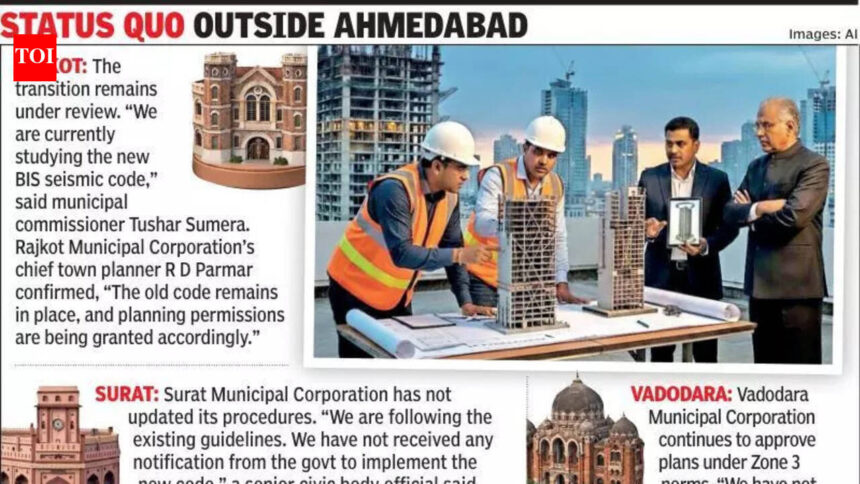
Ahmedabad/Surat/Vadodara/Rajkot: The implementation of the new seismic building code has divided Gujarat’s major municipal corporations, which could result in a policy deadlock over construction norms in the state’s biggest cities.The Bureau of Indian Standards’ (BIS) revised structural code — IS 1893:2025 — has officially upgraded Ahmedabad, Surat, Vadodara and Rajkot from Seismic Zone 3 (moderate risk) to Zone 4 (high risk), mandating stricter earthquake-resistant design standards. However, civic bodies have adopted differing approaches to its enforcement.The Ahmedabad Municipal Corporation (AMC) has taken a firm stand, issuing a circular mandating immediate compliance with the new code for all building plans submitted after Nov 3, 2025. On Jan 19, AMC further directed structural engineers to submit affidavits confirming adherence to the new structural code. The move has reportedly stalled around 15 major high-rise projects in the city.In contrast, municipal corporations in Surat, Vadodara and Rajkot continue to approve projects under the 2016 version of the code (IS 1893:2016), citing a six-month transition window granted by the Centre that keeps the earlier standards valid until May 3, 2026. These civic bodies have also sought clarifications from the state govt on the issue.Developers in Ahmedabad have urged AMC to permit use of the old code until the transition deadline, citing financial and technical complications. The Zone 4 classification requires buildings to withstand higher seismic forces and incorporate mandatory ‘ductile detailing’ to ensure structures bend rather than collapse during earthquakes.“AMC’s insistence on exclusive adherence to the new code from Nov 3, 2025 is inconsistent with the Centre’s transition provision,” said Rajesh Vaswani, chairman, Credai Ahmedabad. He added that around 15 project plans, including buildings taller than 45 metres, are currently stalled.Builders argue that projects in advanced planning stages cannot easily switch standards. According to Credai, “Constructing half a building under the old code and the rest under the new code is technically unfeasible.”Tejas Joshi, president, Credai Gujarat, said AMC should hold discussions with structural engineers before enforcing the new norms. “Credai is ready to work with AMC and engineers to create awareness among builders and stakeholders,” he said.(With inputs from Parag Dave in Ahmedabad, Nimesh Khalhariya in Rajkot, Sachin Sharma in Vadodara, Yagnesh Mehta and Vishal Patadiya in Surat)BOX: STATUS QUO OUTSIDE A’BADRAJKOTIn Rajkot, the transition remains under review. “We are currently studying the new BIS seismic code,” said municipal commissioner Tushar Sumera. Rajkot Municipal Corporation (RMC) chief town planner R D Parmar confirmed, “The old code remains in place, and planning permissions are being granted accordingly.”VADODARAThe Vadodara Municipal Corporation continues to approve building plans under Zone 3 norms. “We have not received any intimation regarding the implementation of the zone change,” an official said, adding that the city will “act as per directions” once guidance is received from the state govt.SURATThe Surat Municipal Corporation has not updated its procedures. “We are following the existing guidelines. We have not received any notification from the government to begin implementation under the new code,” a senior civic body official said. Meanwhile, Credai Surat chairman Rajiv Patel, in a letter to the chief minister, warned that the mandate would require “significant compliance measures,” including complex analysis and mandatory ductile detailing, sharply increasing construction costs for both developers and residents.