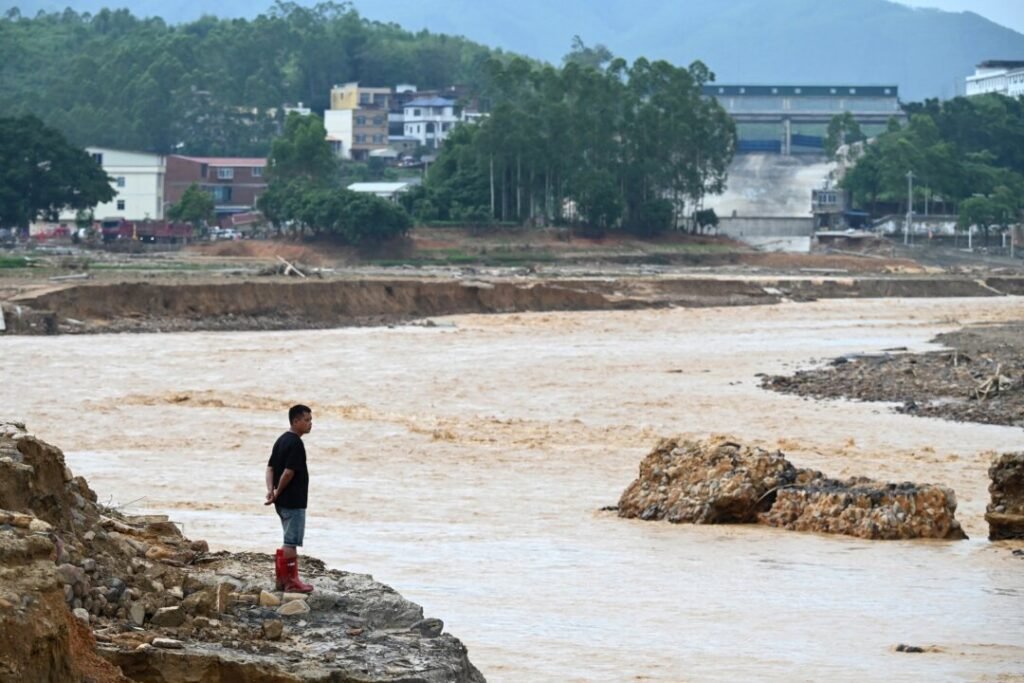
Chinese authorities have raised the death toll from July’s Typhoon Maysak flooding in Guangxi to 159, more than four times the 39 deaths reported six weeks earlier.
The Aug. 21 count, announced at post-disaster reconstruction meetings in Nanning and Guigang, also listed 10 people as missing. More than 1.65 million people were affected in the two cities.
Nanning accounted for 136 deaths and all 10 missing people. Police arrived at the figure through door-to-door inquiries, investigations, cross-checks, and comparisons of records, according to state media Xinhua.
Breaches at the Liulan and Yunbiao reservoirs and other reservoirs accounted for 107 deaths and seven missing people, according to the Aug. 21 account. Guigang reported another 23 deaths.
The July 9 official count was 39 deaths and nine missing across Guangxi. At the time, authorities attributed 26 deaths and seven missing people to the Liulan Reservoir breach.
Villages Cut Off After Reservoir Breaches
Typhoon Maysak brought days of heavy rain to Guangxi in early July, pushing reservoirs beyond their limits and flooding communities.
On July 6, Guangxi authorities said the Liulan and Yunbiao reservoirs were breached.
A separate Guangxi government account said Liulan, Yunbiao, and two other reservoirs exceeded safety limits, flooding villages in Xiaoyi, Yunbiao, Shitang, and other townships.
Roads, power, and communications failed in some of the hardest-hit communities. By July 8, all 11 villages in Hengzhou’s Zhenlong Township were without road access, electricity, running water, or communications.
Rescue appeals were already circulating online.
On July 6, Chinese exiled citizen journalist Li Ying posted an appeal he said came from Team 15 of Xia’gan Village in Yunbiao Town. It said elderly residents, a pregnant woman, and children were trapped in a home and asked for rescuers.
That same day, another citizen journalist, Su YiFeng, posted a video he said was from the Liulan Reservoir area and wrote that multiple people had been swept away while others were stranded on rooftops.
Two days later, Li posted another appeal from Guzhubei Village in Napeng Town. It said seven people were trapped and that the body of one person who had died could not yet be moved from the home.
Another appeal posted by Li said Guigang High School had about 4,000 teachers and students trapped by flooding and had been without water, electricity, and internet for days.
Residents Had Little Time to Escape
Residents interviewed afterward said some downstream communities had little time to react before floodwaters arrived.
NTD Television, sister outlet of The Epoch Times, later interviewed a Nanning government insider using the pseudonym Liang Zhi out of fear of reprisal, who said the reservoir had already failed around 6 a.m. on July 6 and alleged that authorities later standardized the breach time as 10:20 a.m. to shift responsibility toward residents who had not evacuated.
Liang said that when casualty reports from Hengzhou’s townships were compiled, one township alone reported more than 2,000 deaths. He estimated that at least 10,000 people had died across Hengzhou.
“Most of those who died were elderly people and children left behind in the villages,” Liang told NTD, adding that many children were staying with grandparents because schools had just gone on summer break. He said volunteers clearing mud more than 10 miles from the hardest-hit area continued to report finding individual bodies.
Liang also said more than 100 bodies were recovered from one supermarket after floodwaters receded, alleging that people inside had been trapped after a rolling shutter was pulled down.
“The water from both reservoirs hit Yabi directly,” he said. “Large numbers of houses were swept away.”
Residents who reacted quickly fled into the mountains or climbed onto rooftops, he said.
“Those who were slower were simply swept away by the flood.”
The volunteer said that, based on information he gathered locally, 28 people remained missing in one section of Yabi Village that contained 73 households.
When he was finally able to enter the village after road access was restored, he said he saw a body caught in debris.
“I personally saw one body wrapped in debris,” he said. “There were also the carcasses of pigs and other animals.”
A second resident from the area said people living closest to the reservoir had no time to escape. He said some victims remained buried beneath thick layers of mud and that rescue crews had recovered several bodies from accumulated debris.
The residents spoke on condition of anonymity because of fear of reprisal.