

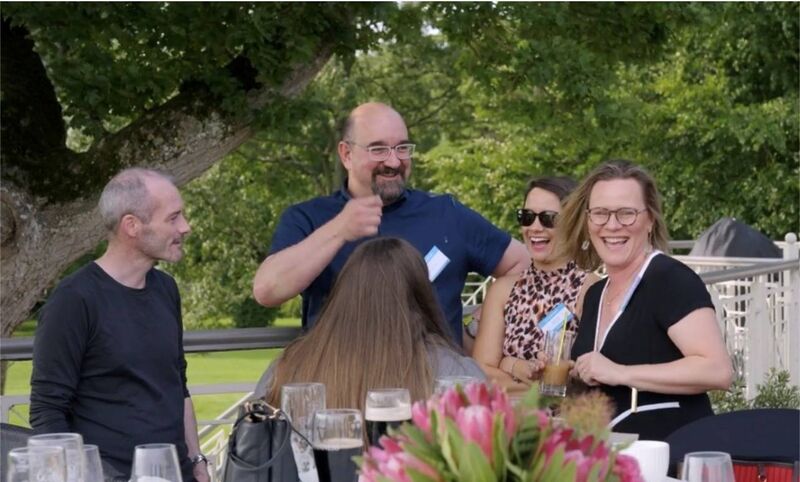
Anna Makarowizc Wilson, the newly appointed general manager of Chempoint, a chemical distribution company recently arrived in Ireland, is acutely aware that her industry has reached a tipping point and that this has left her with a problem to solve.
A wholly owned subsidiary of Seattle based Univar, a leading global distributor of chemicals and ingredients, Chempoint has restructured its EMEA business (Europe, Middle East, Africa) and last summer relocated its regional headquarters from Maastricht in the Netherlands to City West Business Campus on the western outskirts of Dublin.
Her overriding priority, or the problem to be solved, is ‘the ‘need for speed’ in an industry at a crossroads between a traditional, unhurried, order fulfilment methodology and an ever-increasing demand for fast and flexible digital supply chain capabilities. The expectations of new generation buyers are for relevant and accurate information immediately and for flawless product delivery soon after.
“If you present your products online and reach your clients this way you can be more agile and create faster modes of chemical distribution,” says Wilson. “We need to focus on the younger generation of buyers who are used to searching online, finding the information they need, the specifications of the product they want, and then reach them through their laptop window.”
The franchised distribution business can be as much a diplomatic balancing act as an operational process. It’s often a battle of three kingdoms, the protagonists being the manufacturer (OEM) of a product, their ultimate end customers and a distributor that plays on both sides of the transaction, serving both other parties on the basis that some of the margin flows their way.
Most OEMs will argue to their distributors that their products and markets are more ‘special’ than everybody else and demand individually customised processes to maximise their revenue outcomes. Many customers feel the same way. A distributor could be representing hundreds of producers to many thousands of customers, so the cost of individualised customisation would be poison to their bottom line.
The most successful distributors implement singular processes, systems and structures so that they can aggregate all that incoming and outgoing customer and supplier noise into an efficiently flexible and profitable business model. This is the challenge that Anna Wilson relishes.
“Our suppliers benefit because the digital approach is new in the chemical distribution industry,” she says, “and they in turn need to know how to do the digital marketing to reach their clients online. They have hundreds of clients, but they just want one distributor to sell their group’s chemicals, so instead of hundreds of customers to deal with they have only one. At Chempoint, we have customers of every size, but we are not choosy. We will serve them all lovingly.”
Wilson came to Ireland ten years ago when she married, in her words, “the best kind of man, an Irishman”. Her pathway to Chempoint is paved with business experience and academic excellence. MSc and PHD in Chemical Engineering, Post Grad in Business at UCD and a 17-year career with abcr, a German manufacturer and distributor of specialty chemicals where her ultimate role was that of managing director for Ireland and the UK.
She joined Chempoint in July of last year, tempted by the challenge of finding new solutions to old problems.
“At Chempoint, we try not to differentiate between customers of any size, and I think that’s where our advantage lies,” she continues. “A lead we identify on our website is responded to in forty minutes on average. In the traditional chemical industry, a new demand for a product would be identified and the buyer would complain that they would need to contact this new manufacturer and that’s going to take forever. Well now it doesn’t have to take forever. Even if you are a small manufacturer, it will still only take us forty minutes to get back to you and show you something that might want to buy. That’s the advantage of digital agility in a traditional business.”
Wilson compares her customers’ expectations with a visit to a supermarket. A customer might be able to buy the same branded product at an equivalent price in several stores so the winner might be the one that operates the speediest check outs. This is the problem that needs to be solved in chemical distribution. Get in, find what you need at a dependable quality, buy it at a fair price and then get out again as quickly as you can.
Chempoint doesn’t manufacture product, their OEMs own the IP and most of their warehouses are outsourced to third party logistics providers, (3PLs). Their main value add is a digital model in the distribution space that differentiates their service from competitors in terms of information flow, ease of doing business, shorter lead-times, reduced inventory investment, reducing the subsequent risk of excess and obsolescence financial write downs.
“Buyers are generally engineers and mostly they don’t want to make a phone call, although if they do our team will happily talk to them about their order, their family or dog or whatever they want to talk about,” explains Wilson. “But usually, they would rather send an Email with their needs and receive an accurate response within an hour. This is not trivial because we are selling chemicals, not bananas.”
In recent years, there was a realisation at head office that the EMEA region was not achieving the expected growth potential for Chempoint, the bananas weren’t shifting quickly enough, and the executive decision makers began to wonder if their European supermarket was situated in the optimum location. They concluded that it wasn’t and thoughts turned to relocation. But where, when and how?
“It was a gradual decision,” says Anna Wilson. “The previous European head office was in Maastricht in Holland and that wasn’t growing very fast and was closed for not performing to expectations. There were three locations seriously considered, Portugal, the UK and Ireland. Because they exited the EU the UK was quickly out of consideration and Ireland was chosen and there was no going back. The talent was here, it’s extraordinary, there are more STEM graduates in Ireland proportionally than any other European country. This is something that cannot be understated. Language is very important too as is the access to a single European market.”
Contacts were opened with the IDA and Wilson joined conversation when she came on board last summer and was soon convinced that not only does Ireland have the best kind of men, but it also has the best kind of agencies supporting inward investment.
“Ireland as a country welcomes people with open arms and there is no difference with the IDA,” she enthuses. “They supported us in finding accommodation, a place for our office, they made us welcome. Having somebody here that said,’ let us help, you are not a stranger,’ is a phenomenal support from IDA. Hospitality is your secret weapon. The people that we hired here, when they talk to clients, they are relaying this warmth. I’m not saying that if you come from Central Europe that you are less professional but Irish people make you feel that you are welcome, that when you open the door there is a warm soup on the stove waiting for you. They are genuinely interested in people; it’s not just a business transaction. Business relationships grow from that human connection.”
Change is difficult and it can take the external stakeholders such as customers, suppliers and field sales teams some time to come to terms with a major business redesign and relocation when they have long been comfortably familiar with the prevailing infrastructure. When staff, location and process all change at the same time it can cause awkward wrinkles in embedded relationships. Wilson recognises this but believes that if you have patience with clients and ‘be honest and frank about what the business is at’ things will come good in the long run. Just keep calm and carry on.
“You will lose some clients because something will go wrong and it will always be your fault,” she believes, “but we will go back in a couple of years and say, ‘hey, look, we are better now, will you come back?’ You will always get a second chance if you are honest.”
Now that Chempoint has landed in Ireland and already grown the team to thirty-five, over 10% of the global headcount, thoughts in City West turn to the future and exciting possibilities. But along with all subsidiaries of US companies in Ireland, Chempoint faces a ‘double dip’ competitive landscape. Commercial competition with their opponents they meet in the marketplace and internal competition for investment when HQ has many global locations to choose from. Does Wilson feel this is an issue?
“No actually, I don’t,” she responds, dismissive of the premise, knowing that she has an important voice at the top table. “I am part of the executive team in the US, and they believe that we can bring success, so they offer the investment. They care about us. When you talk with the executive team you know that performance justification must always be there, but they will say, ‘we believe in you and we will show you by that investing in you. I can feel that support.” She gives an example of what she means by ‘support’, specifically in the critical transfer of knowledge from the mother ship to the satellite when the new venture was going live.
“We have huge support. Some of our colleagues in the States work in the middle of the night to train our staff! The devotion and involvement of those people is unparalleled. However, starting a business is complex and chemical distribution is difficult, so the hardest thing was to transfer the knowledge in. Especially with chemicals, there is so much regulation and red tape, you have to know all the ins and outs.
While recognising that she can rely on support from her executive team, she is after all a highly trained chemical engineer and understands the difficulty of blending volatile elements. Her new Dublin enterprise is a critical development to Chempoint, and the long-term trajectory of the location will live or die by the quality of the people she recruits and the culture and values they experience when they get there.
“Revenue is important, that’s why I was hired, to create accelerated growth,” she says. “The second most important thing for me is to create an inclusive work environment. I’d like people to be happy to come to work on Monday mornings! Put simply, I want to make a lot of money for the company and have a staff that is happy to be here and we are looking for more talented people all the time.
“The talent that you attract is going to propel the business forward. We have been careful who we hire, people that are both ambitious and collaborative. We have hired a team of future leaders that will bring the business further. Promotion will not necessarily be for the person that drives the most revenue, but for the person that helps the group drive the most revenue.”
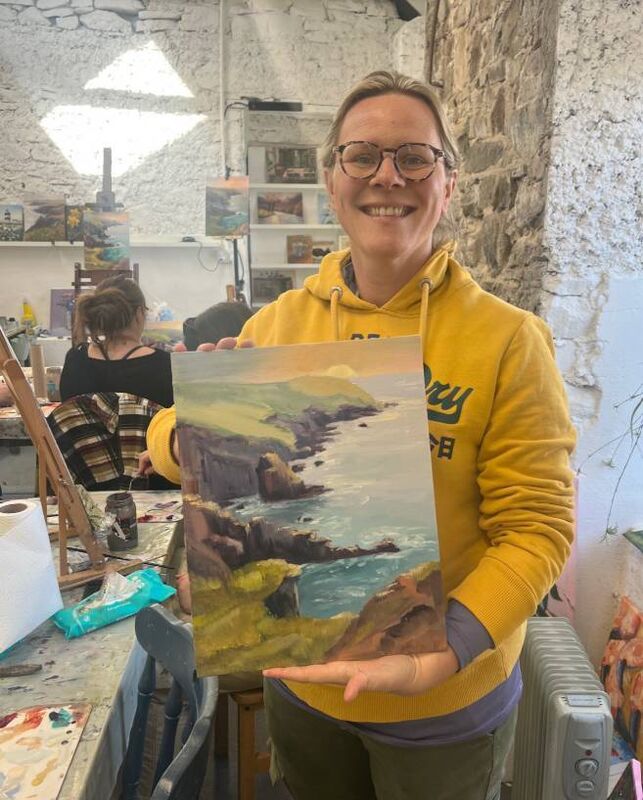
Anna Wilson is also a keen advocate both to her team and to herself on the need to switch off, to park the brain when you go home to your family. In her own spare time, she takes time to “jump ordinary horses over low poles”; she is such an oil paining enthusiast that she is running out of space to store her work. And she still loves to come to work on Monday mornings.
“I’d have a conversation with a coach, and he would ask me how I am feeling,” she concludes. “I would answer that ‘I am feeling just brilliant, and he’d say, ‘why? have you not listened to the news?’ But when you come here, in a startup, you cannot be unhappy!”
It all sounds like there’s a problem about to be solved.

The people you hire at the start. Don’t just settle for somebody you think might not be right, because you will pay for that in the long term.
Pick people that fit with your vision for the business and your personality, people create the business and the atmosphere and if that is broken nothing else will work.
It’s not about beautiful offices and beautiful things; here, it is about people selling and people buying.
Always have a private life at every stage of the start-up, its all-consuming and you could be dead, mentally, after a year, and this can happen quickly, so you need to be watchful. You have to have a second passion, somewhere to disconnect.