
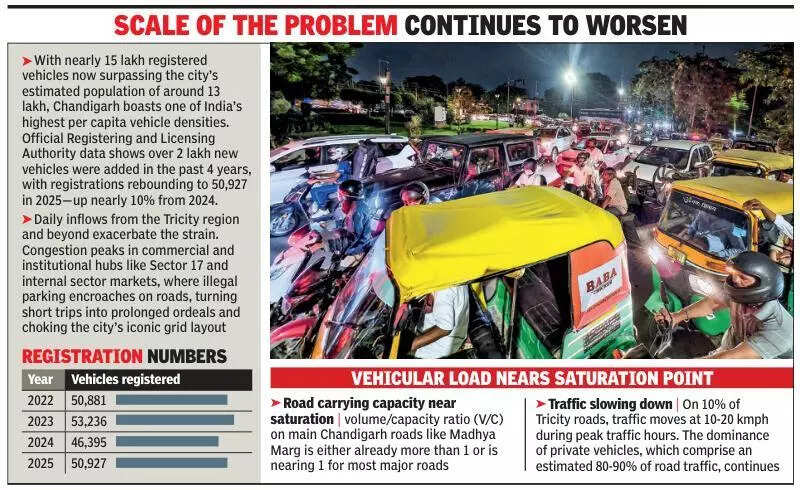
Chandigarh: Chandigarh’s traffic and parking crisis reached a critical point, threatening the city’s famed liveability, even as fresh national recommendations revived calls to examine solutions like congestion pricing—a measure long advocated in local policy but left unimplemented amid political and public resistance.The Economic Survey 2025-26, tabled in Parliament in late January 2026, explicitly urged Indian cities to adopt targeted congestion pricing in dense business districts alongside demand-based parking management. Such strategies, it noted, can slash traffic volumes, boost average speeds, and reduce emissions, drawing from proven international examples.The survey highlighted recent reforms like Chennai’s Metropolitan Area Parking Policy 2025, which disincentivises excessive private vehicle use by treating parking as scarce urban real estate, enforcing stricter rules, and prioritising walking, cycling, and public transport. These demand-management tools, it argued, serve as practical complements to major transit investments.In Chandigarh, similar ideas have languished on paper. The city’s parking policy recommends that the municipal corporation prioritise peak and non-peak hour congestion pricing across high-demand zones—including commercial, institutional, residential, and public/semi-public areas. It called for a technology-enabled parking management system to handle differential rates and congestion-based fees. The policy also pushed innovative concepts like car-free days and vehicle-free zones, none of which materialised.Some other parking solutions in Chandigarh parking policy yet to be implemented included plying of staff buses by all govt/PSU/organisations/industrial/IT companies; differential timings for schools/office among Punjab/Haryana/UT; on-street parking on payment basis; community parking for night in each sub sector; dedicated bus corridors.Failure to act on these short-term measures is especially stark given the paralysis of longer-term fixes. A proposed metro rail project remains stalled due to opposition within the UT administration and central govt, with implementation—if revived—likely years or even decades away.A 2023 attempt by the Chandigarh Municipal Corporation under then-Mayor Anup Gupta to double parking fees for vehicles registered outside the Tricity area (Chandigarh, Panchkula, and Mohali) aimed to deter external inflows but sparked backlash from Punjab and Haryana govts—both of which use Chandigarh as their capital. The UT Administrator ordered a rollback in August 2023, citing the policy as “biased.”INTERNATIONAL ROLE MODELSInternational role models demonstrate the potential. Singapore’s 1975 Area Licensing Scheme cut central business district car entries by about 45%, with the later Electronic Road Pricing system delivering further reductions on key routes.London’s cordon-based Congestion Charge reduced zone traffic by 16% (including 30% for cars), eased overall congestion by 32%, and boosted bus, cycle, motorcycle, and taxi usage.YET LOCAL VOICES EXPRESS SCEPTICISM.A senior UT official, speaking on condition of anonymity, acknowledged congestion pricing’s theoretical merits but deemed it impractical due to anticipated public and political opposition. Past efforts, including a pilot on-street parking scheme in Sector 35 and recent pushes for expanded paid parking, collapsed amid resistance from residents and elected representatives.Former Mayor Anup Gupta, who backed the 2023 out-of-Tricity fee hike, echoed doubts: “Congestion tax within the city is not practical. The supporting infrastructure—like adequate parking near central business districts such as Sector 17—is lacking. Similarly, the public transport system isn’t equipped to handle those willing to leave their vehicles behind.”BOX—FOR GRAPHICSTHE SCALE OF THE PROBLEM CONTINUES TO WORSEN.With nearly 15 lakh registered vehicles now surpassing the city’s estimated population of around 13 lakh, Chandigarh boasts one of India’s highest per capita vehicle densities. Official Registering and Licensing Authority data shows over 2 lakh new vehicles were added in the past 4 years, with registrations rebounding to 50,927 in 2025—up nearly 10% from 2024.Daily inflows from the Tricity region and beyond exacerbate the strain. Congestion peaks in commercial and institutional hubs like Sector 17 and internal sector markets, where illegal parking encroaches on roads, turning short trips into prolonged ordeals and choking the city’s iconic grid layout.Increasing registrations Year | vehicles registered 2022 | 50,881 2023 | 53,236 2024 | 46,395 2025 | 50,927 Road carrying capacity near saturation: volume/capacity ratio (V/C) on main Chandigarh roads like Madhya Marg is either already more than 1 or is nearing 1 for most major roads.Traffic slowing down: On 10% of Tricity roads, traffic moves at 10-20 kmph during peak traffic hours.The dominance of private vehicles, which comprise an estimated 80-90% of road traffic, continues.