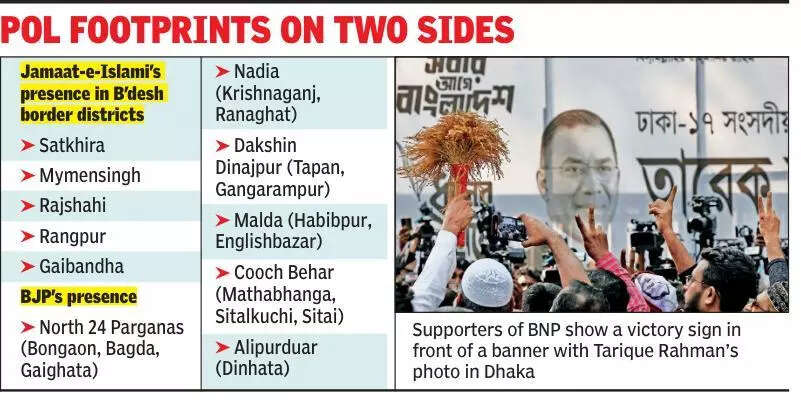
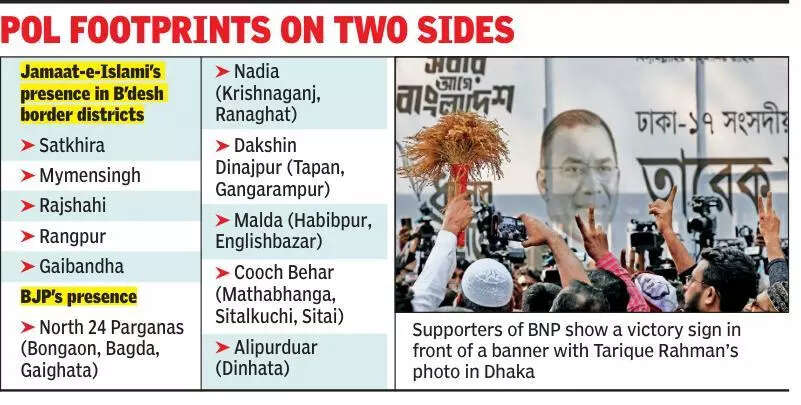
In the just-concluded Bangladesh elections, Jamaat-e-Islami has established its footprint on the entire western part of Bangladesh which includes Satkhira district, Sherpur of Mymensingh, Naogaon in Rajshahi, Rangpur and Gaibandha. Awami League leaders on Friday indicated that Jamaat-e-Islami, which was earlier banned in Bangladesh, has started spreading its influence in large parts of Bangladesh in the past one year.“Jamaat-e-Islami is a radical outfit which believes in hardlines which was never acceptable to democratic parties like Awami League. Unfortunately, they spread their organisation across Bangladesh during the tenure of the interim government,” said Salim Mahmud, former MP of Chandpur (1). In the 2001 election, Jamaat-e-Islami participated and secured 17 seats in areas like Jessore, Khulna, Dinajpur and Satkhira. In 2008, its presence was reduced to two seats. In 2013, Jamaat’s registration was cancelled by the Supreme Court of Bangladesh.Awami League leaders pointed out that Jamaat continued its activities in the areas like Gaibandha, Rangpur, Chittagong, Sylhet and Bogra. “When one of their leaders Delwar Hossain Saidee was given death sentence by the International Crimes Tribunal, Jamaat and its student wing supporters destroyed households, temples and shops in these areas prompting many Hindus to flee,” said an Awami League leader.While former Prime Minister Sheikh Hasina imposed a complete ban on Jamaat, the interim govt lifted the ban in Aug 2024. However, Jamaat continued its political activities in these areas and consolidated its presence along the India-Bangladesh border. During the 2026 polls it ended up strengthening its presence in Satkhira, Kushtia, parts of Khulna and Rangpur. These areas faced West Bengal, Assam and the Siliguri corridor.“Bangladesh is a different country. We expect the newly formed government to maintain law and order and the minorities will not be persecuted. But Jamaat’s victory along the border of West Bengal and Bangladesh is worrying. It shows that there has been strong radicalization on both sides of the border,” Union minister Sukanta Majumdar said.