[ad_1]
While moviegoers most often connect Bela Lugosi with his suavely sinister portrayal of Bram Stoker’s vampire in the 1931 film classic “Dracula,” the actor also had a significant connection to another celebrated horror film character.
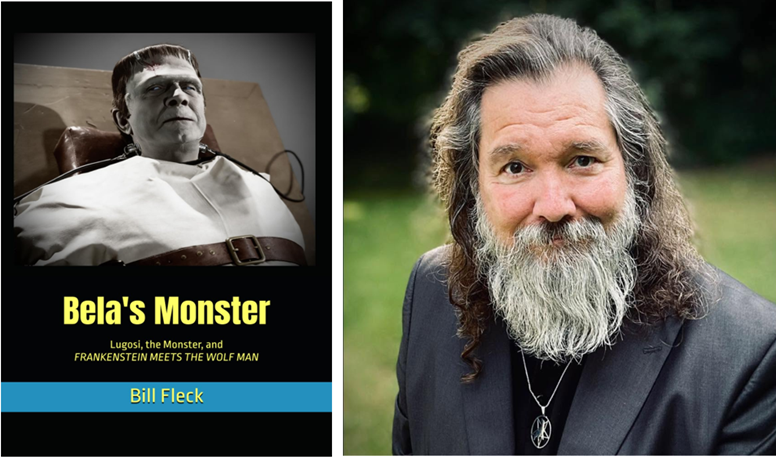
Bill Fleck’s delightful new book, “Bela’s Monster: Lugosi, The Monster, and Frankenstein Meets the Wolf Man,” details Lugosi’s history with the Frankenstein monster. The author deftly erases several long-held legends surrounding Lugosi and this role while offering cogent insight on how the classic horror flicks were made.
A Casting Dilemma
Lugosi was 48 years old when he starred in Universal Pictures’s version of “Dracula.” The film’s commercial success inspired the studio to rush him into another horror production. But Universal’s adaptation of Mary Shelley’s 1818 novel “Frankenstein” quickly ran into problems.

Publicity still in 1943 of Bela Lugosi in heavy makeup as the Monster in “Frankenstein Meets the Wolf Man.” Universal Pictures
For starters, director Robert Florey envisioned Lugosi for the role of Victor Frankenstein, the recent university graduate who creates the Monster. Universal’s executives thought Lugosi was too old for the part and insisted he play Frankenstein’s monster. But the star was displeased that the role lacked dialogue and believed the character would come across as a “scarecrow” instead of a fully textured personality.
Nonetheless, the notoriously tight-budgeted Universal agreed to finance a 20-minute test based on a screenplay by Florey and Garrett Fort. Lugosi’s monster was only seen briefly in this footage, awaiting reanimation while the other characters spoke around him.
Studio executives were unimpressed with the results and briefly shelved the project. Later, British director James Whale took over “Frankenstein,” casting Boris Karloff as the monster. Florey and Lugosi were reassigned to create the 1932 version of “Murders in the Rue Morgue,” based on an Edgar Allan Poe story.
No footage or photographs of the Florey-Lugosi test survived, so we have no idea what might have gone wrong. Reportedly, Lugosi’s creature looked similar to the Jack Pierce-designed makeup later worn by Karloff. Fleck shares the script used for the test and offers an AI-generated image of his making that envisions what Lugosi’s Monster may have resembled.
Related Stories

The author points out that Lugosi later tried to save face by insisting he turned down the role of Monster. That is unlikely since his contract with Universal required him to accept roles he was offered. Lugosi also claimed that he recruited Karloff for the part, but that is easily disproved.
Here Comes Ygor
Lugosi would cross paths with the monster in Universal’s 1939 “Son of Frankenstein.” Karloff returned as the monster, but Lugosi stole the film with a wildly imaginative performance as Ygor, the malevolent blacksmith-turned-grave robber who controls the monster.
Unrecognizable beneath matted hair and gnarly teeth and bent out of shape with a broken neck from a botched hanging, Lugosi created a vibrant villain whose dark presence overshadowed Karloff’s mostly passive monster.
Fleck highlights how Lugosi’s full-throttle performance sparked a rewrite of the “Son of Frankenstein” script, where Ygor was initially a very minor character. Director Rowland V. Lee immediately recognized the character’s power and changed the screenplay to expand the role.
Lugosi repeated the Ygor role in the 1942 feature “The Ghost of Frankenstein,” with Lon Chaney Jr. replacing Karloff as the monster. That film ended with Ygor’s brain being transplanted into the monster’s skull. Due to mismatched blood types, the monster goes blind.

Dracula’s iconic actor was part of several projects that were never released.
A Troubled Production
Universal then decided to blend its horror franchises with the creation of “Frankenstein Meets the Wolf Man” (1943). Chaney revived his celebrated role from “The Wolf Man” (1941), while Lugosi finally got to play the Monster.
Fleck goes into great detail on the many problems that plagued “Frankenstein Meets the Wolf Man.” Lugosi, who was 60 and in poor health, twice collapsed on the set due to the heavy weight of his make-up and costuming. As a result, the more strenuous aspects of the role were shot with a stunt double.
Curt Siodmak’s script gave the monster dialogue, but reportedly some attendees at a studio screening laughed at the monster’s verbosity. Siodmak later claimed the snickering was due to Lugosi’s bad acting, but Fleck shares script excerpts that show Siodmak created wildly overripe dialogue (with the monster pledging to “rule the world”) that no actor could credibly recite.
Based on the disastrous screening, the monster’s dialogue was cut. This included a reference that the monster was still blind after the Ygor brain transplant. The latter deletion created new confusion since the closed-eyes, outstretched-arms plodding walk of Lugosi’s Monster was never explained.
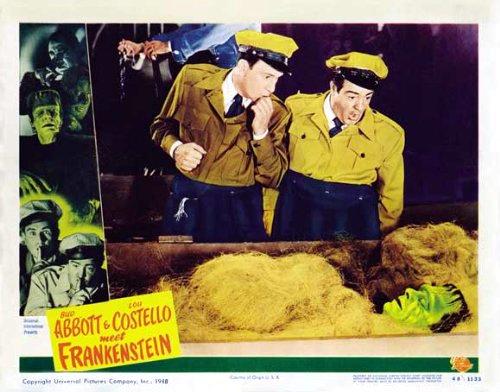
Lugosi encountered the monster one final time in the 1948 “Abbott and Costello Meet Frankenstein.” Glenn Strange took the monster’s role and Lugosi revived his Dracula performance, with Chaney joining as the Wolf Man.
The resulting film was a delirious mix of Universal’s moody horror flicks and the broad wackiness of Abbott and Costello comedy. Lugosi gave a vibrant star turn as the monster’s keeper and the funnymen’s nemesis, and the author hails Lugosi’s work as one of his greatest performances.
Fleck’s book represents a triumph of research, with rarely-seen script excerpts and publicity stills along with multiple interviews that Lugosi conducted during his career. Fans of old-school horror will have the grandest time with this wonderful tribute to Lugosi’s memorable achievements in the wild world of classic monster movies.
‘Bela’s Monster: Lugosi, The Monster, and Frankenstein Meets the Wolf Man’
By Bill Fleck
Just Pay the Ransom Publishing: July 10, 2026
Hardcover, 447 pages
[ad_2]
Source link